
Every PS1 Game – 頭文字D aka Initial D
This website started out as a place for me to write about my adventures with cars and put words to my photography. Recently, I decided to expand into my other nerdy obsession, Playstation games. Well, after ten videogame articles on this ostensibly car-themed blog, a pretty obvious question surfaces: where are all the racing games?

Well, so far it’s been a case of decision paralysis. As you might expect, I have quite a few PS1 racing games, from sublime to absolute shite. Which one to focus on first? I waited for the lightning bolt of inspiration to strike, and last weekend, it did: I decided to finally complete the story mode of Initial D.

Originally released in June 1998 for Sega Saturn and January 1999 on Playstation, this game was in development at the same time as First Stage, the original Initial D anime, which first aired in April 1998. As a result, the videogame is only based on the manga, remaining its own unique adaptation.
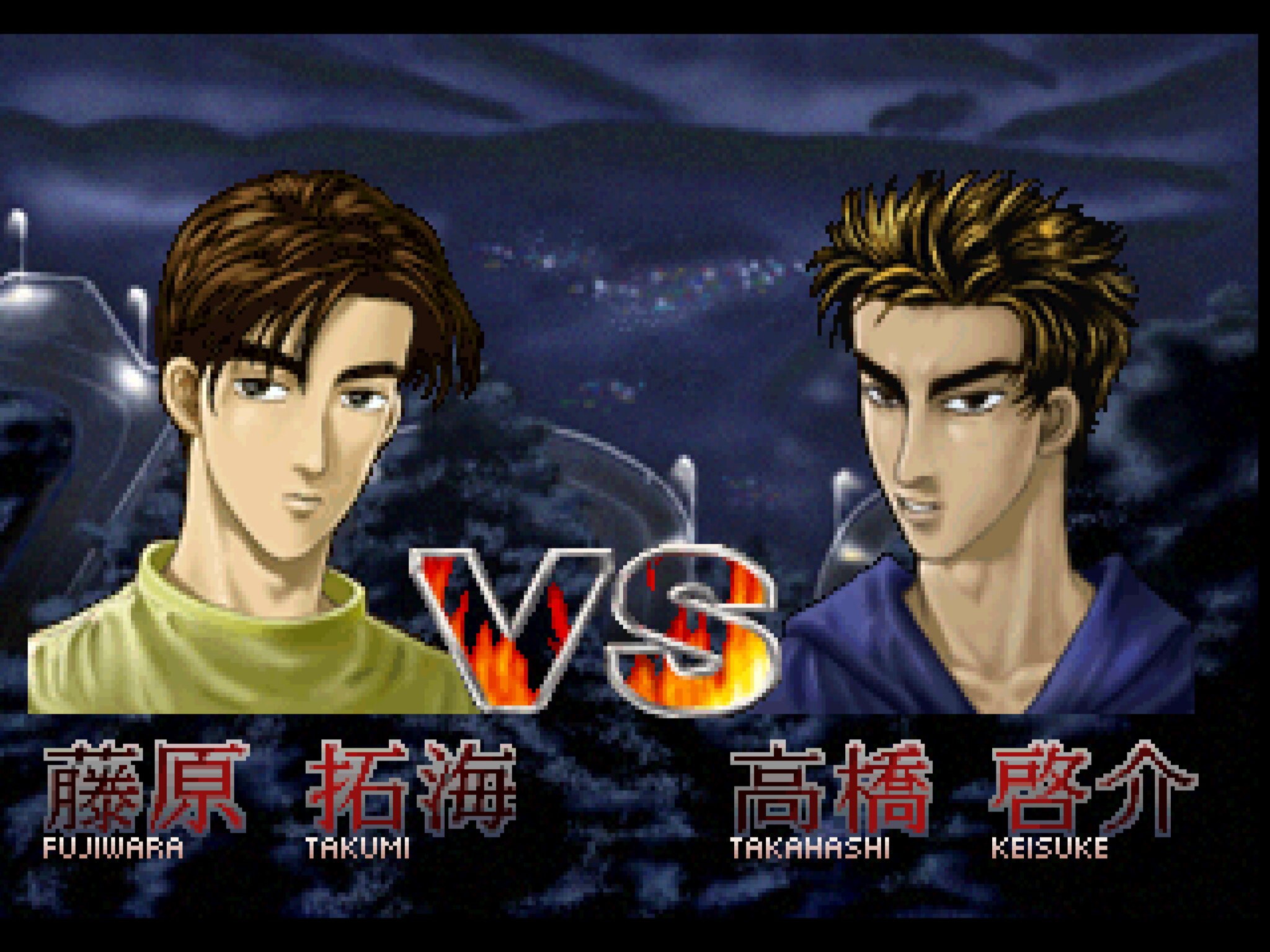
The “Versus” screen before a race looks just like the manga. For example, here is Keisuke Takahashi:
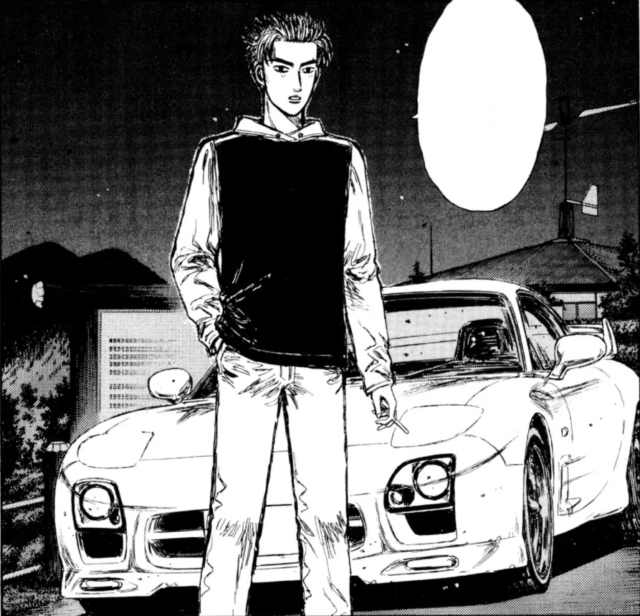
and here is Keisuke Takahashi from the “First Stage” anime:

For whatever reason they decided to slightly remake all the characters for the anime, particularly Keisuke Takahashi who looked significantly different in each of the five anime seasons. The other characters changed a bit too, but they really could not nail down the look of animated Keisuke Takahashi.

Another big difference that seems to surprise or disappoint a lot of people is the soundtrack: since most Westerners discovered Initial D through the anime, there is an intrinsic association with Initial D and Eurobeat music. Of course the manga itself is silent, but it never makes any mention of music. It’s actually notable for the pages being literally filled with sound effects. The only reason Initial D has Eurobeat is because somebody making the anime thought it was cool and exciting.
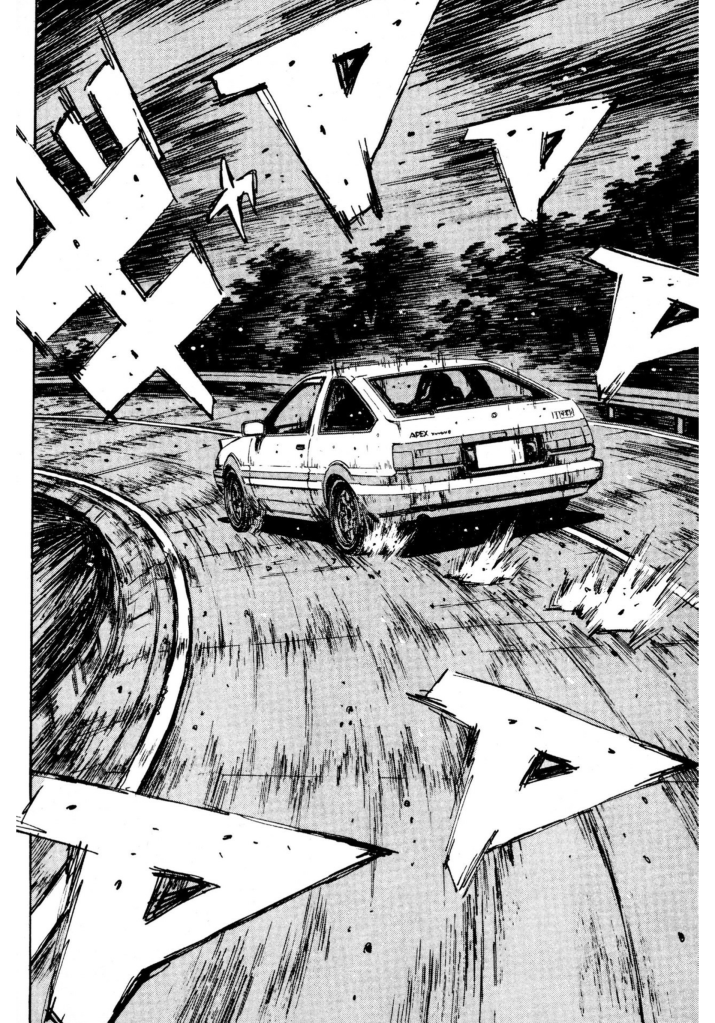
The manga is as much of a visual treat as anything else. There are quite a few pages with no dialog at all, just one or two brilliantly drawn panels with huge onomatopoeia.

Most of the music in this game is neither cool nor exciting. The soundtrack is pretty minimal; there is a lot of repetition–in itself not a bad thing–but there is one that usually plays when you finish a race that is downright annoying.
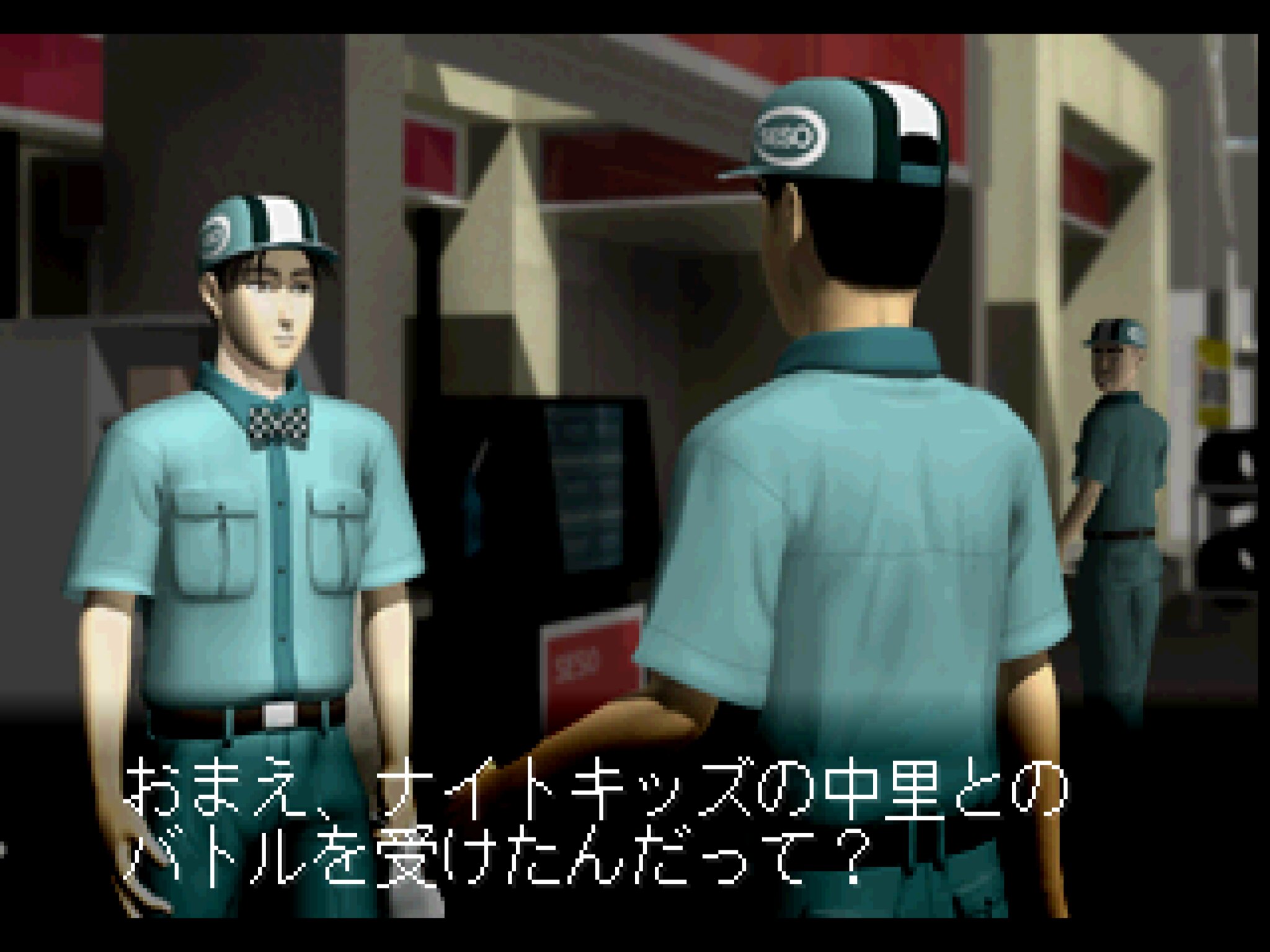
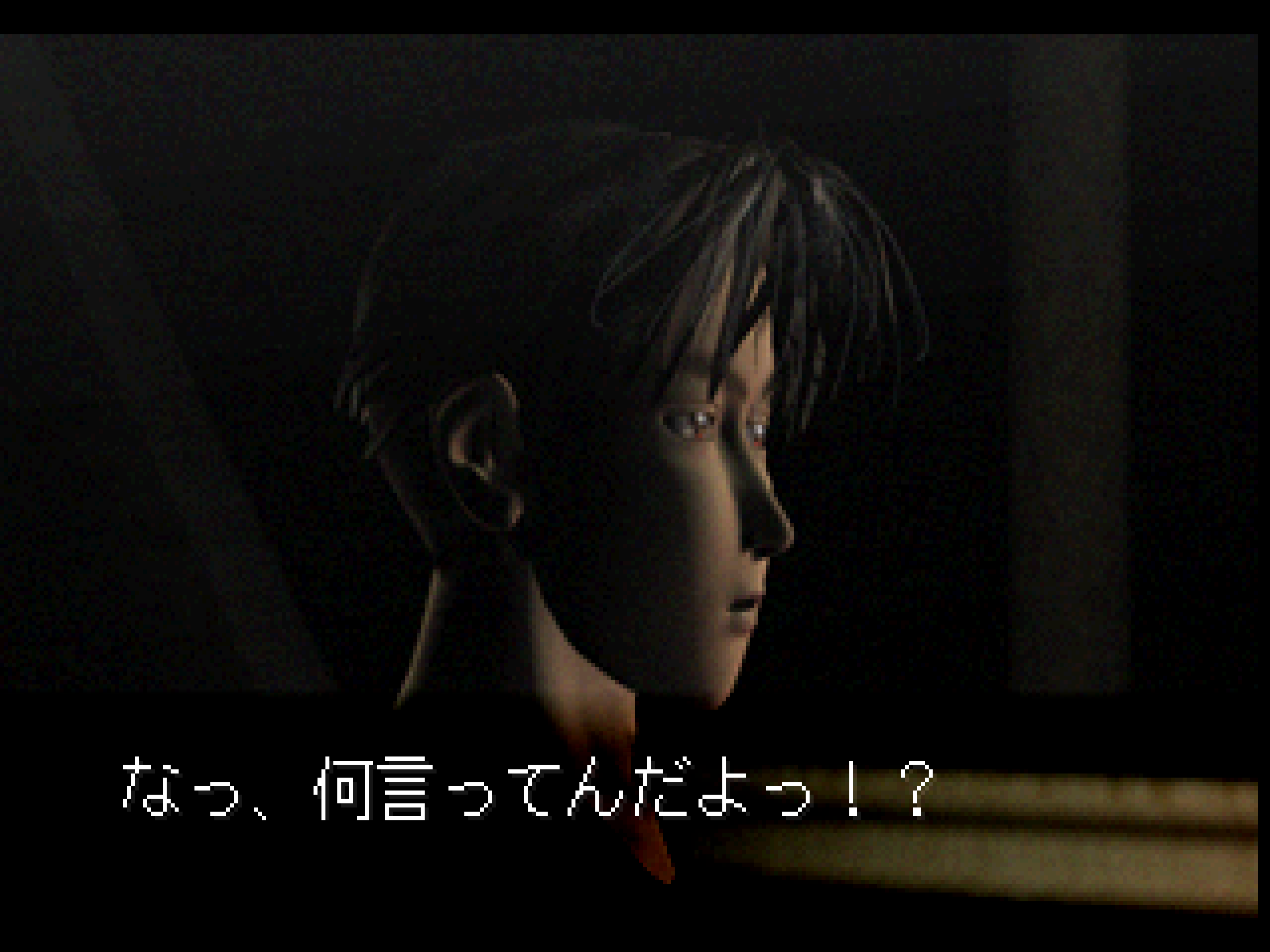
The plot follows the main points of the manga, and…that’s about it. For example, in the very first scene (pictured above, with Takumi and Itsuki on the school roof), Natsuki asks Takumi to pick her up in his car and take her to the beach–and that’s all you ever hear about that. In the rest of the game, they touch on little to nothing besides the touge battles.
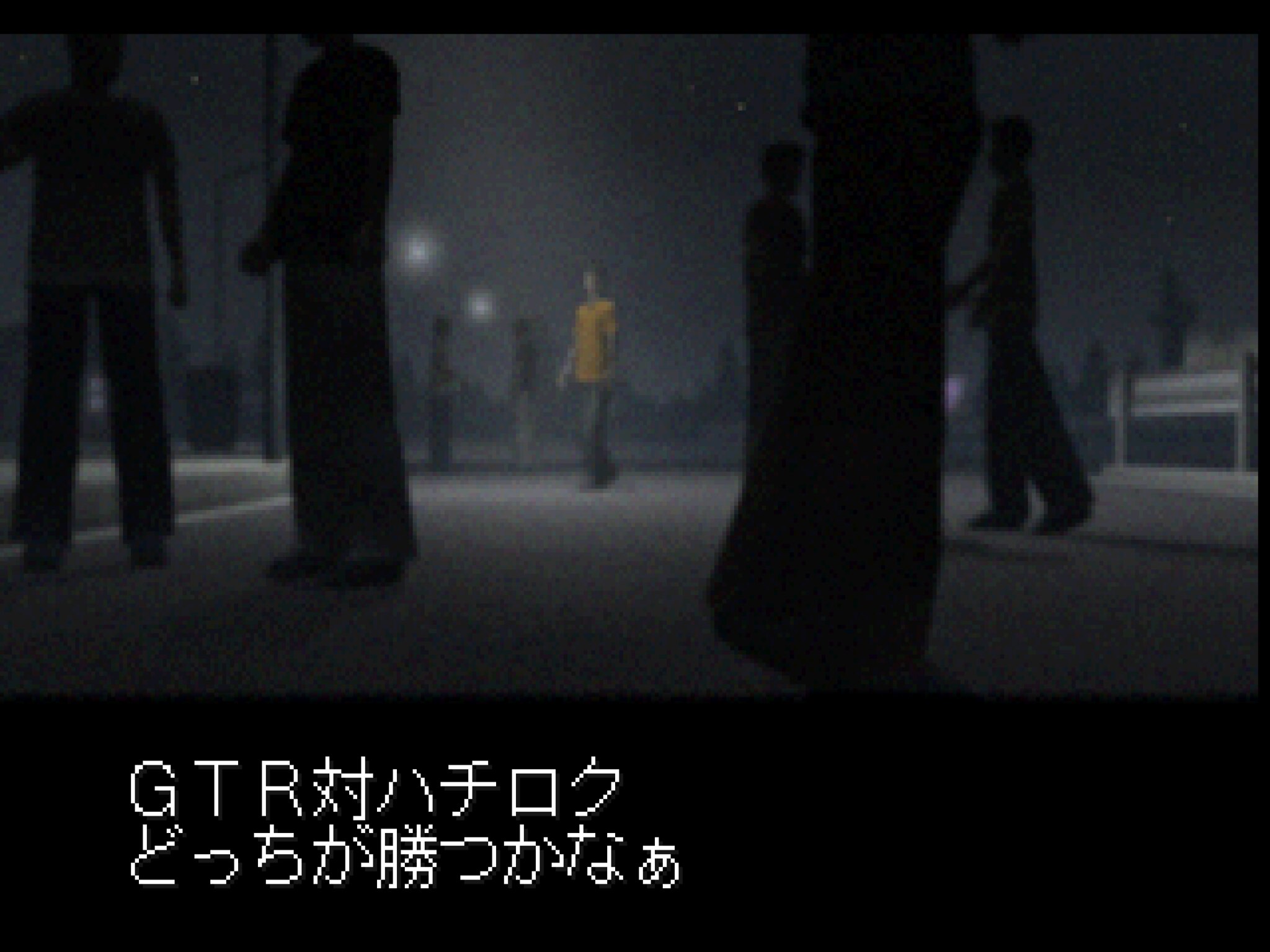
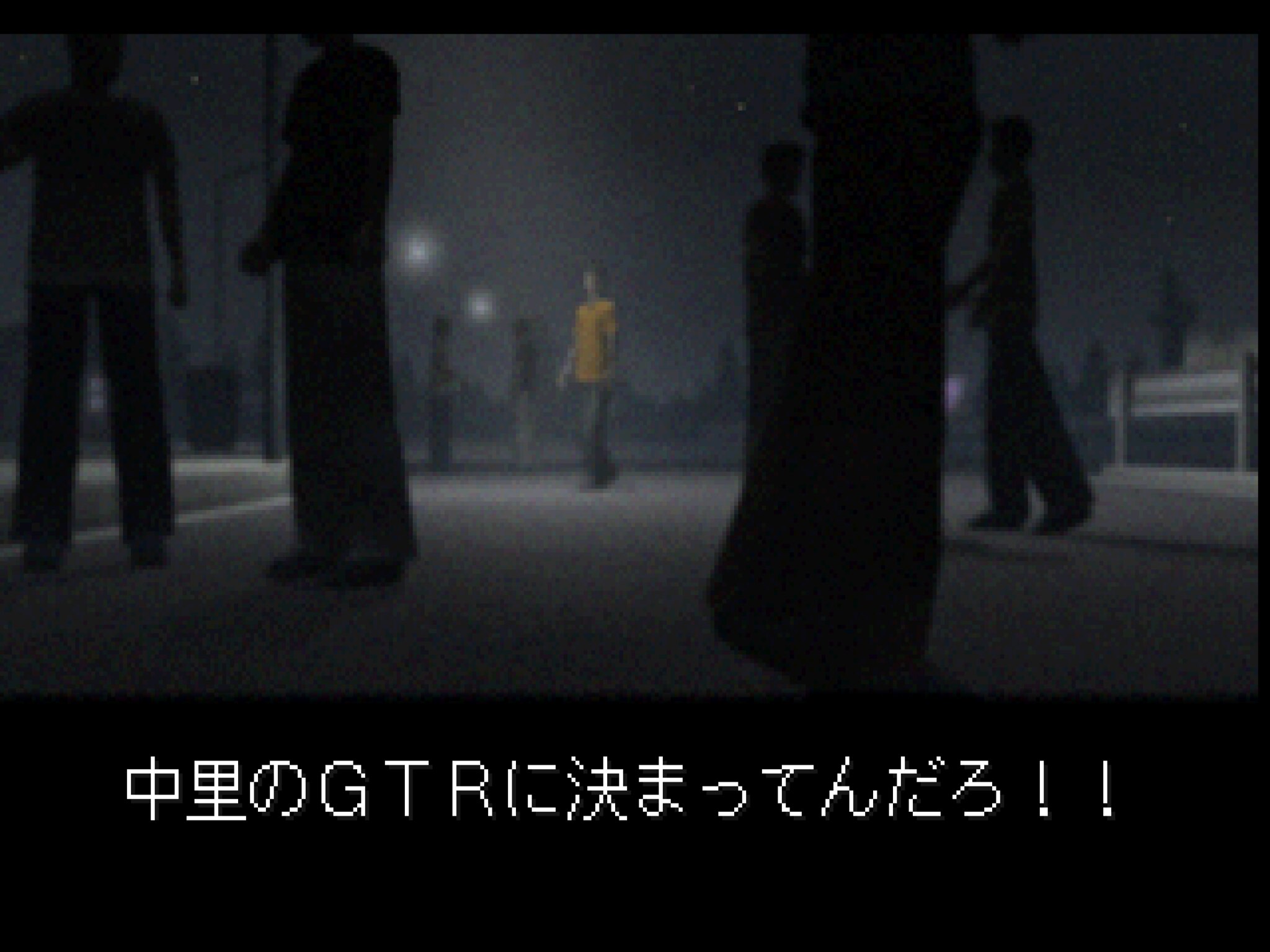
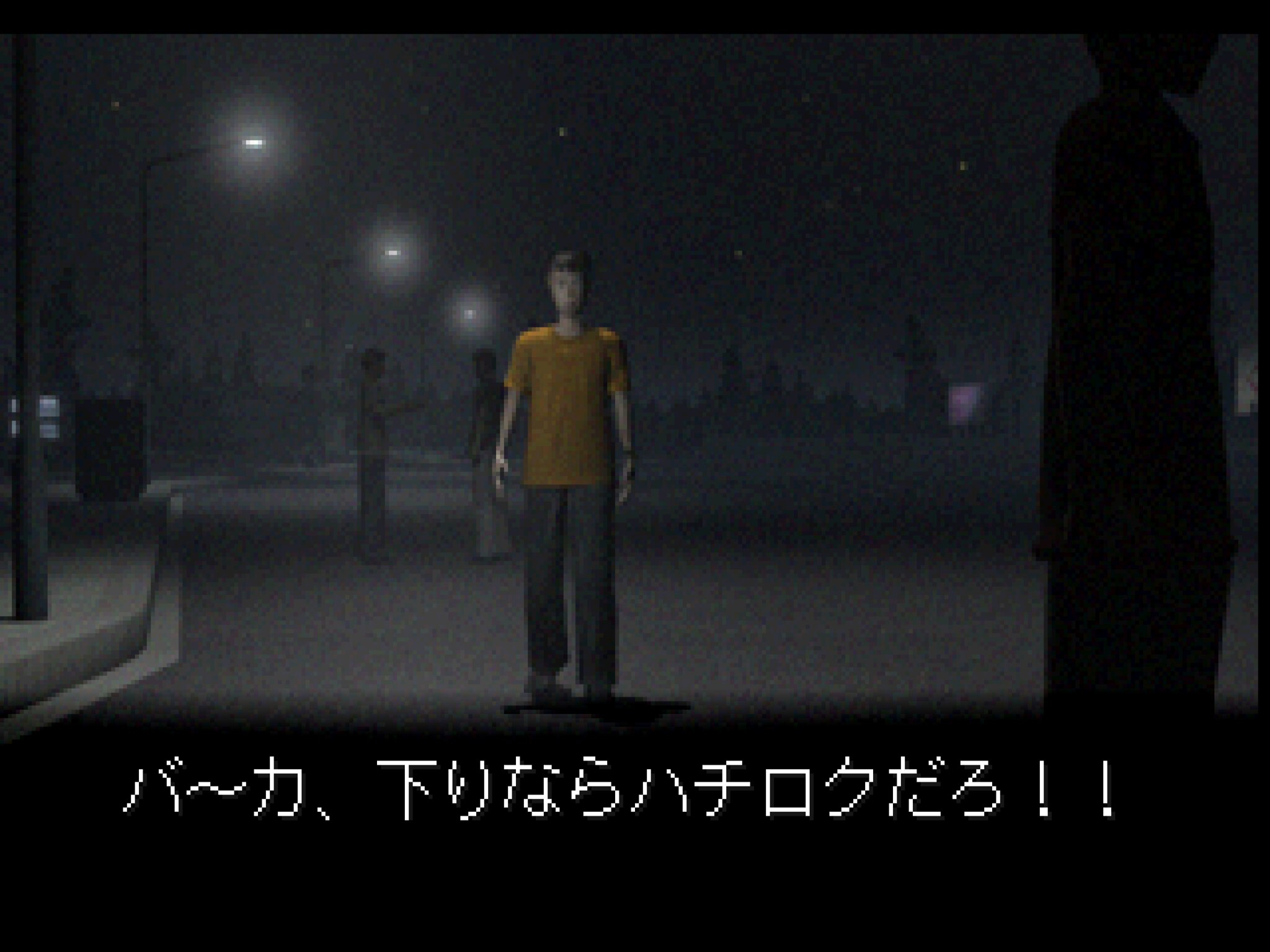
The dialog is just text against fixed backgrounds, which is pretty normal for 90’s RPG’s. However, given the time period of this game and the (CD-based) platforms it was released on, it’s a shame this game doesn’t have voice acting.
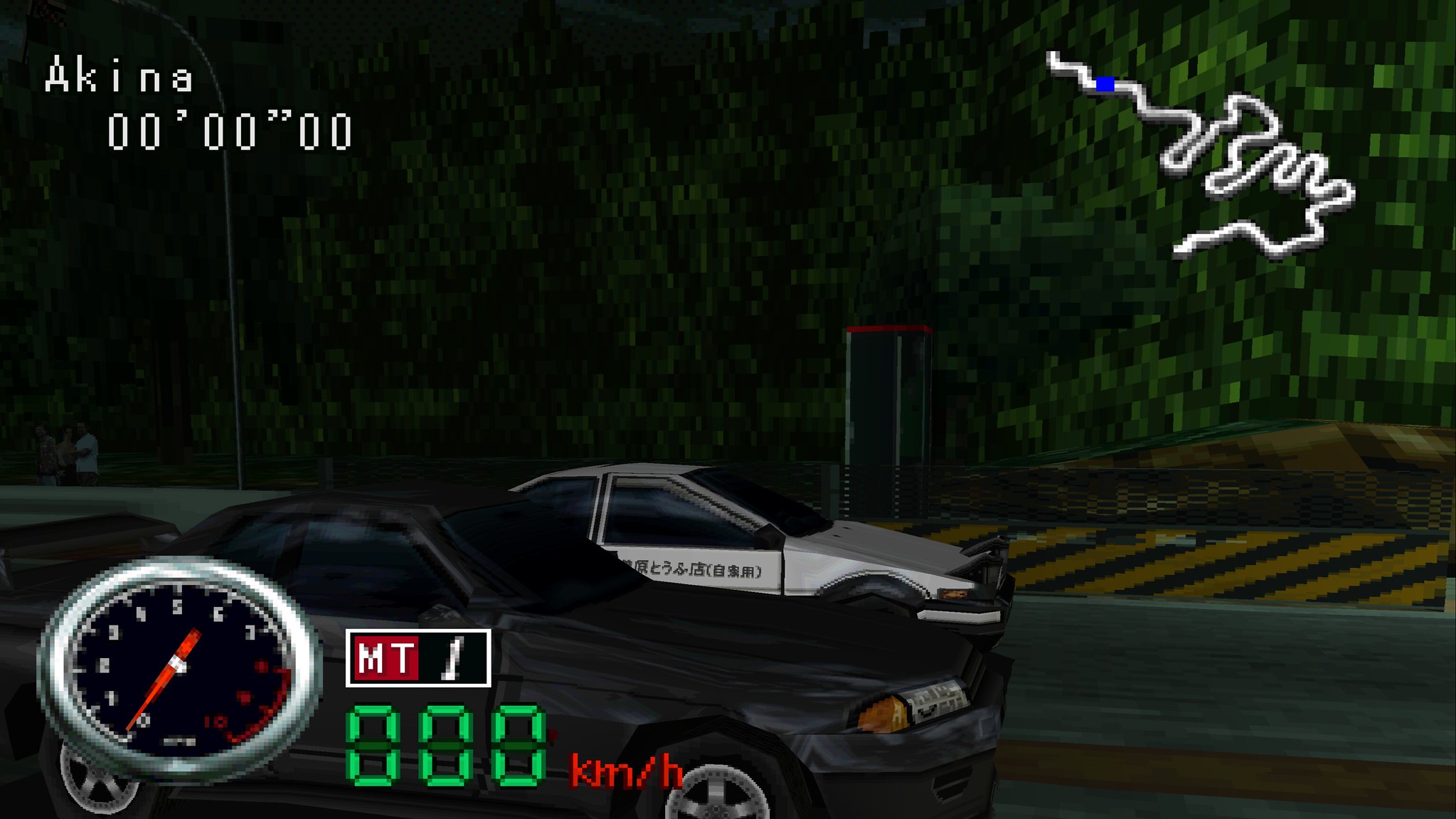
The more you play this game, the more low-budget it reveals itself to be. At first it’s not really a big deal that you’re doing another downhill race at Akina, but stay tuned…
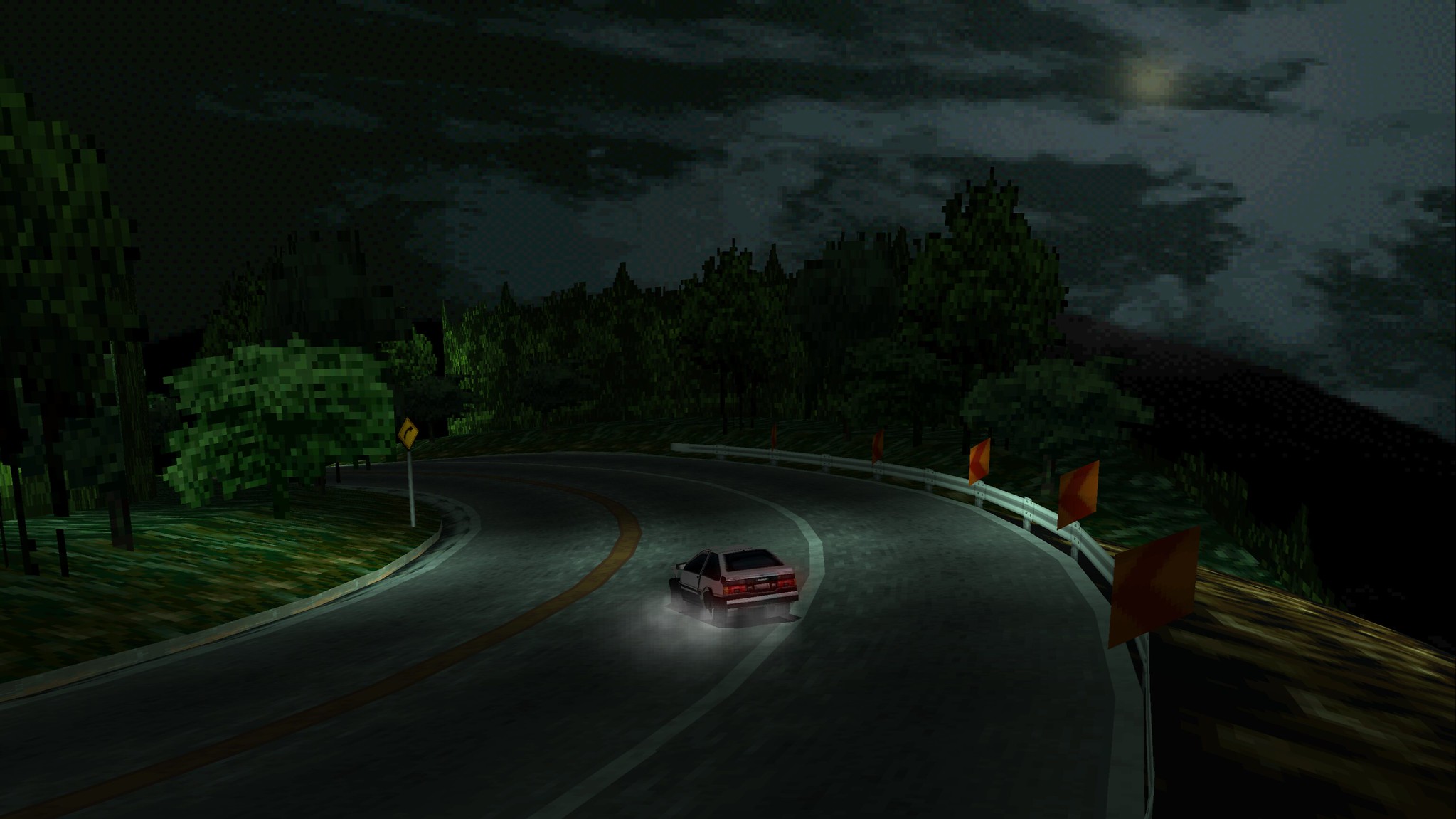
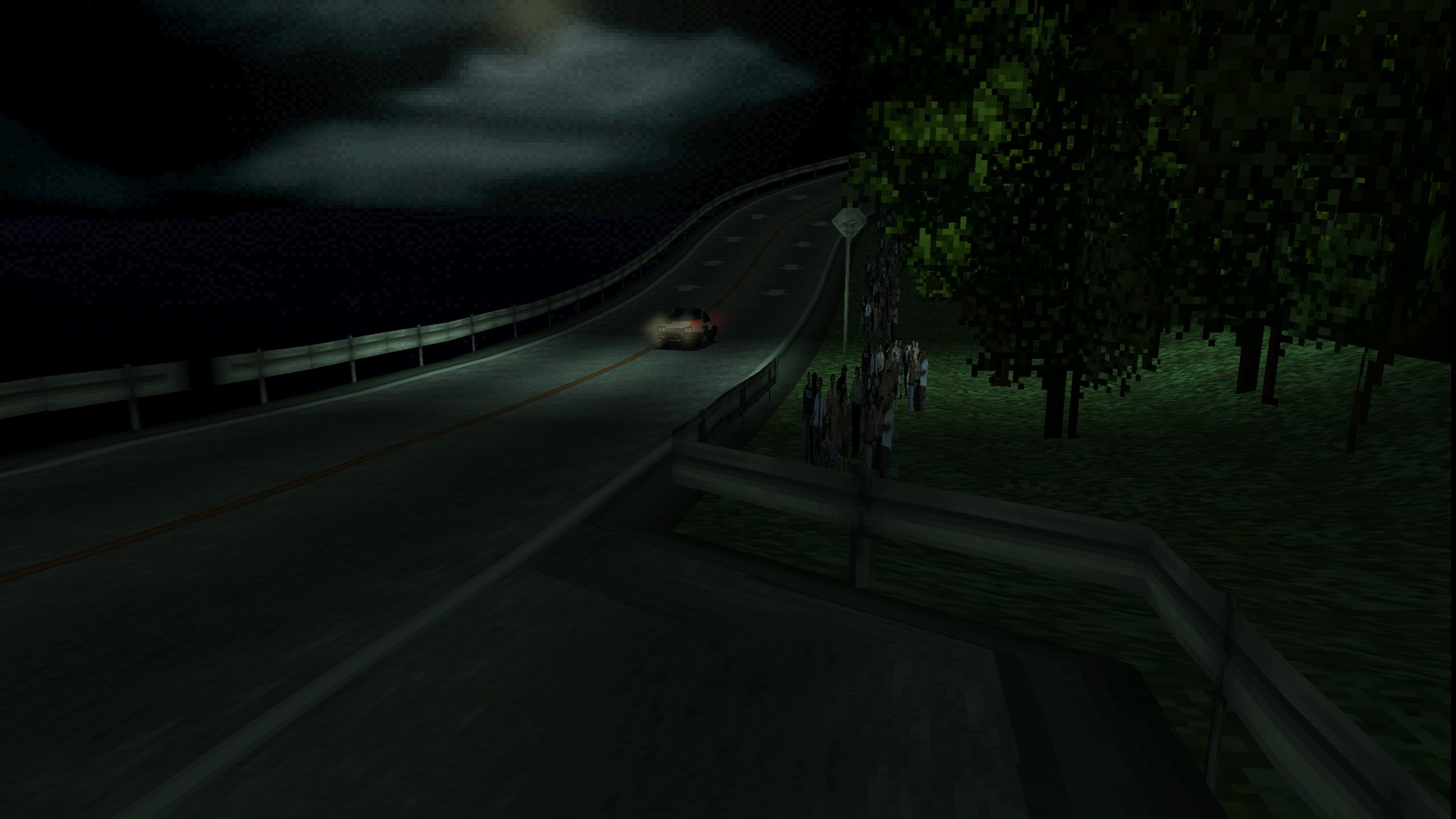
Gran Turismo showed up in December 1997 and blew up racing games forever. Among its many accomplishments was the replay system, which not only featured dynamic and realistic camera angles, but many dynamic and realistic camera angles. Initial D has a replay feature that plays automatically when you finish a race, but despite the small amount of courses and their short lengths, the replays are very simplistic and have very limited camera angles. Still, the graphical style comes across well, and I particularly dig the moon-at-4-AM skybox.

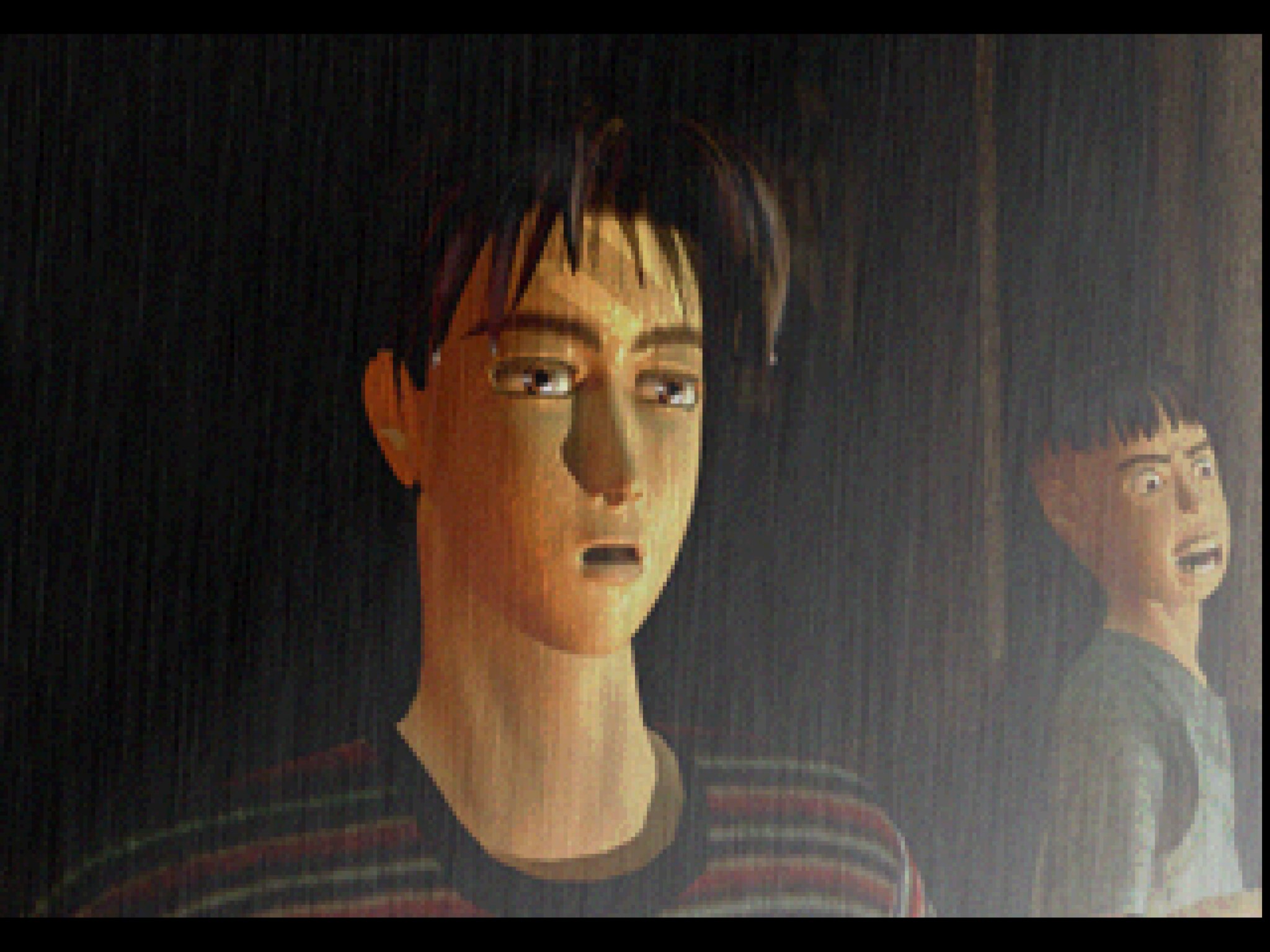
Saturday, 9 PM: Takumi and Itsuki watch from the “gallery”. By this point, several of the manga’s plot points have been skipped; this really is a whirlwind tour through the Takumi story.

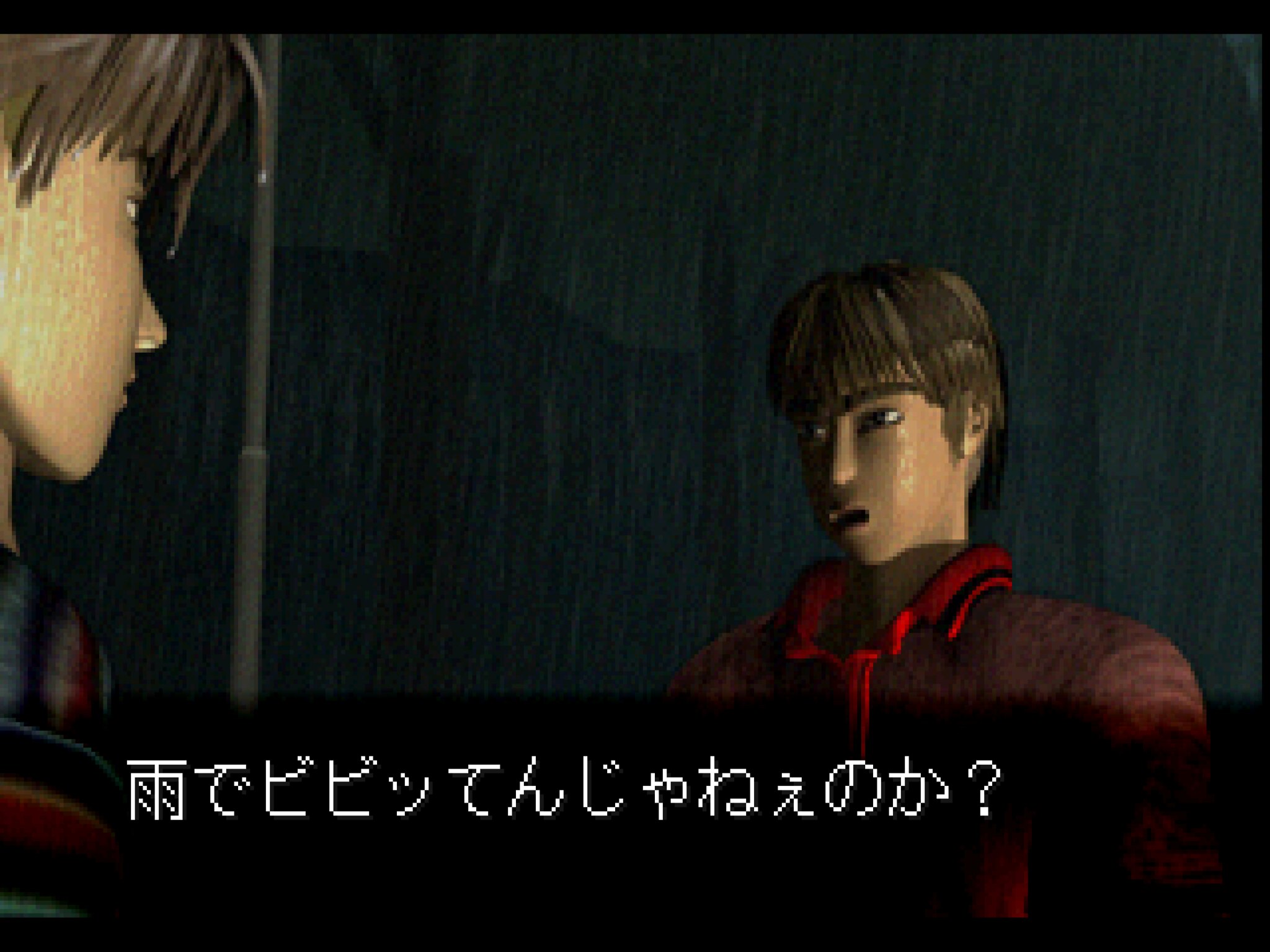
After Keisuke Takahashi races Nakazato, as in the manga, Kenta Nakamura from Red Suns challenges Takumi to a race.

Even though this game feels like a lot of corners were cut in the name of budget and development time, one thing that feels very premium is the quality and variety of loading screens. There have to be at least two dozen different loading screens with unique artwork. They could have easily just made one generic loading screen and called it a day, but instead they gave you a neat piece of artwork to look at every time.
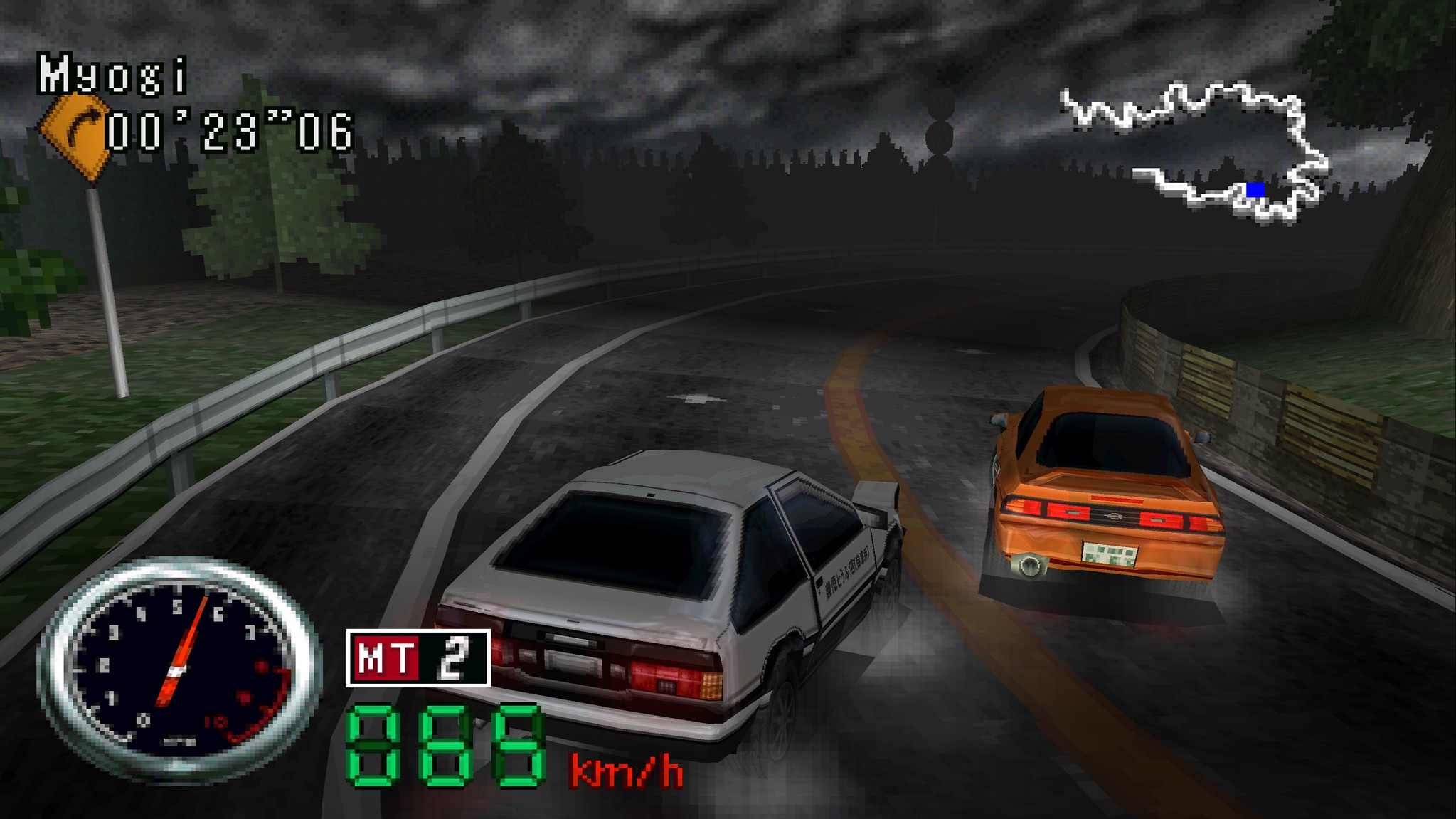
Alright, a different course! Myogi is a bit narrower than Akina, and as you can see from the map, a lot twistier too.
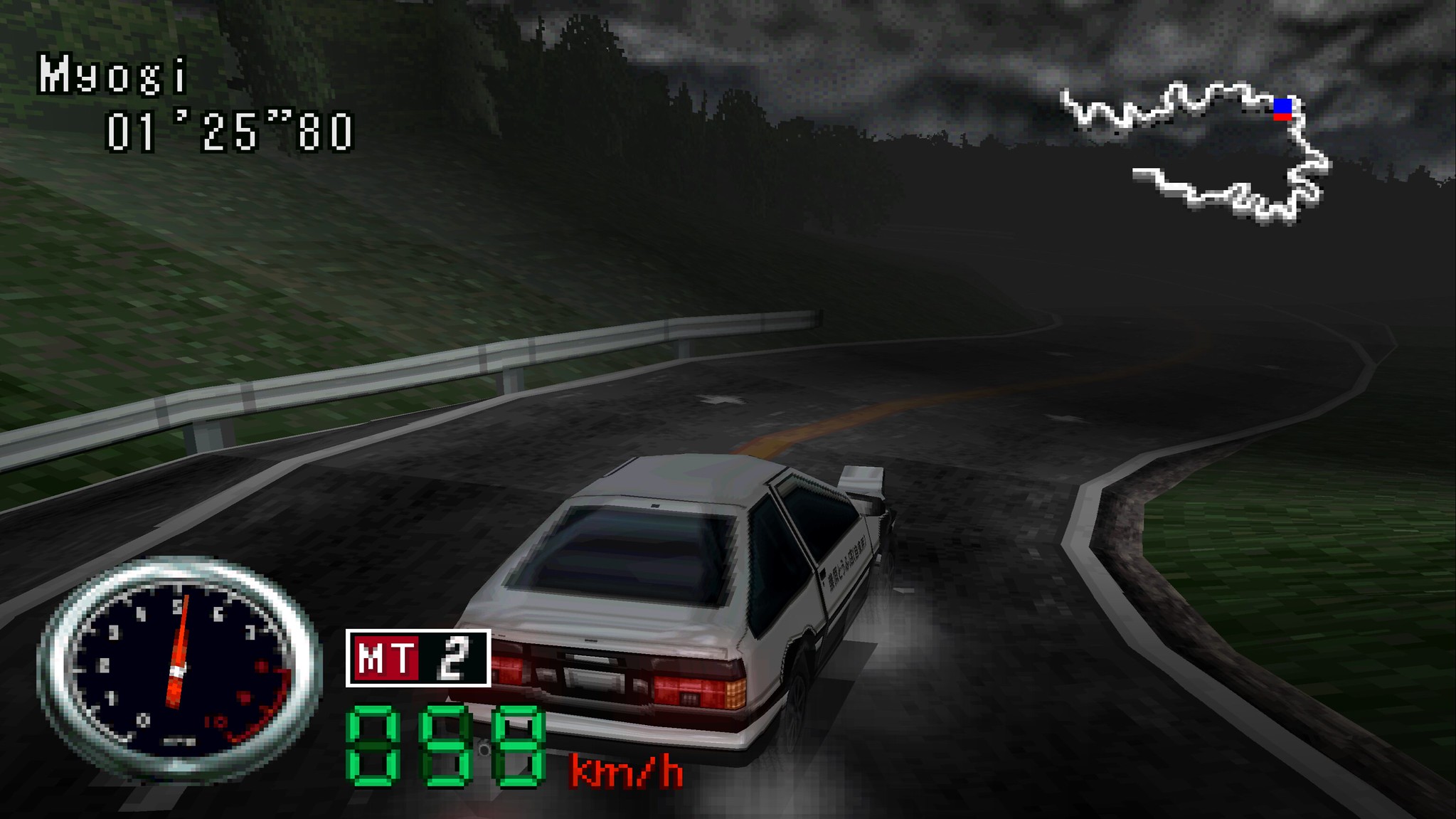
The cover of darkness is a great old school technique for shortening draw distance. It might look a little bad here, but I never actually had a problem with it in-game. In contrast, the Saturn version has shorter draw distance and just poorer graphics overall.
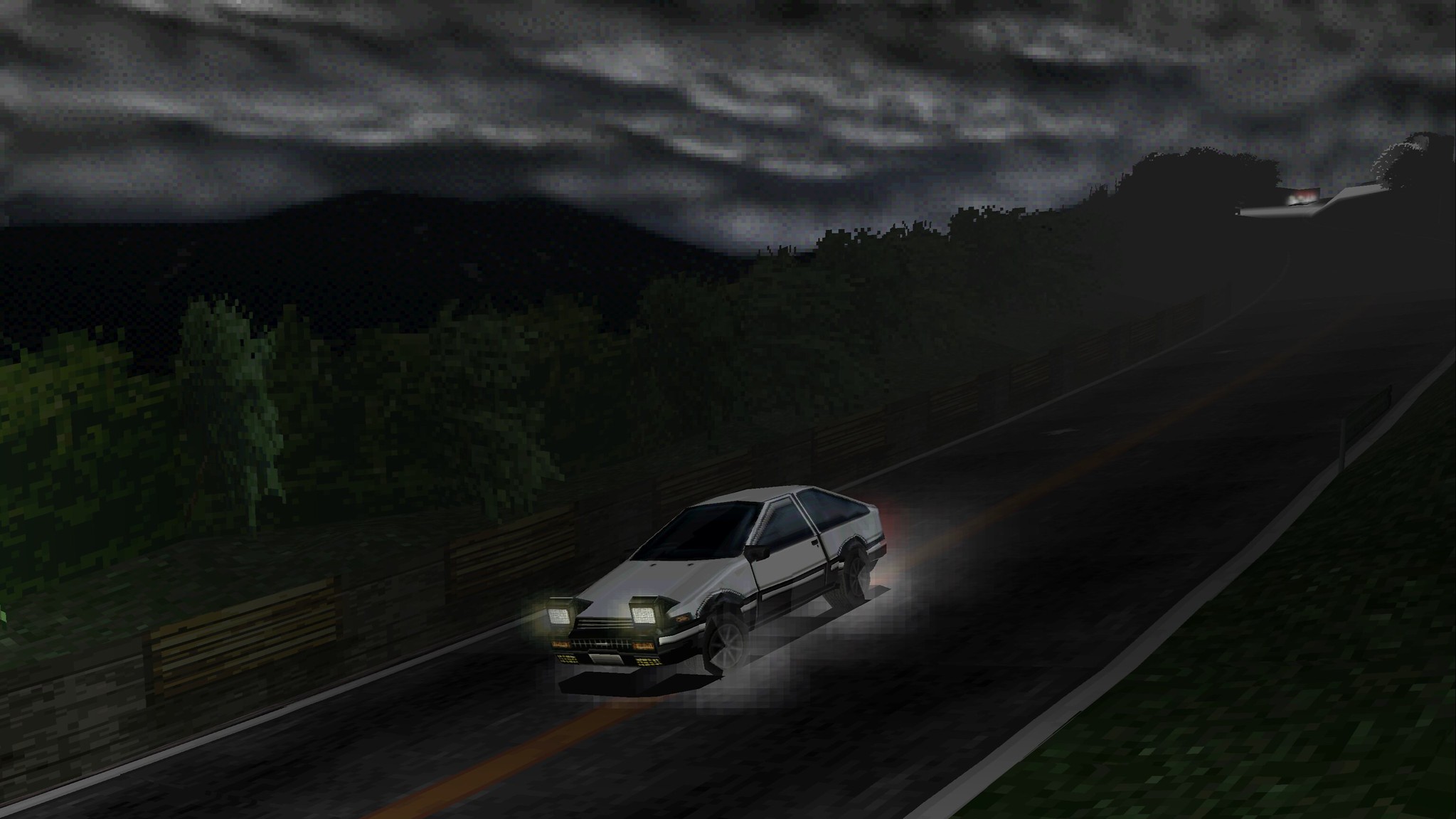
Another neat skybox; those are some ominous clouds. This race takes place in the rain, so there is a tiny bit of spray coming off the tires.
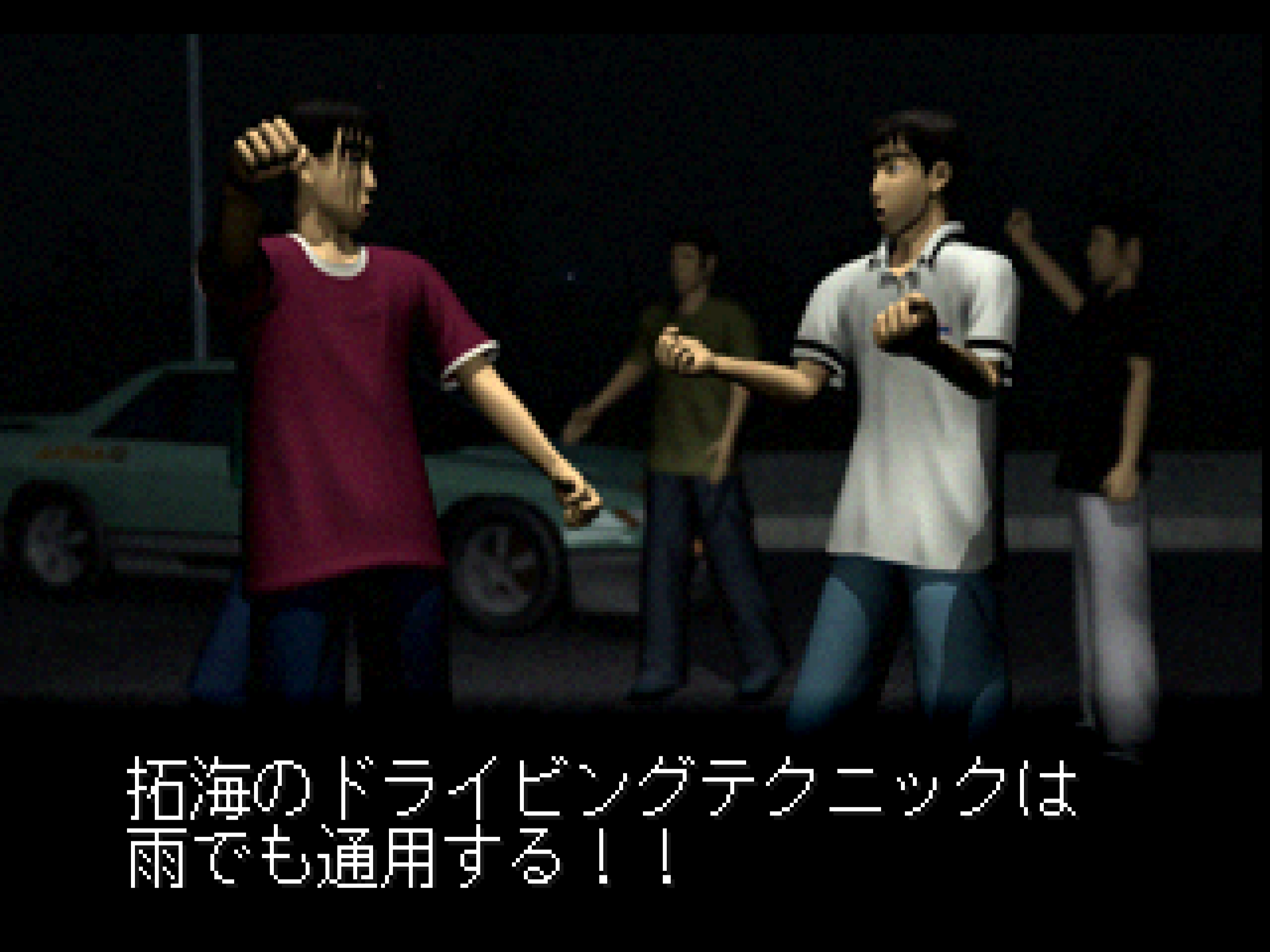
If the rainy conditions affected the driving, I didn’t notice it. It’s nice that the gallery was excited though.
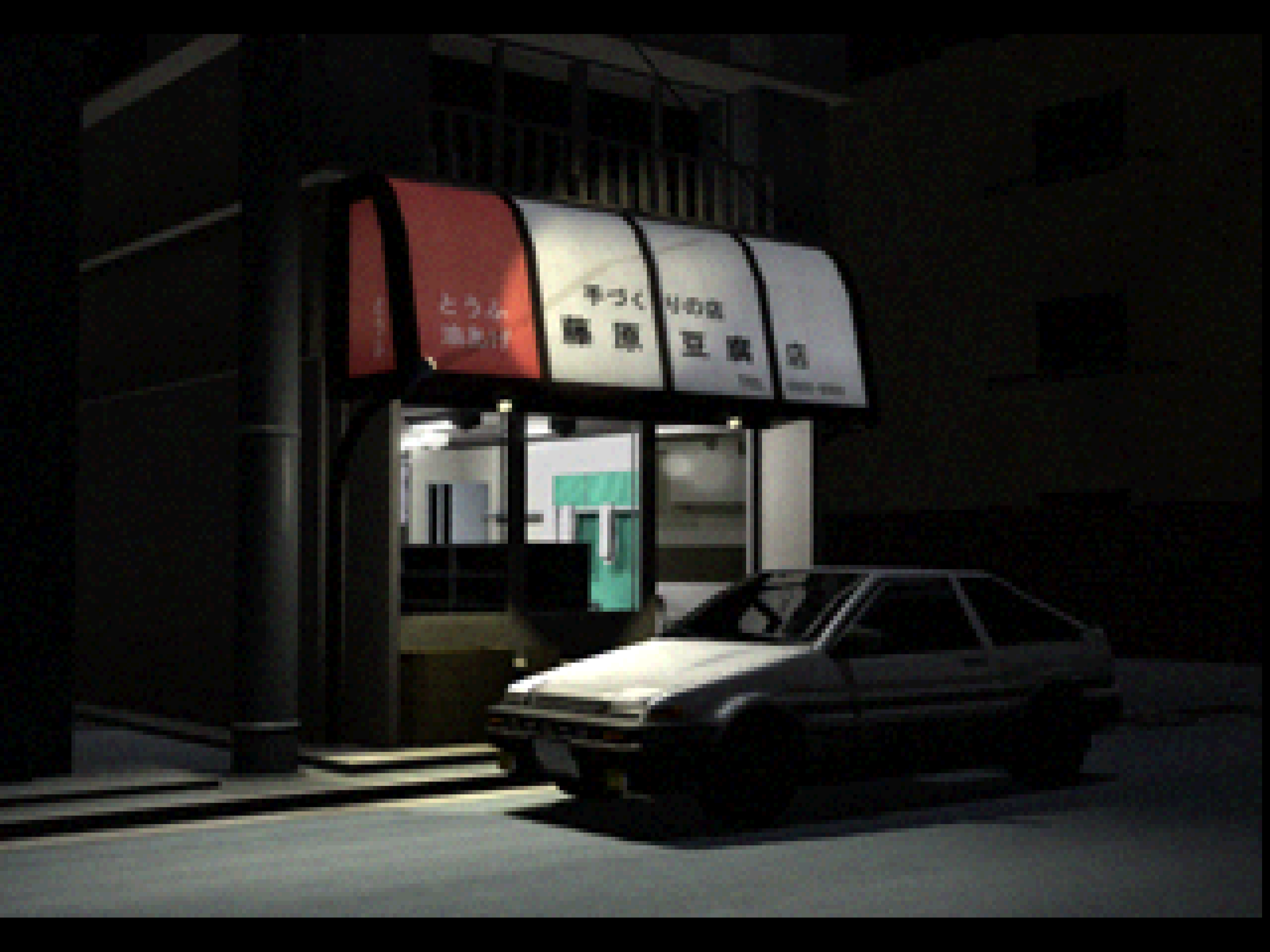
The ol’ hachiroku parked in front of the family tofu shop. I assume that most readers will already know this, but just to point it out: hachi means “eight” and roku means “six”. Eight-six, like AE86.
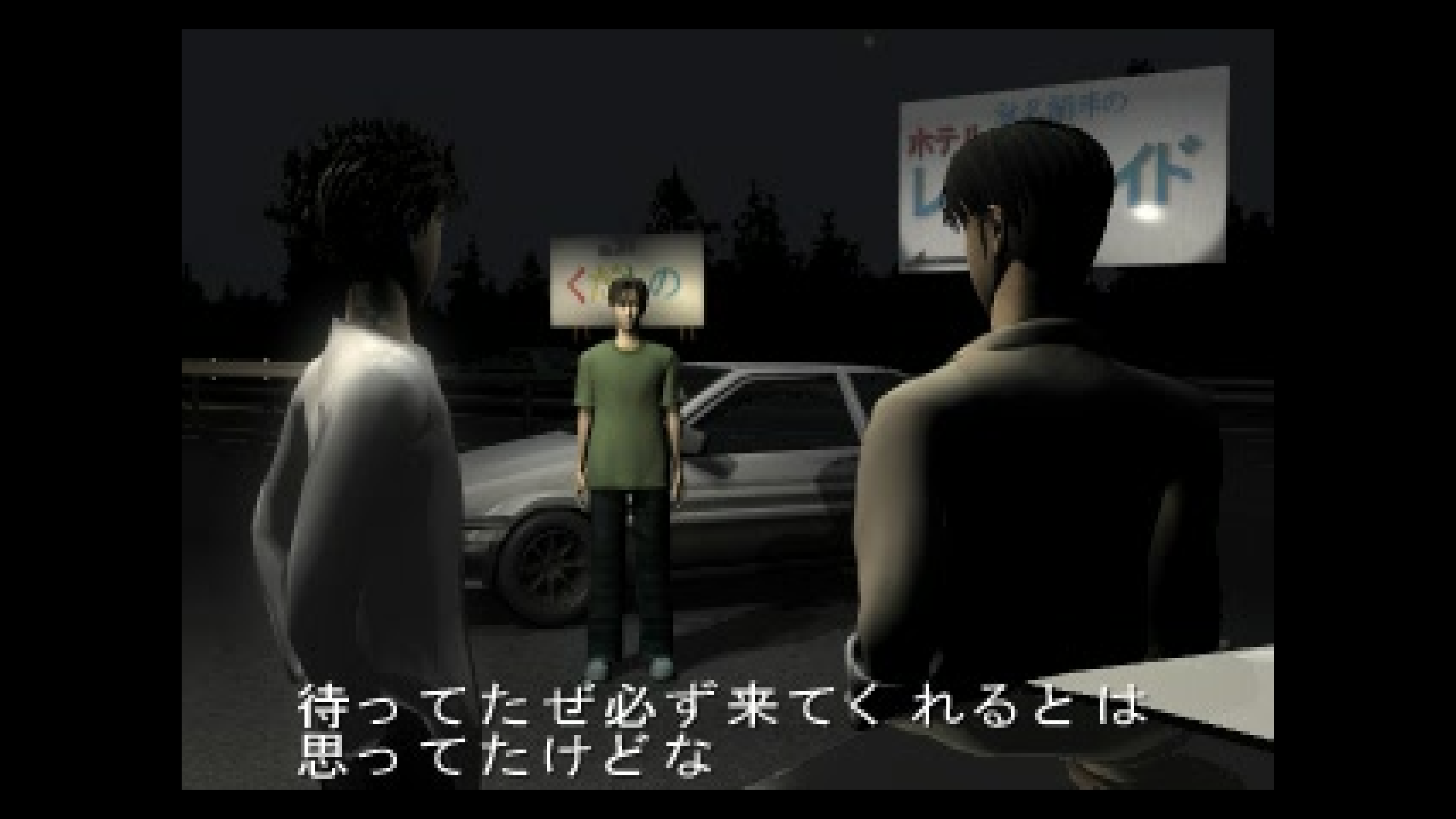
The Red Suns challenged Takumi to a race, and since the Red Suns only race on others’ home courses, here we are back at Akina.
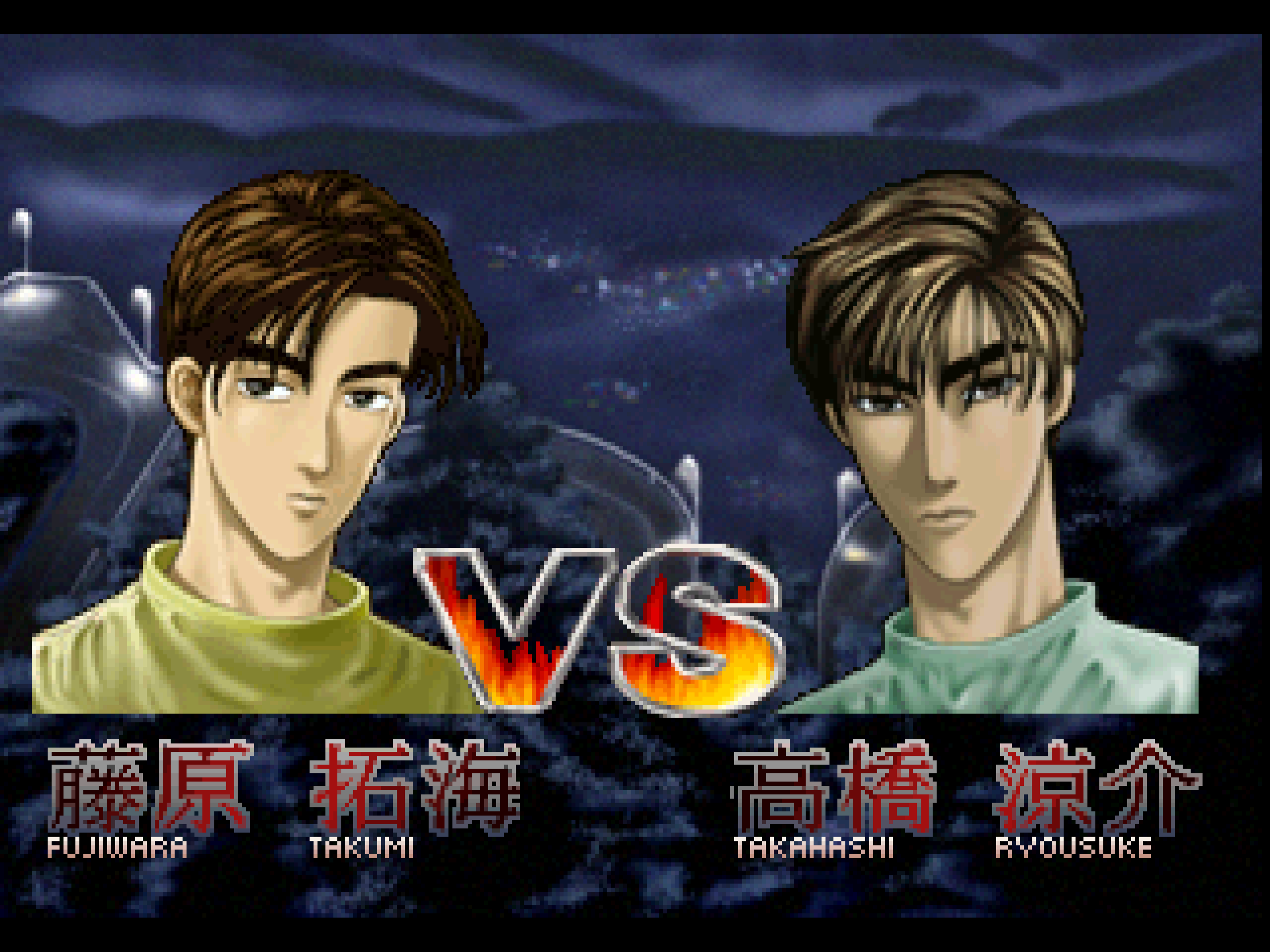
I do enjoy the pre-race spectacle. The fighting-game style versus page with driver portraits is a nice touch.
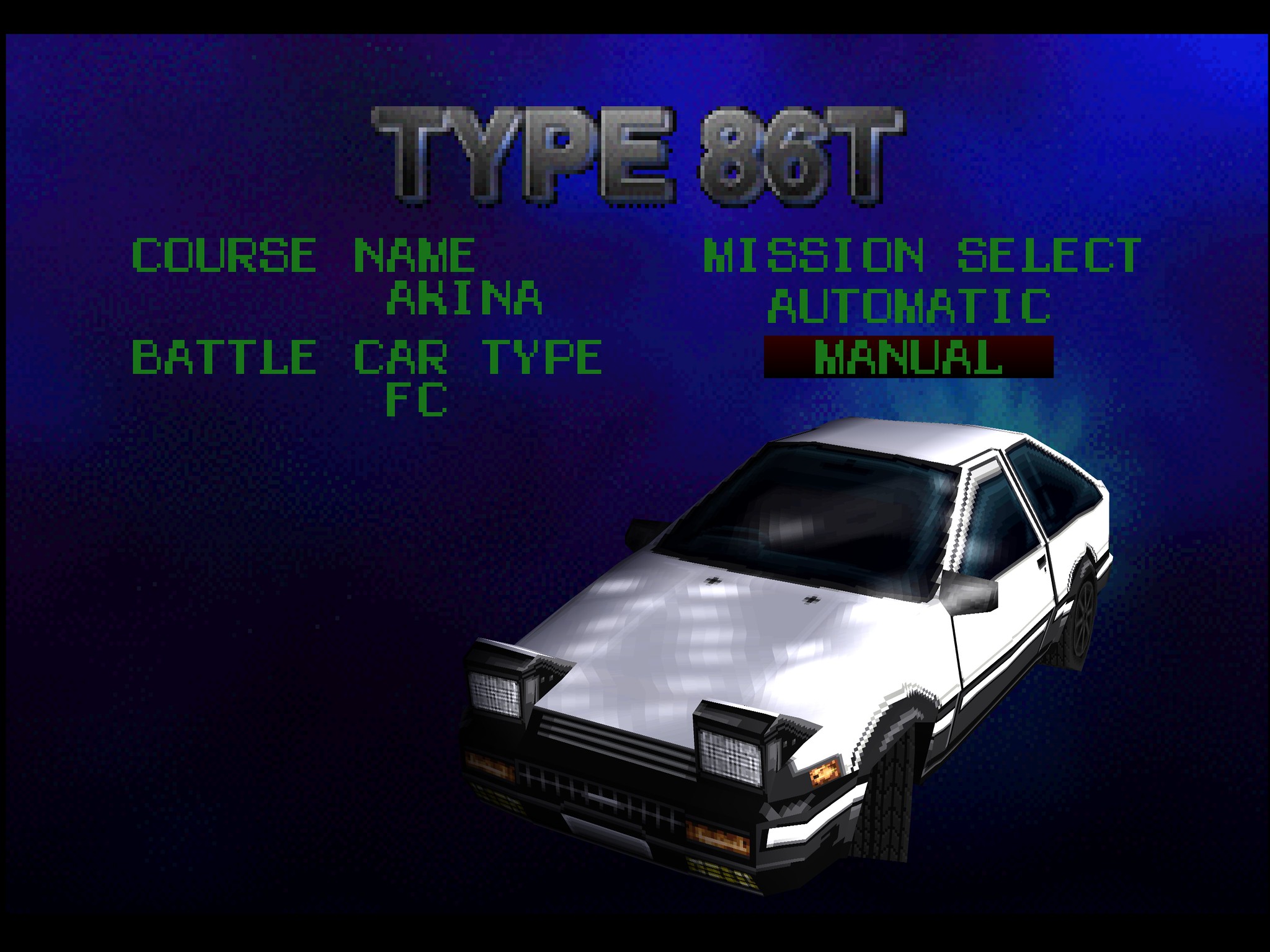
Then you get to pick your transmission. In Japanese, ‘transmission’ is usually shortened to just mission (ミッション or “misshon”); that’s what you’re selecting here, not some sort of assignment.

And then you get to see your opponent’s car too.

Ah yes, another downhill race on Akina at night. You start to become a bit of a Takumi yourself at this point, driving Akina over and over.
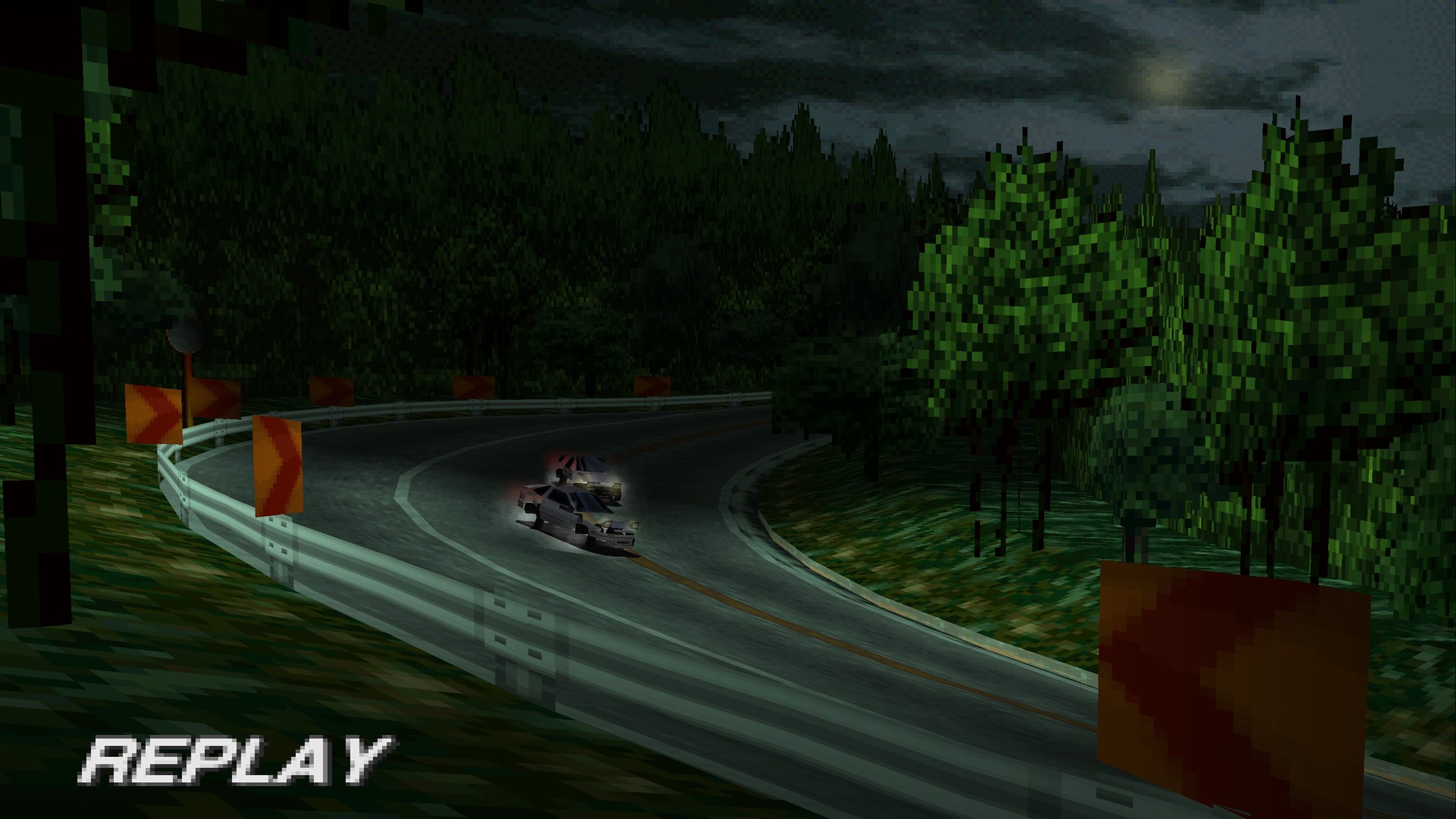
This game has pretty aggressive LOD‘s, which is fine because you can’t see anything at the Playstation’s original resolution anyway. But when you start cranking up the internal resolution, the lack of detail is pretty hilarious.
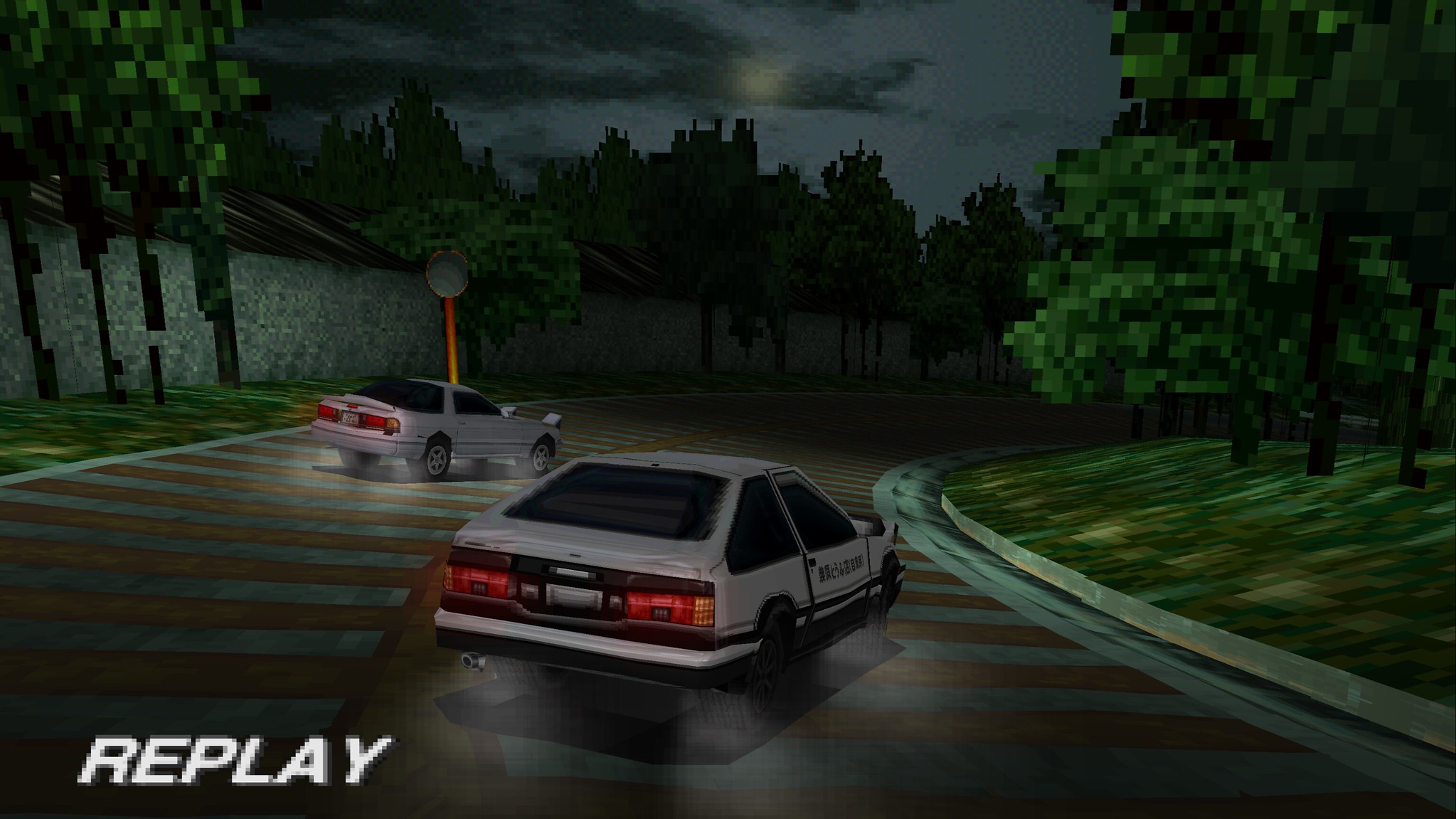
At the risk of stating the obvious, the key component of any driving game is how the driving model works. And any game needs to be judged two ways: not just by the modern, or rather everlasting, standards of goodness, but also as a product of the time in which it was released. I ask that about every game, but I think it’s even more relevant with racing games due to the nature of their progress over the years. Like all racing games of the era, there is a bit of learning curve to the controls. Once you learn what the game wants, you can start to push the car and actually place it with a good degree of accuracy. Against modern standards, the controls are a bit vague and simplistic; but for the standards of 1999, the ease in which you can throw the car sideways in the turns is impressive. This statement might sound weird to a modern gamer, but as I will discuss in future articles, the challenge of many racing games from the 00’s and earlier was simply controlling your vehicle.

Akina is a bit XXL-sized compared to the real road, but that just makes the wheel-to-wheel racing a bit easier.
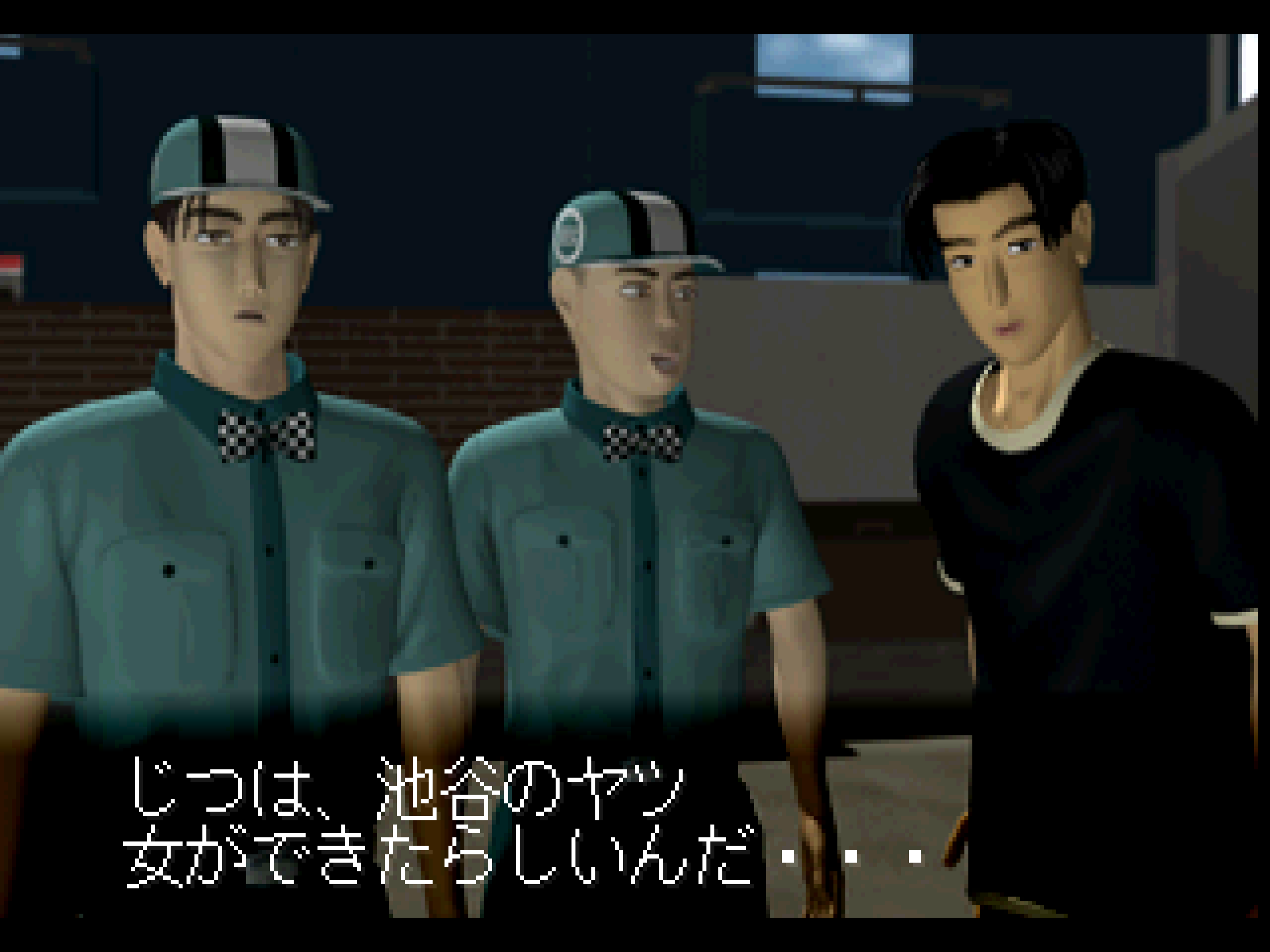
Ah yes, the classic scene where word gets out that Iketani-senpai supposedly has a girlfriend, which everyone is shocked by.
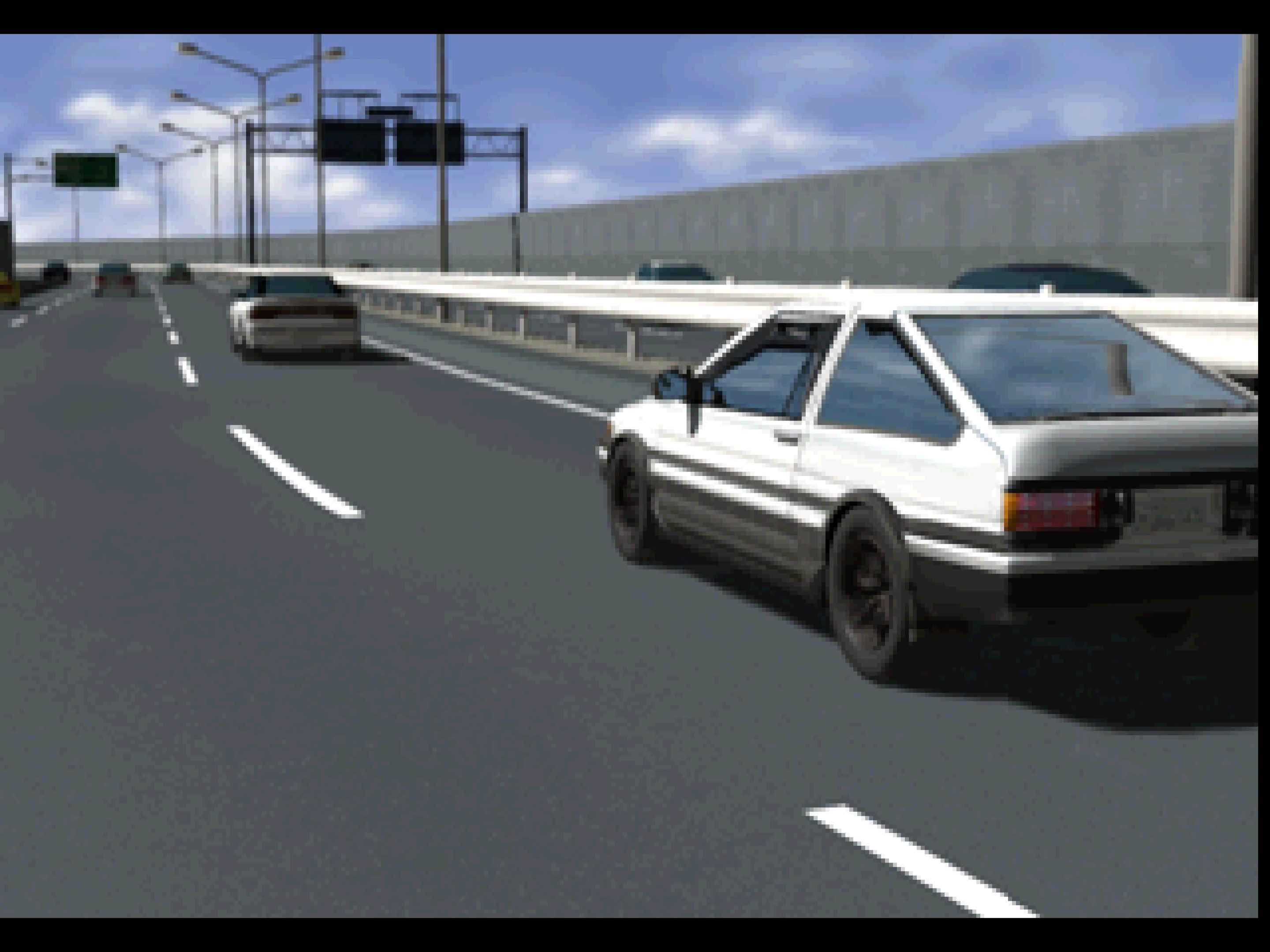


There are a handful of FMV’s, but most of the story is presented in slideshows like this one. The boys are rolling deep to see Iketani’s new girl!
(Side note: Iketani is this character’s last name, and that’s how his friends refer to him. I’m trying to maintain some consistency, calling Takumi Fujiwara, Itsuki Takeuchi, and Natsuki Mogi by their first names; but it just feels odd to call Kouichirou Iketani by his first name, when they don’t use it in the game and I don’t recall them using it in the anime either. Japanese is very interesting in this way because it’s much more common than English to refer to people by their last names; there’s a lot of nuance to the choice of using someone’s family or given name, plus the addition–or not–of an honorific like san, sensei, etc).
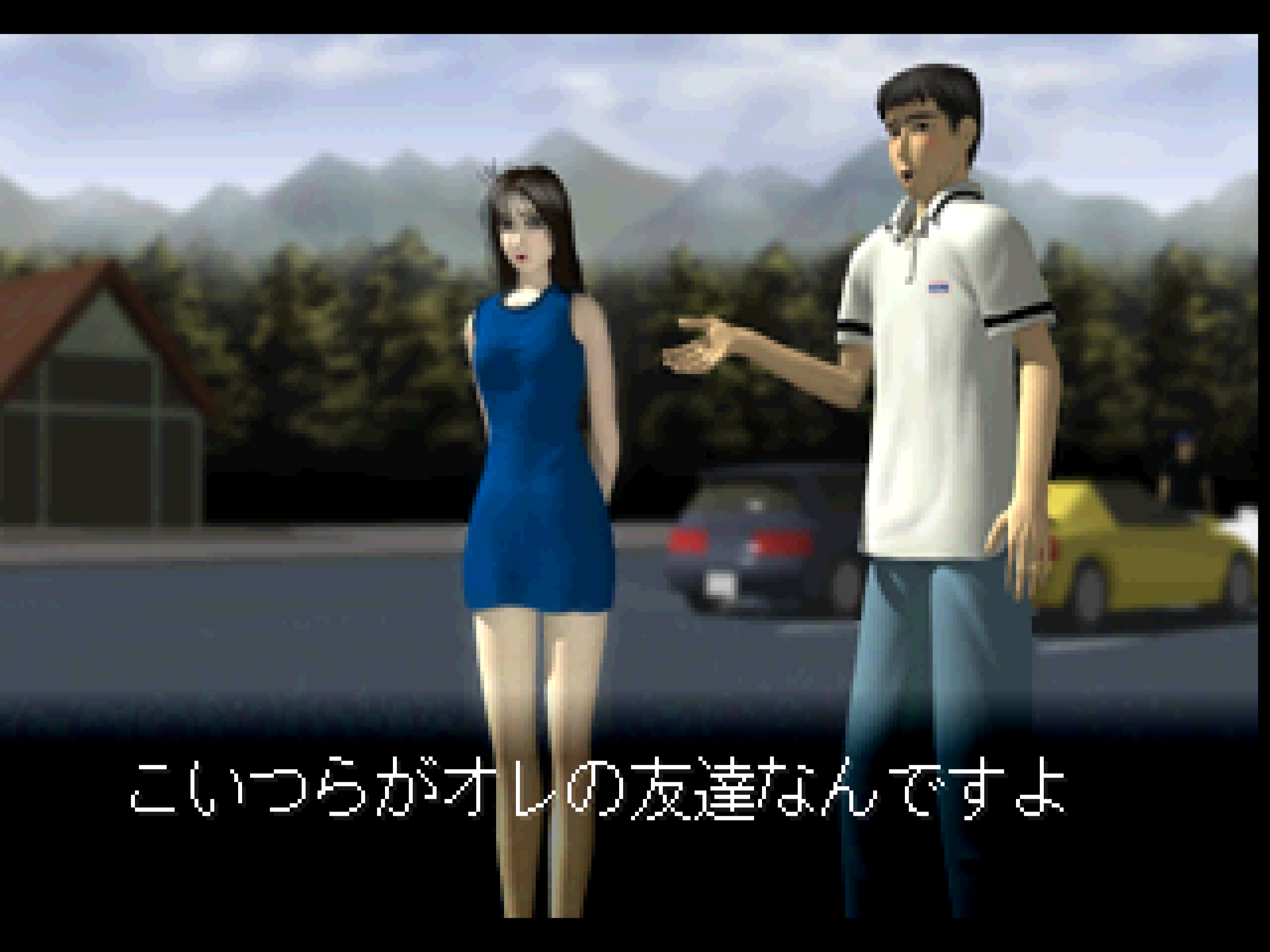
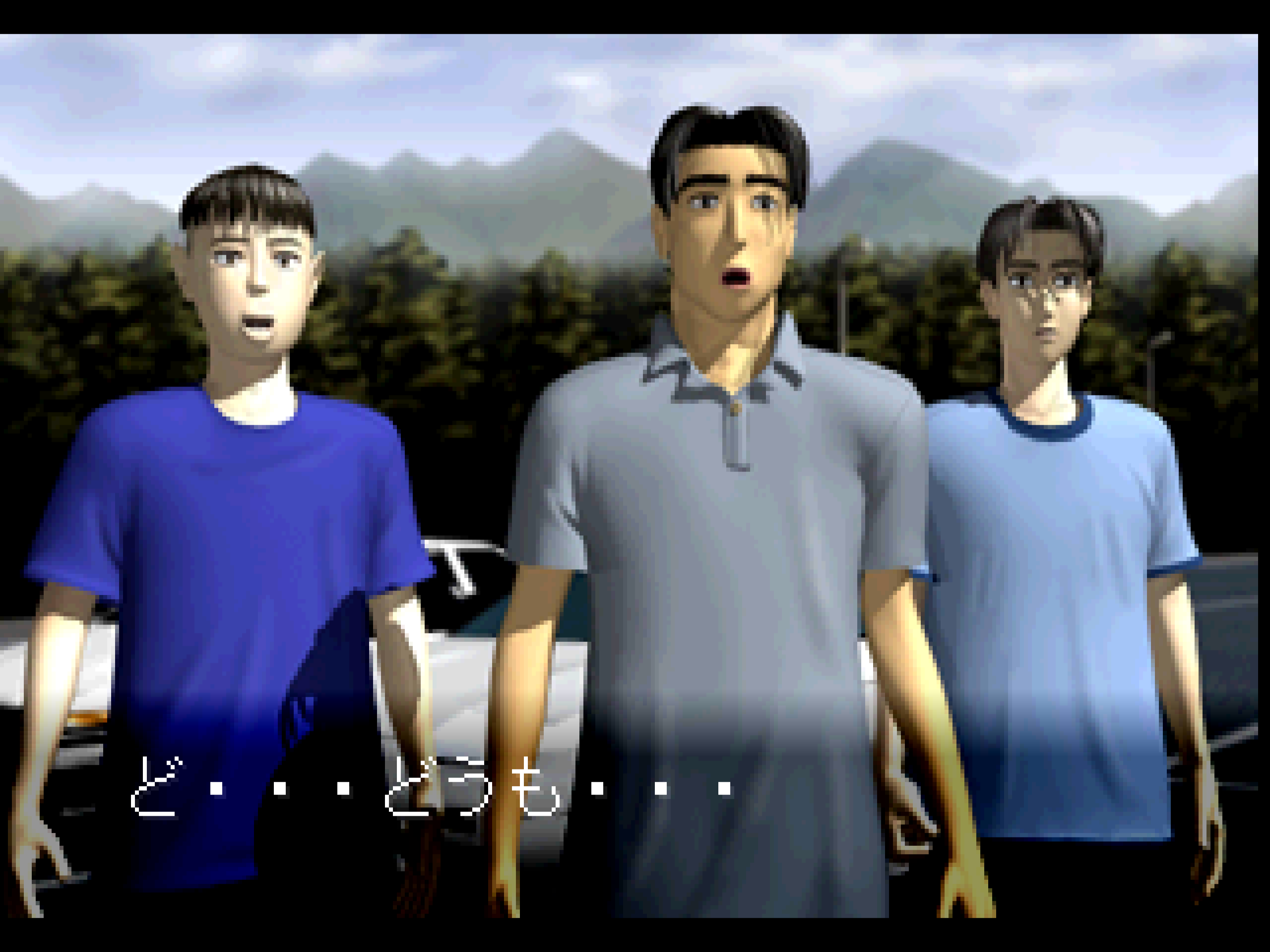
Holy crap this is awkward. Sure, Mako is a hottie, but these guys literally act like they’ve never been this close to a woman in their lives.

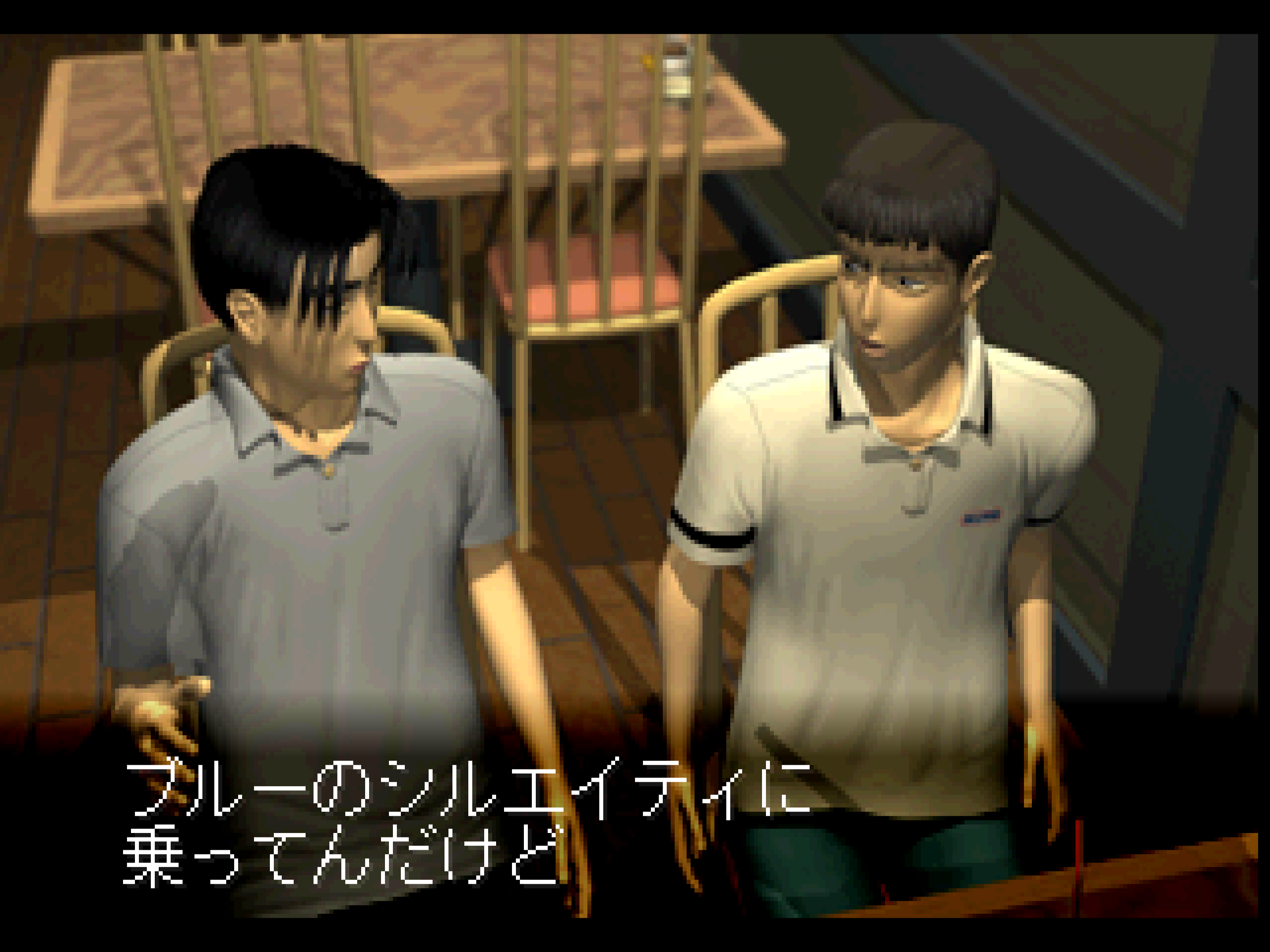

Afterwards, the stunned homies convene at a restaurant and discuss the rumor of a “stupid fast” driver of a blue Sileighty on Usui touge–who is apparently a woman!
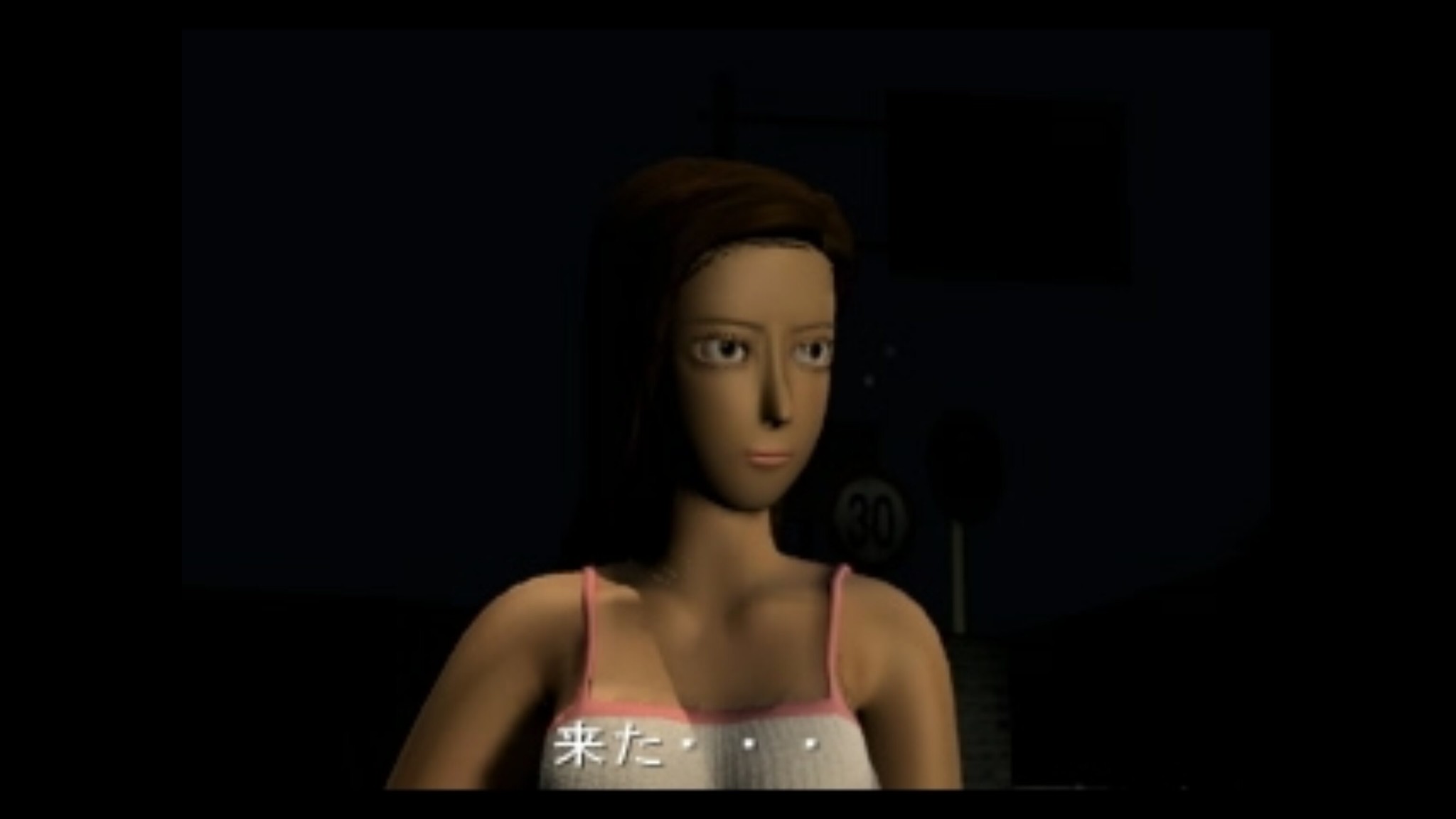
Watching this FMV made me wonder if the animators had ever seen a woman either. The other characters are nothing brilliant, but they look alright. On the other hand, Mako and Sayuki just look…weird.

Is it just me or do these ladies look creepy?
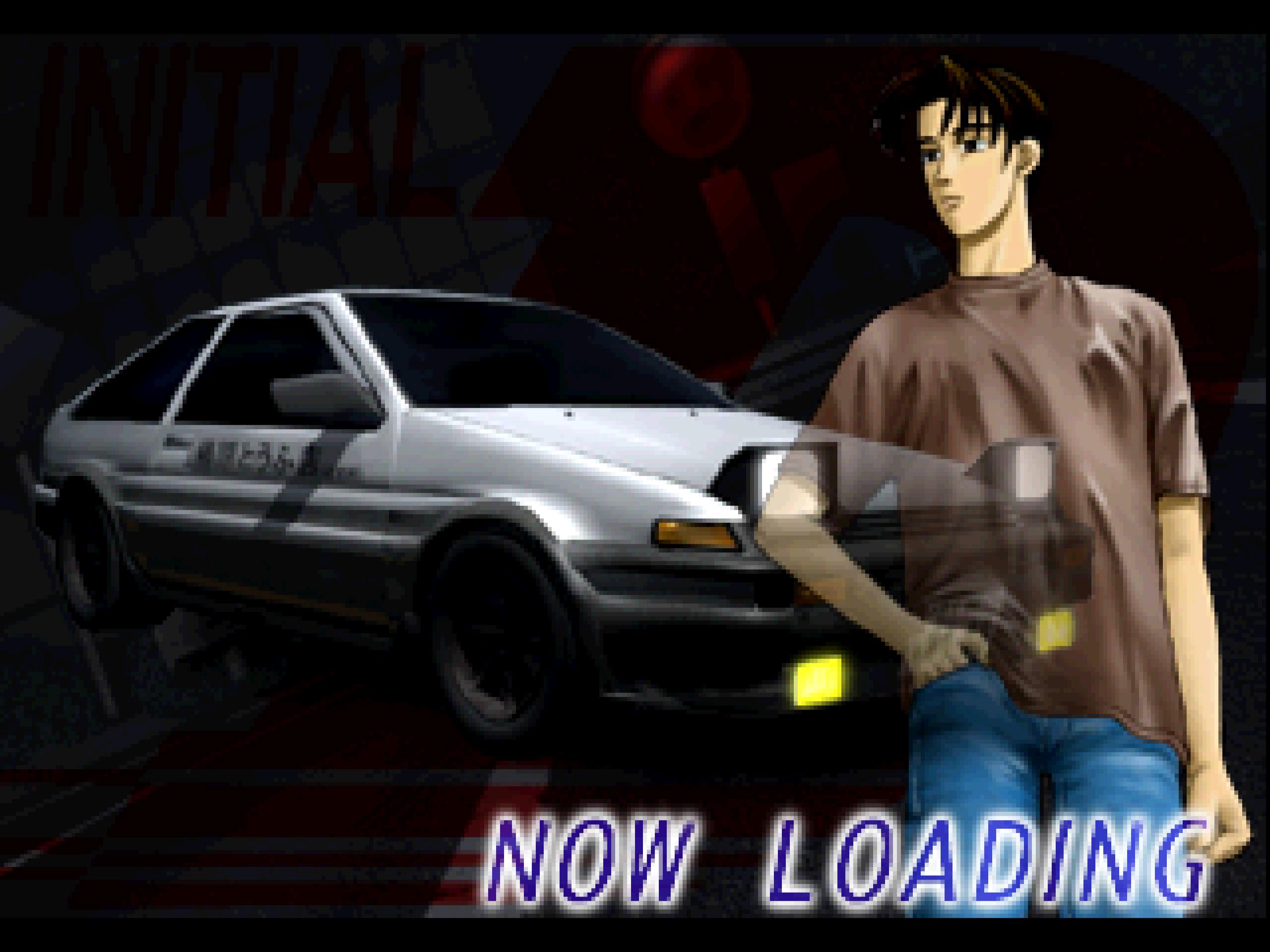
Another of the many cool loading screens.
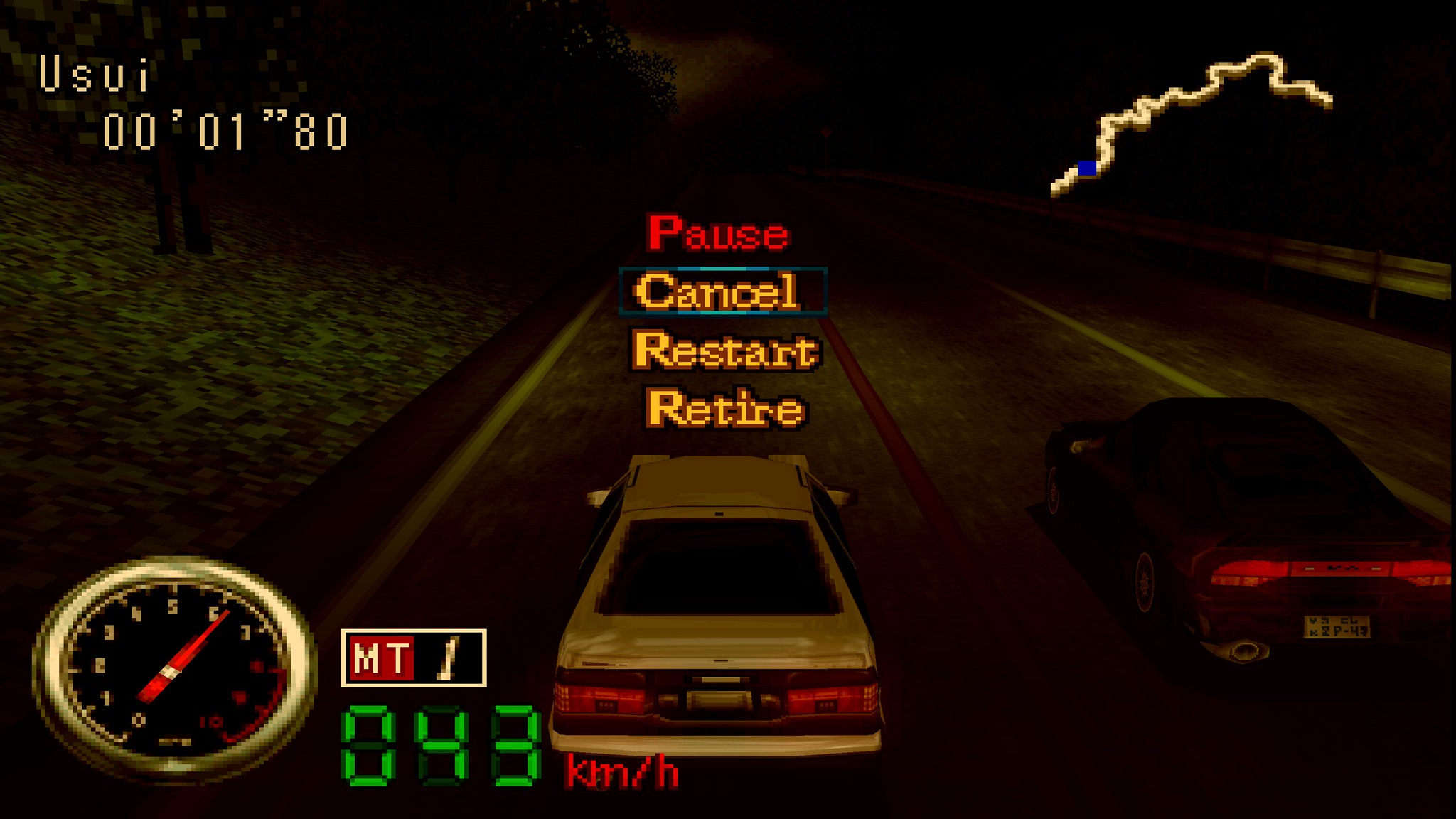
The way the story mode works is that you have to win every race: if you don’t, it’s game over. Thankfully, the game doesn’t try to be too punishing; you can pause the race and restart any time. If you only play modern games this might sound ridiculous, but this is actually a luxury by 90’s racing game standards.
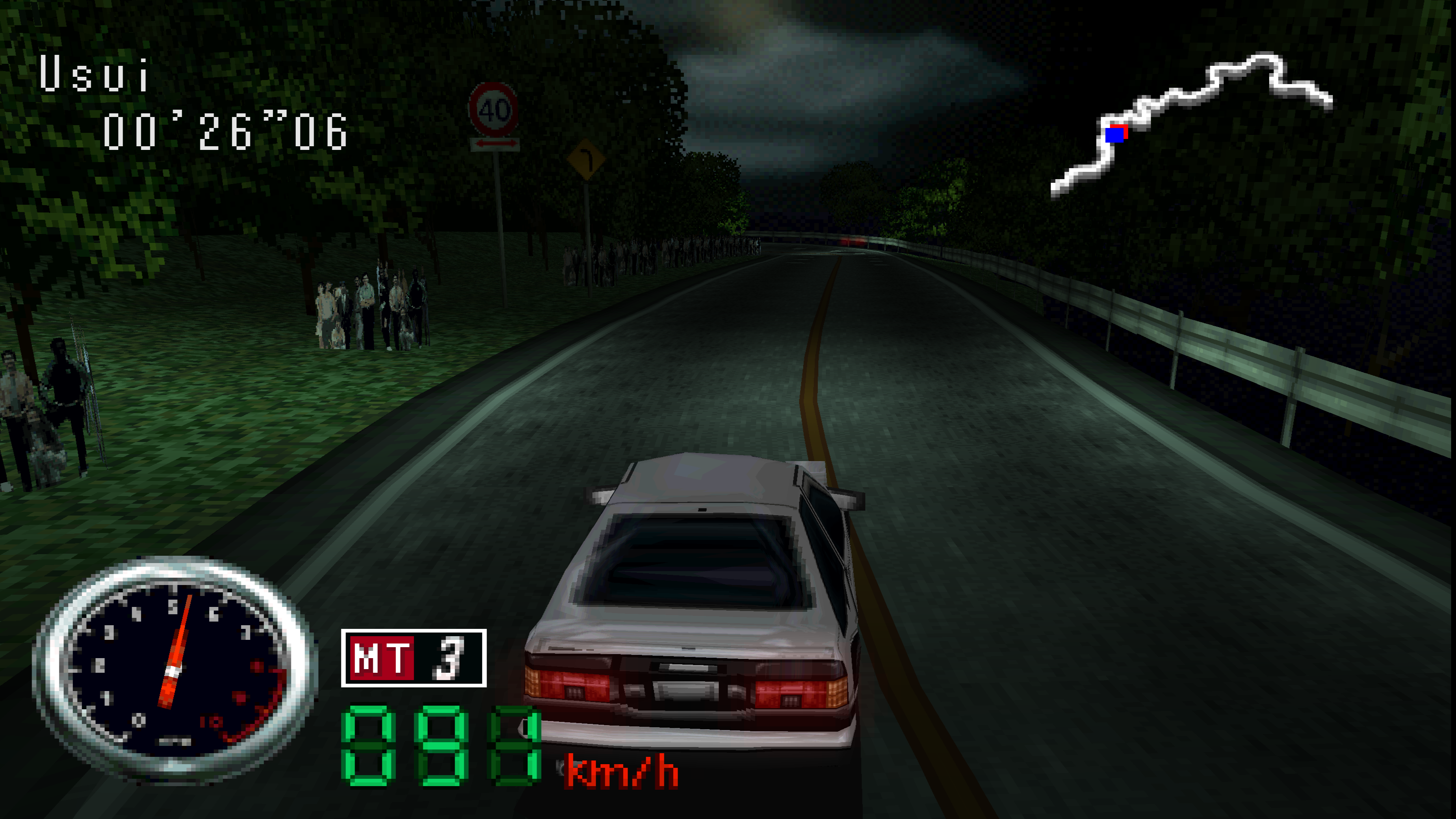
If you zoom all the way in (try opening the image in a new tab), all you can see is a pair of floating tail lights going through the next corner. The LOD’s don’t just simplify the model, they delete virtually all of it! This would be completely unnoticeable on a real Playstation, so it’s just amusing to notice it on emulation.
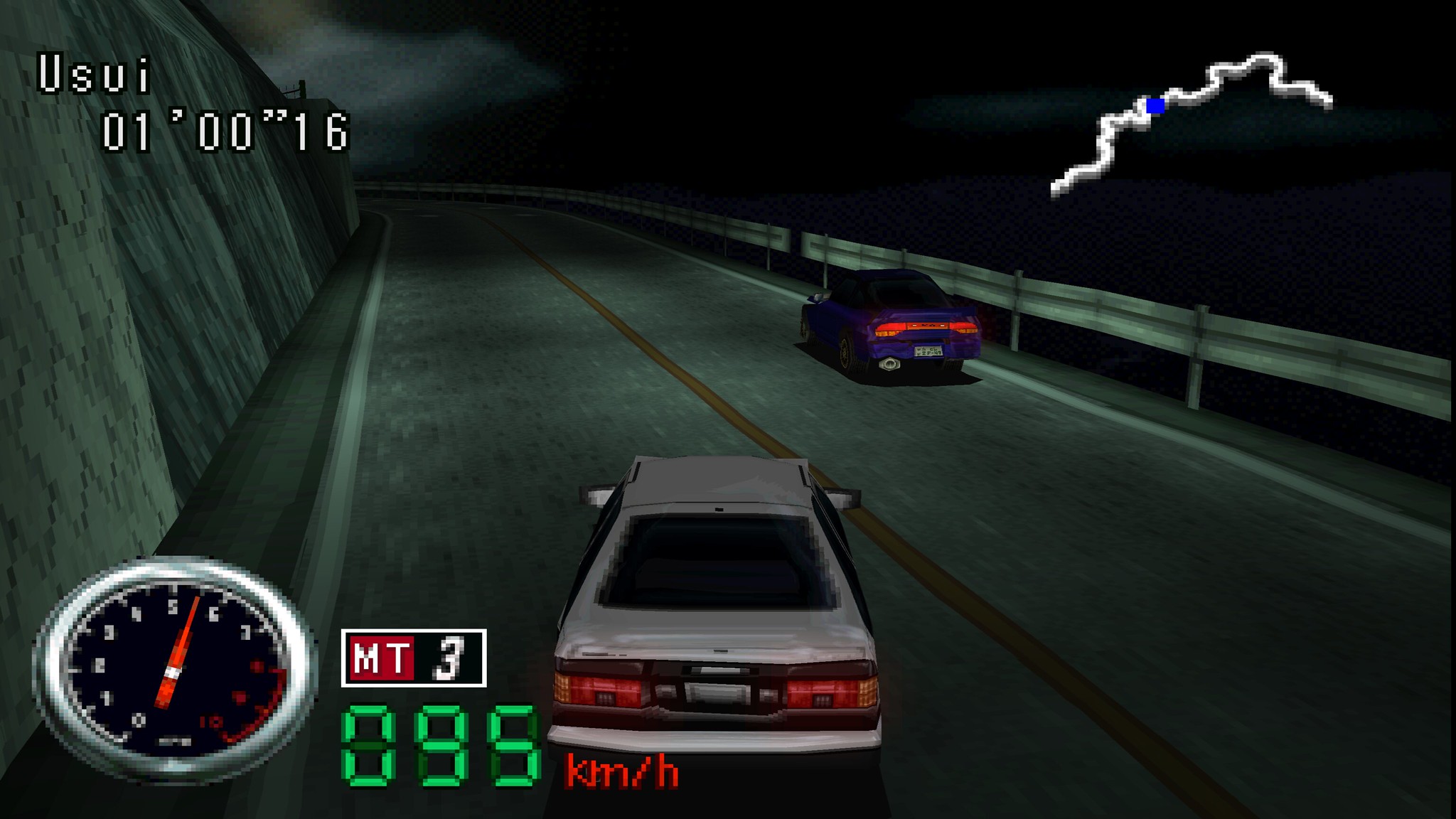
Anyway, we’ve finally reached the third course of the game. We’re visiting Usui, the home of Impact Blue.

The Playstation and Saturn versions have significant differences beyond just the graphics. In this Playstation version, there are only three roads: Akina, Myogi, and Usui. The Saturn version also gets Akagi, and the story mode is very different in presentation, using a lot of animation compared to the PS1’s slideshow style.
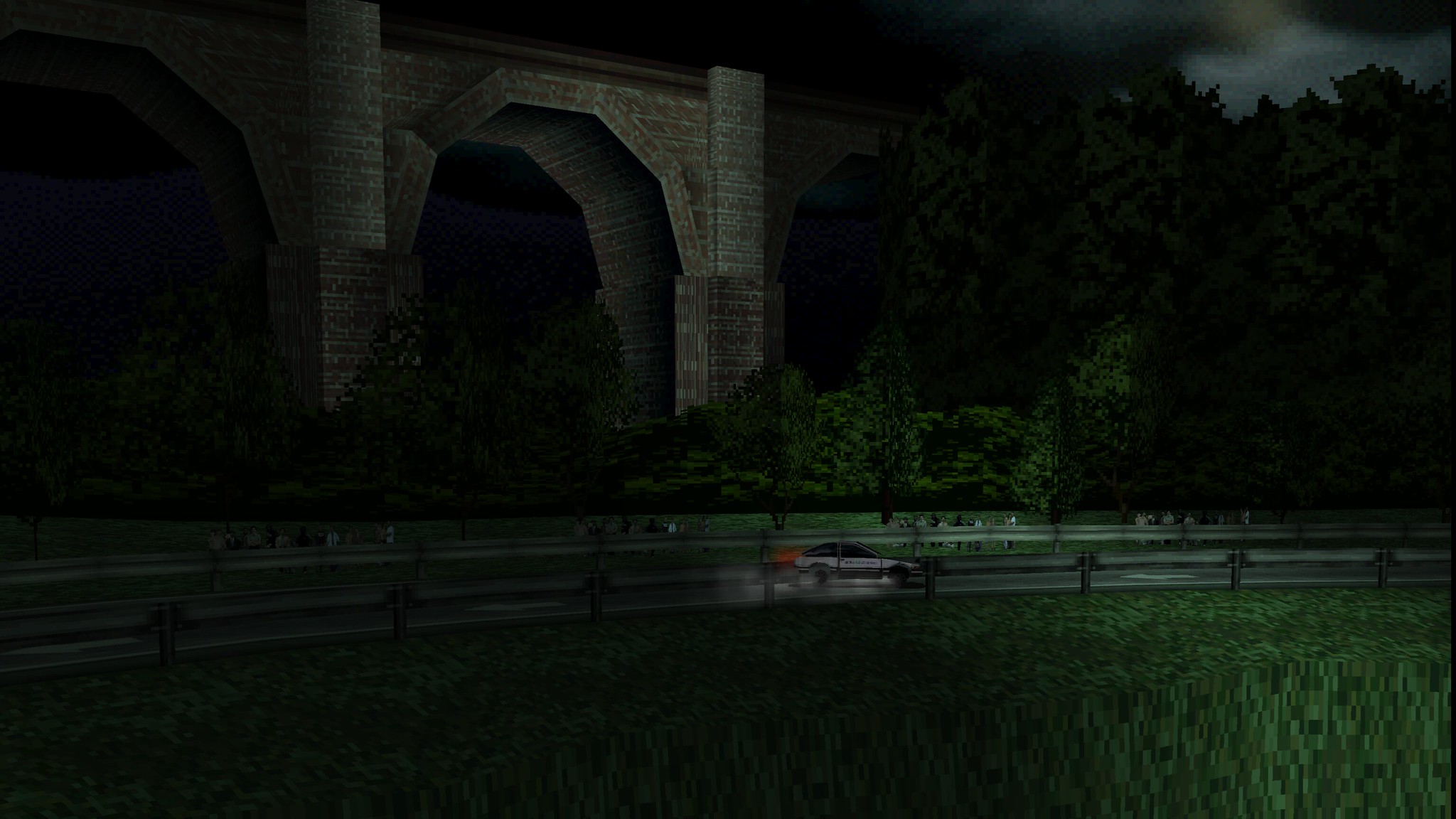
It’s the Usui 3rd Bridge! This is the largest arched brick bridge in Japan, and the most recognizable landmark on the Usui Touge.
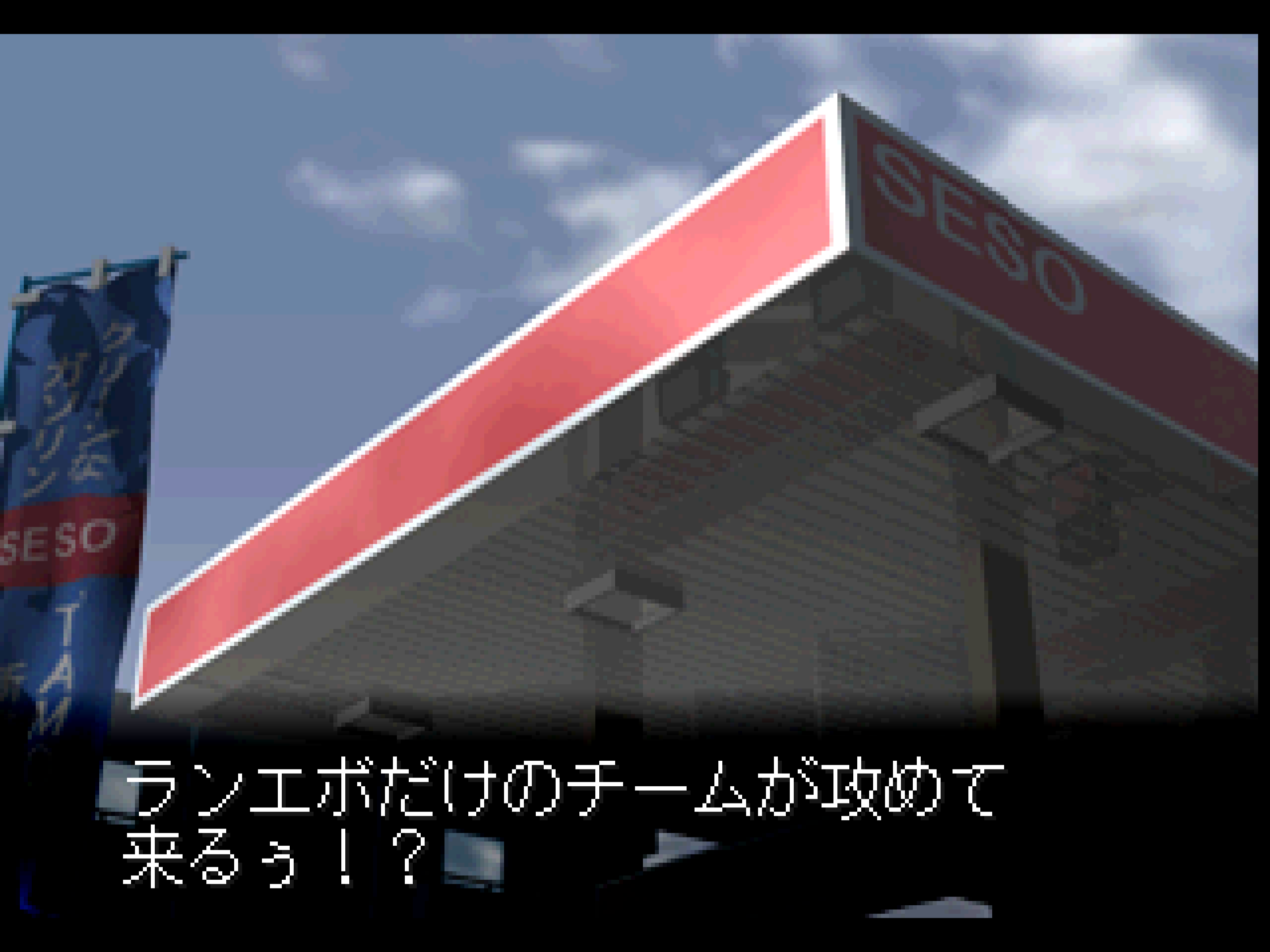
Apparently Emperor, a team of Lancer Evolutions, is coming to Akina, and they want to battle Takumi–of course.

Everybody in this game seems to be really surprised when people show up who said they were going to show up.
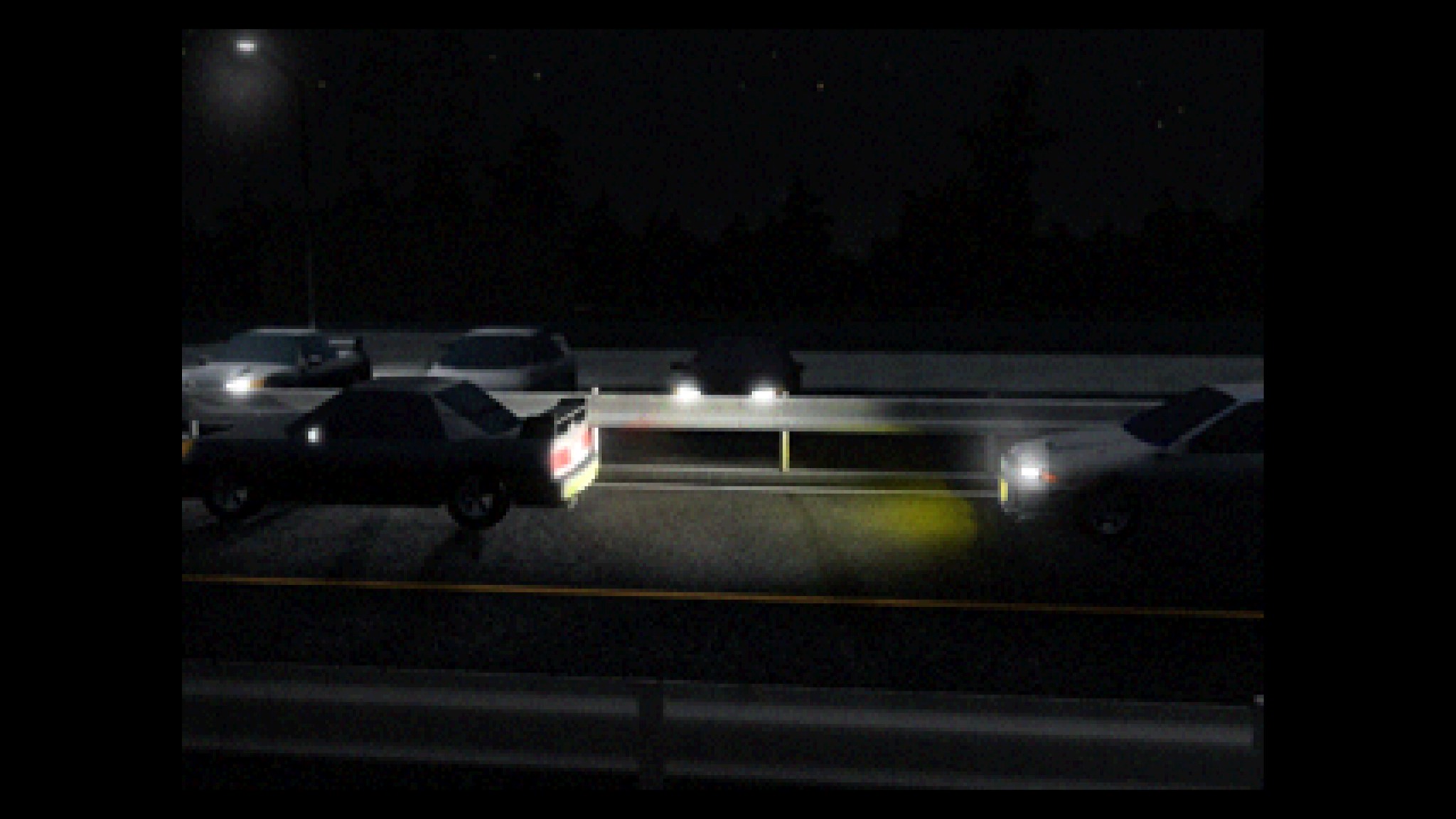

These guys definitely put on the tough-guy act. One of Initial D‘s core themes is loudmouth competitors being put in their place by the mild-mannered Takumi.
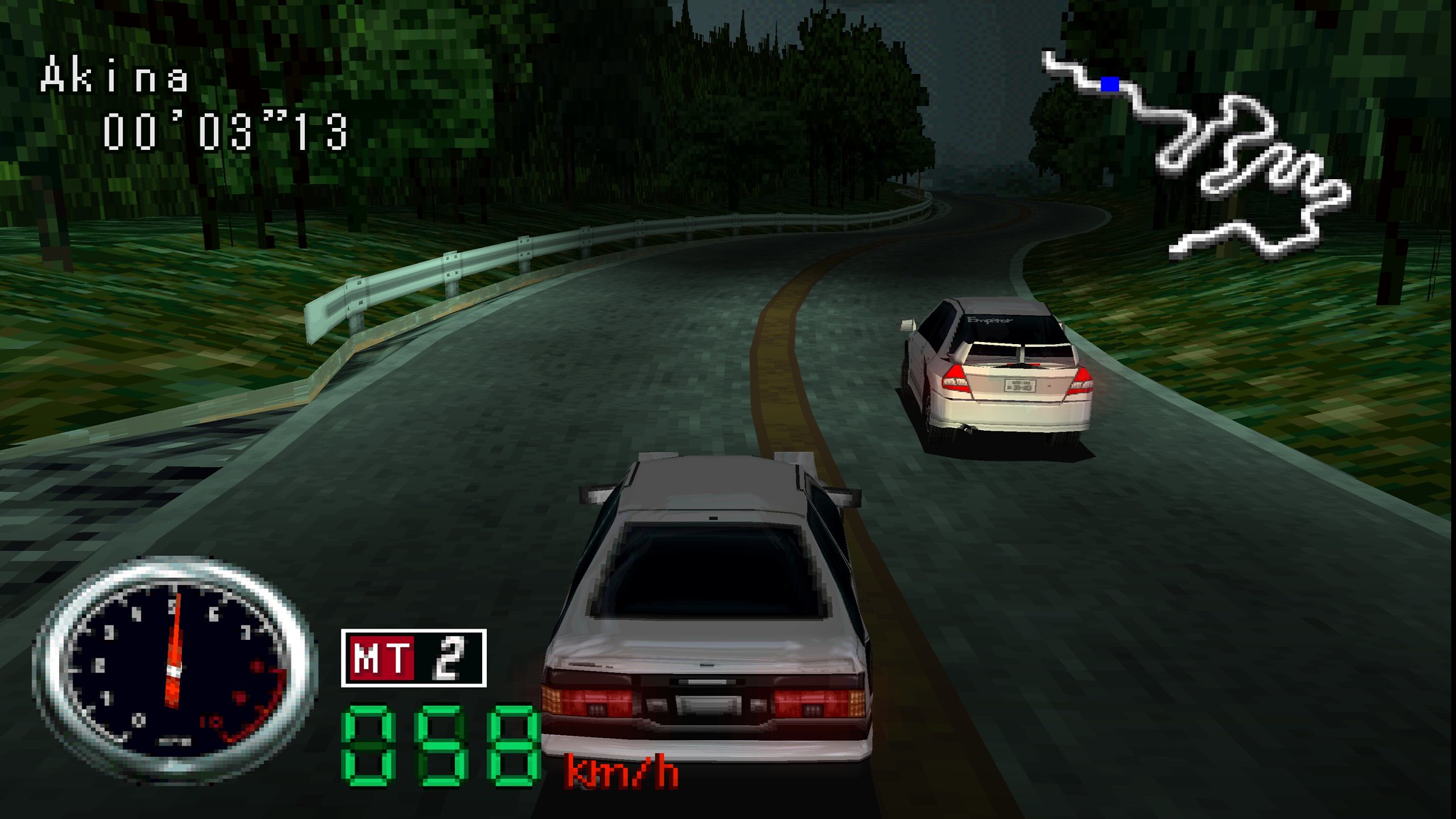
We don’t actually race their leader yet; this is Seiji Iwaki in an Evo IV.
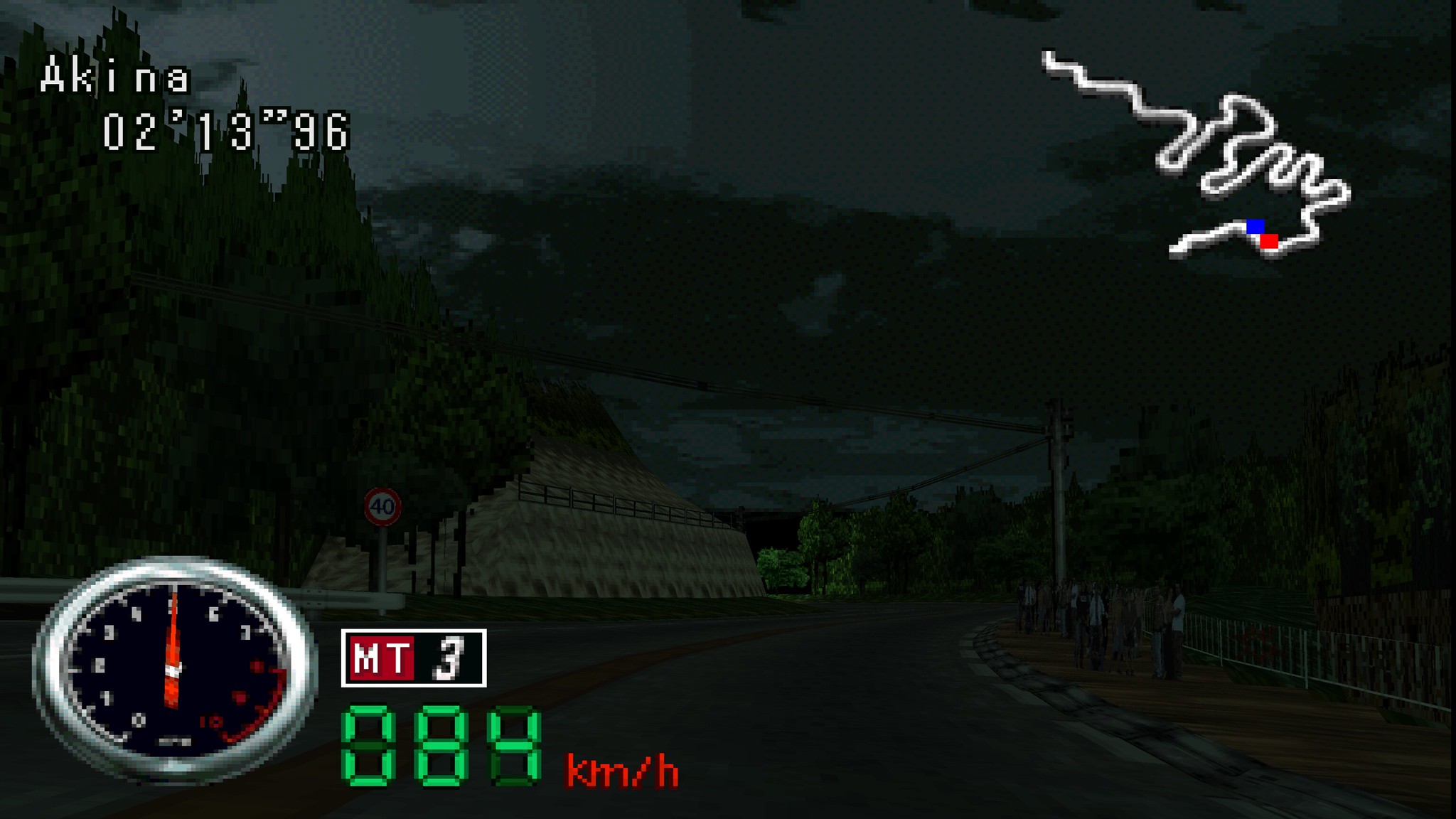
And yes, we’re at Akina downhill…again. There is a rear view, accessed by pressing “down” on the D-pad, although it’s pointed strangely high and I never found myself using it.
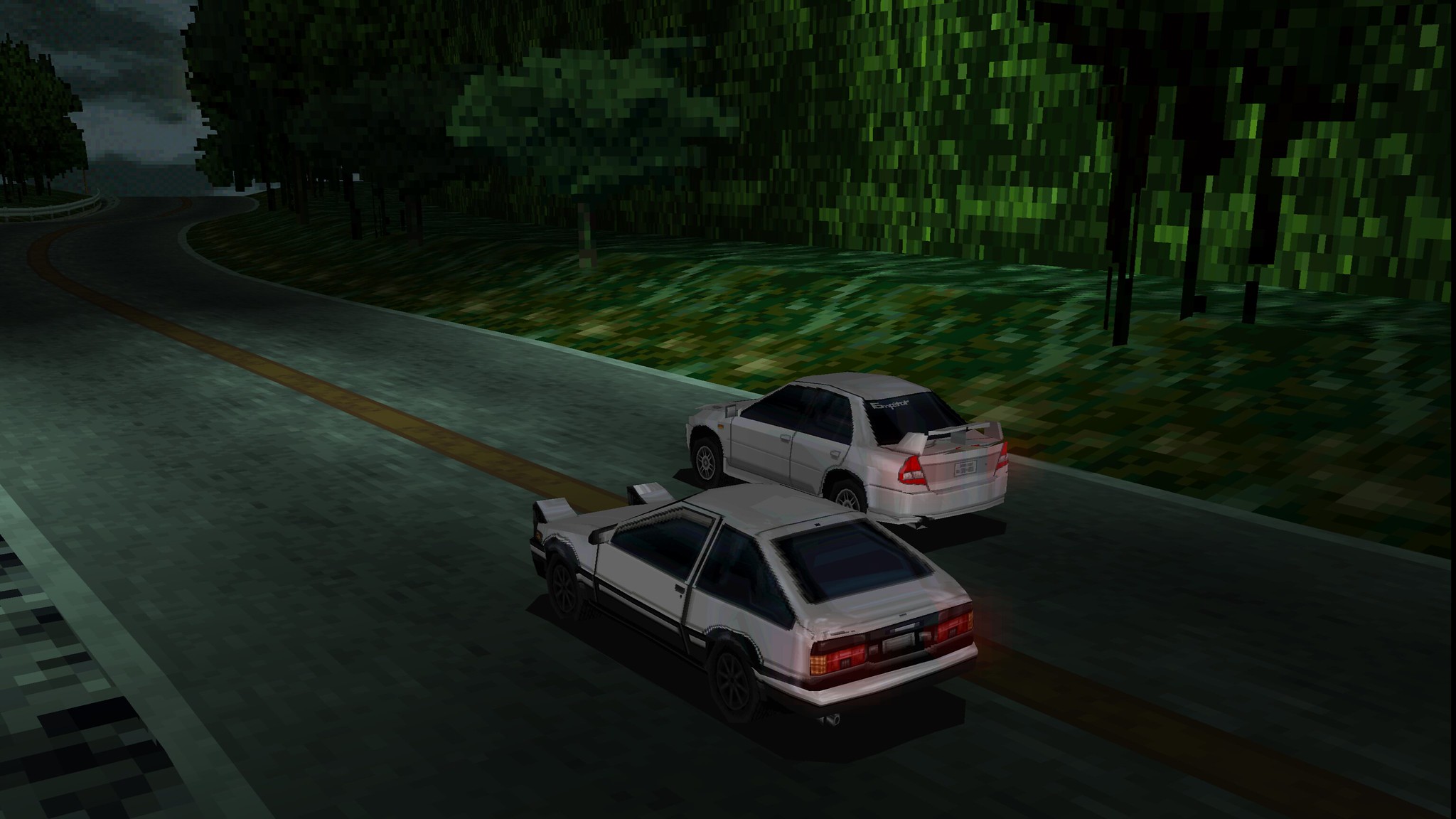
Wait, D-pad? Yep. This game supports the Dual Shock controller–but only the vibration function. There’s no analog steering, let alone the analog throttle/brake that some racing games were attempting by this game’s release in 1999.
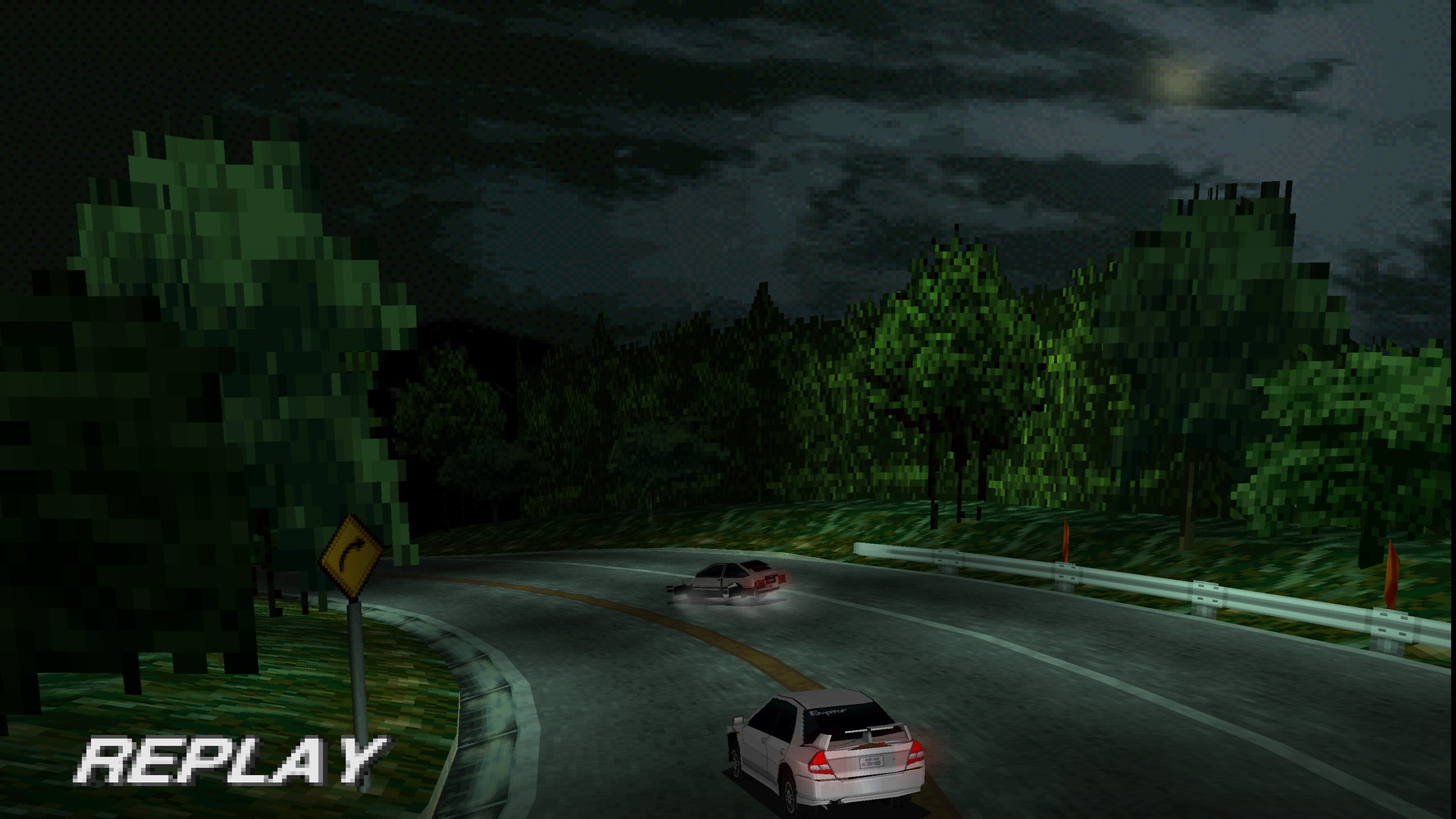
You know what though? It doesn’t affect the enjoyment of the game at all. The concept of analog controls, despite having been around forever in general, was still pretty new to mainstream gaming consoles in the late 90’s, having just arrived in 1996 for Nintendo and Sega, and 1997 for Sony. Developers had been making racing games with digital controls for years, so there were already some prevailing theories around translating digital input taps and holds into vehicular controls. If D-pad controls are tuned correctly, they can be very playable, even by modern standards. Art of Rally, for example, has extremely good digital controls by the standard of any era, even though it was released in 2020 and has fully analog controls as well.
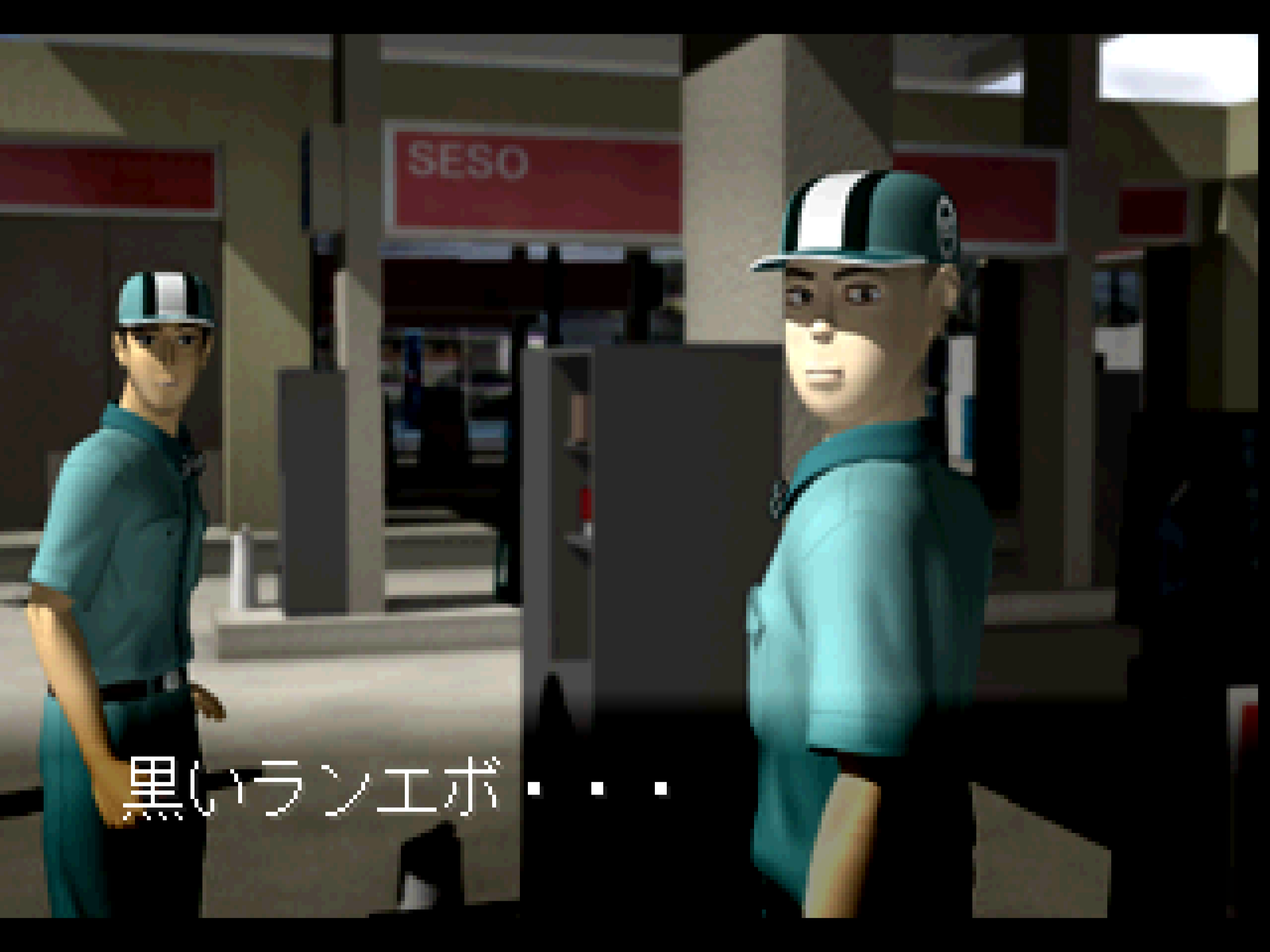
The next day, Kyouichi Sudou rolls up to the gas station in his Evo and challenges Takumi in a race outside of his home course. In the manga, this is Akagi. Since that road is sadly not in this game, the race is set for Myogi instead.
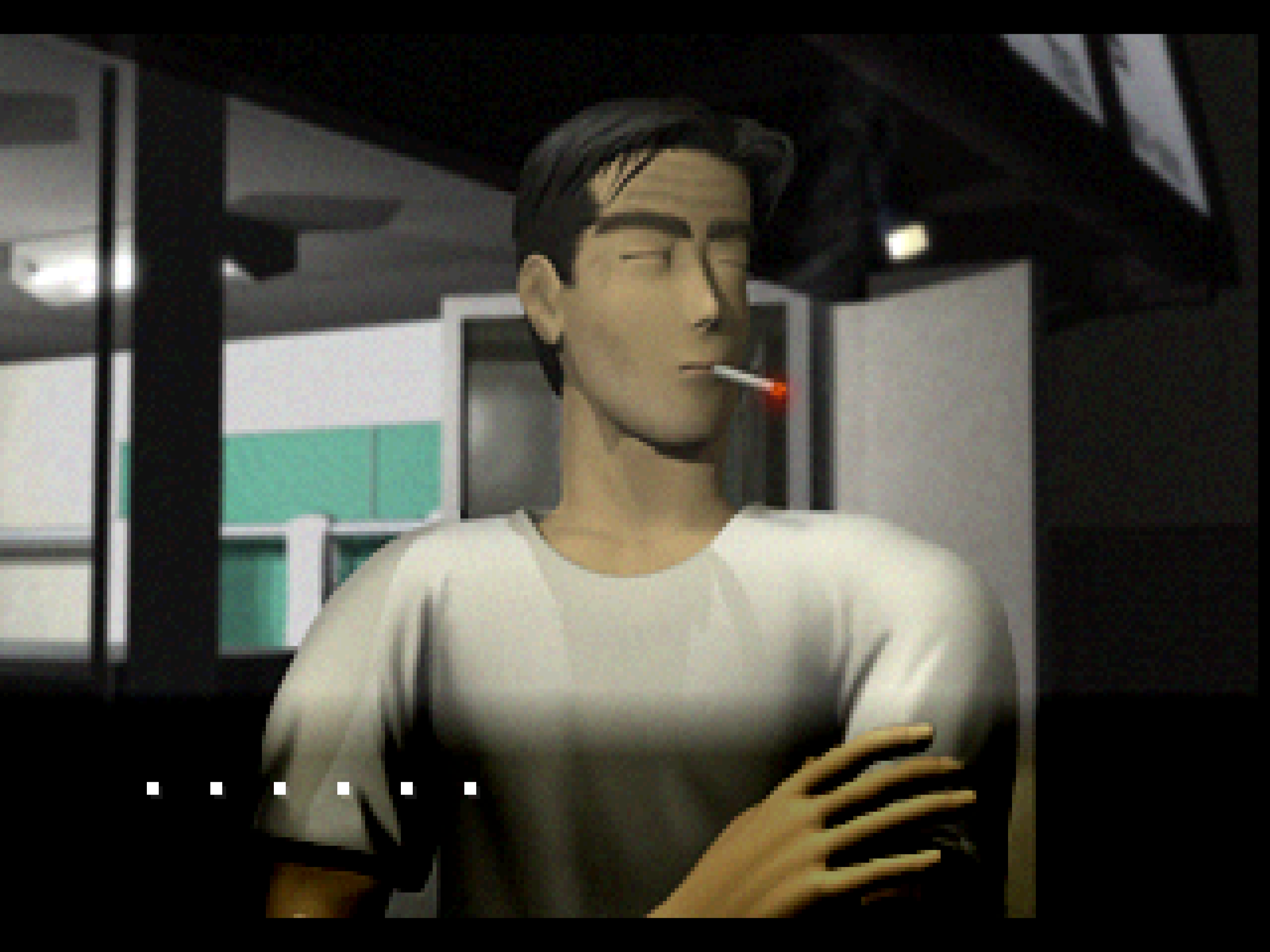
Back at home, Bunta decides to tweak the 86 a bit.
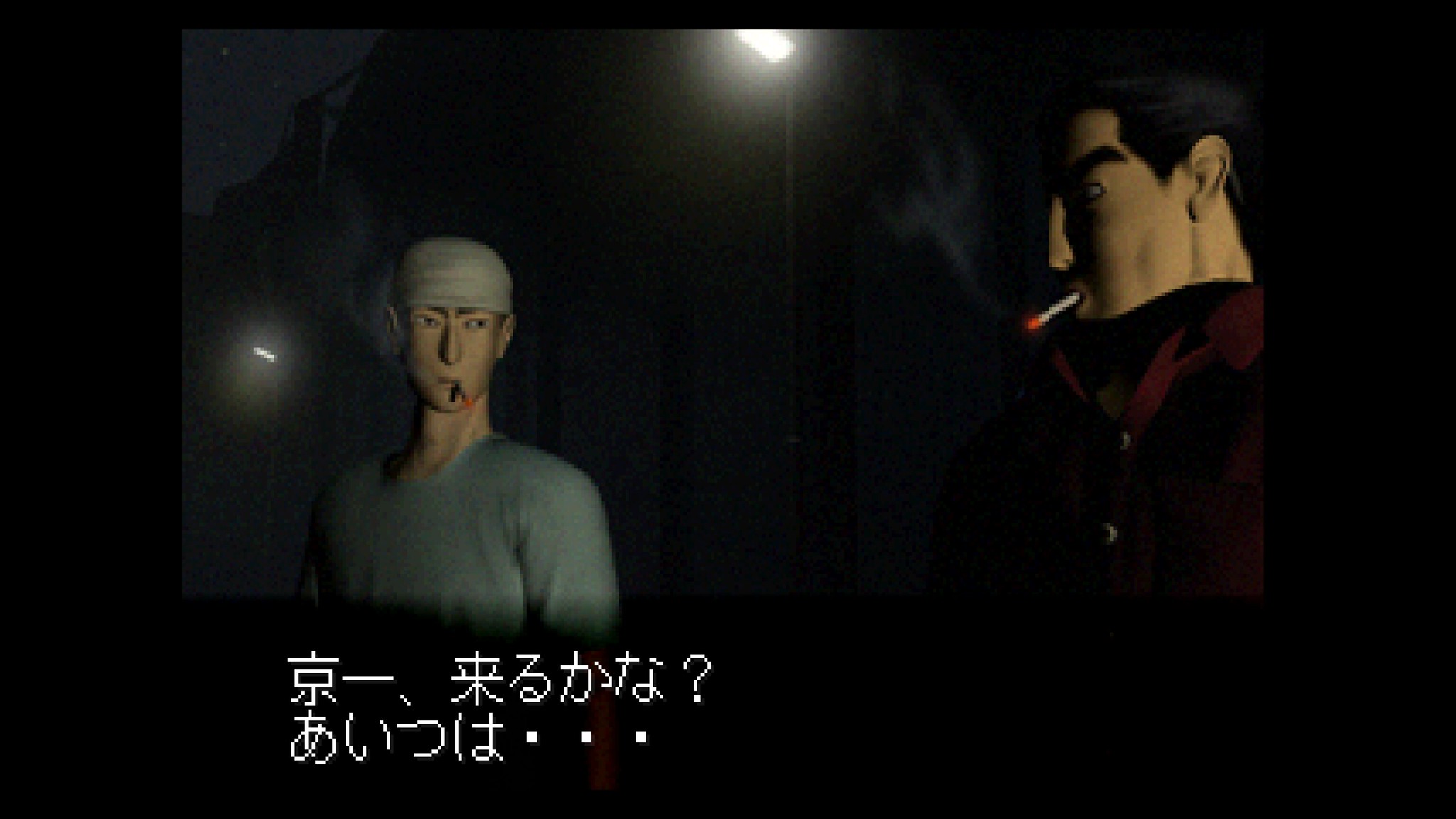
Man, again with the flakey driver doubt. When I read Initial D, I got the strong suspicion that many of the characters are based on real life personalities that the author, Shuichi Shigeno, knew in real life. I wonder if the anticipation if someone would really show up was an actual part of real-life touge racing.

Up until now, Kyouichi has always been shown wearing a red du-rag (I just realized I have no idea what this thing is called in Japanese), but in this scene it switches to grey or white?
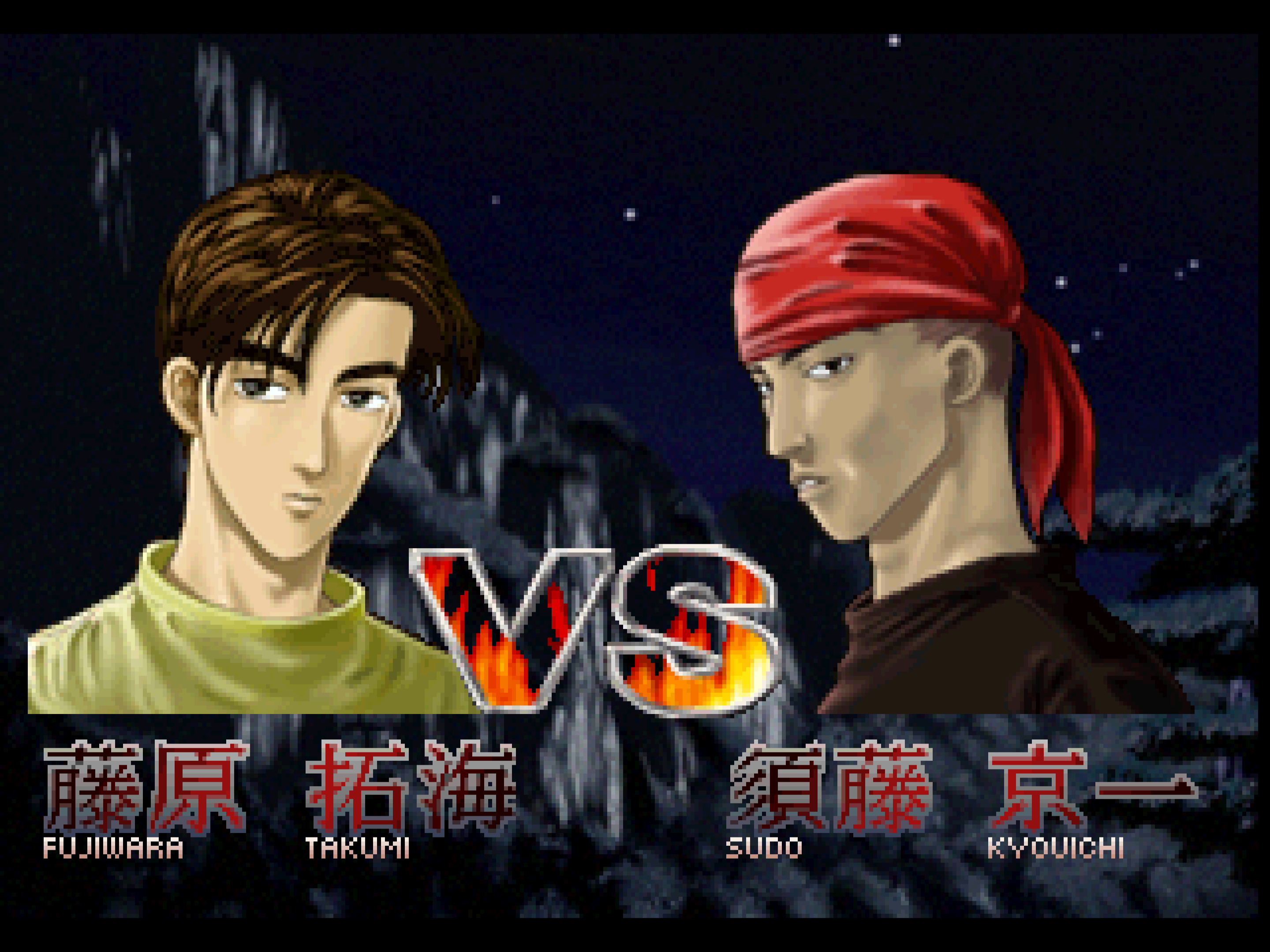
And then back to red for the versus screen? Maybe the previous scenes were created using only the black-and-white anime as a reference and no one ever noticed it. Or maybe he was just wearing a grey hat on this particular night, and the versus screen is wrong?
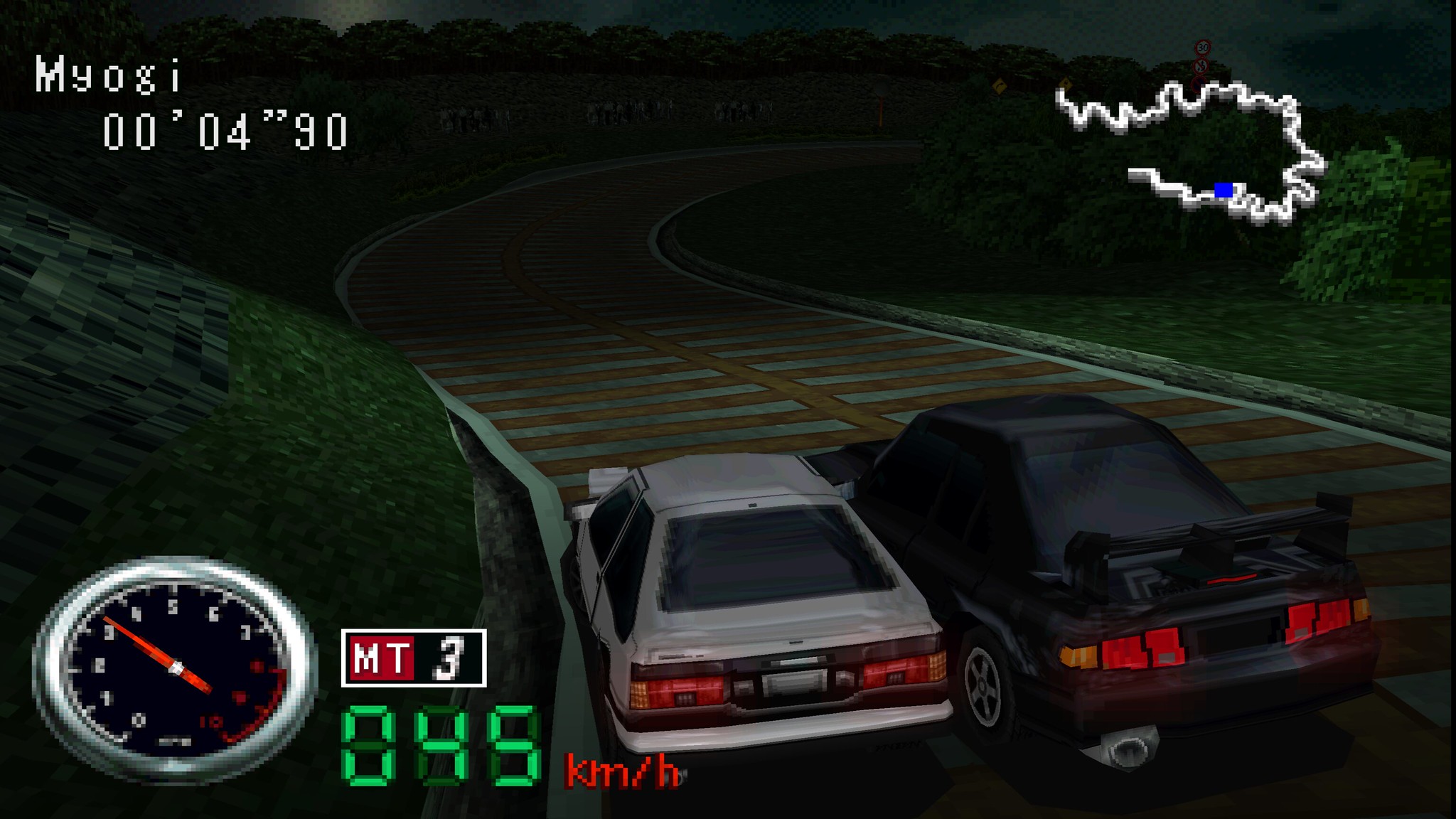
The collision physics are pretty good; you don’t get hung up on walls, and you can drive very close to other cars without ruining the fun. That’s another seemingly-stupid thing that we take for granted these days, but was not always a given back in the 90’s.

The cars can sometimes take on a bit of a “chibi” look, like Choro-Q, but overall I don’t mind. They look pretty good for the era.
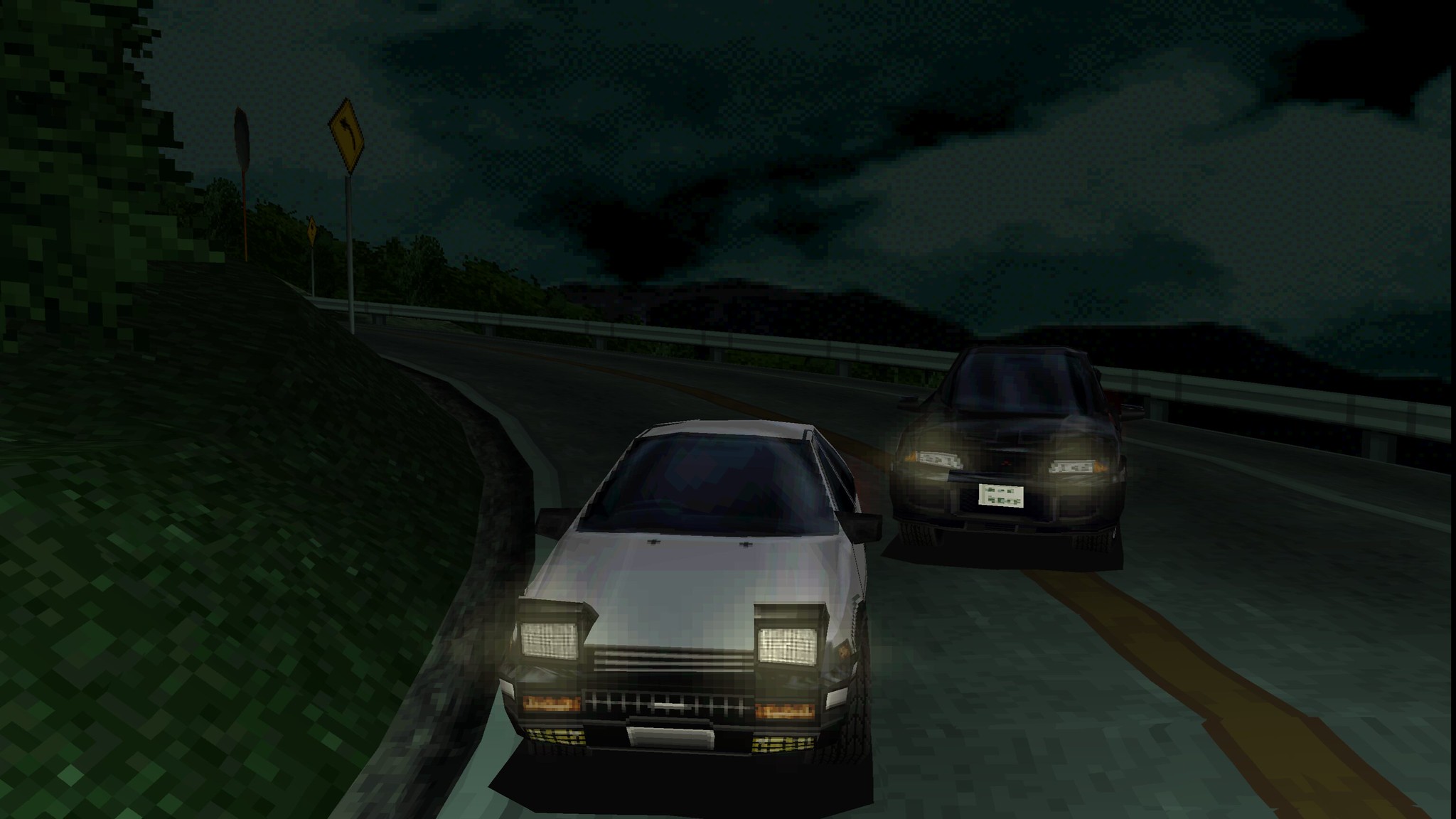
Driving through turns with some angle is one of the hallmarks of Initial D and pleasingly, that is one of the core aspects of driving in this game as well.
From here…it gets weird. It’s 4 AM on Mt. Akina, and Takumi is driving around (whether he’s cruising or delivering tofu is unclear).
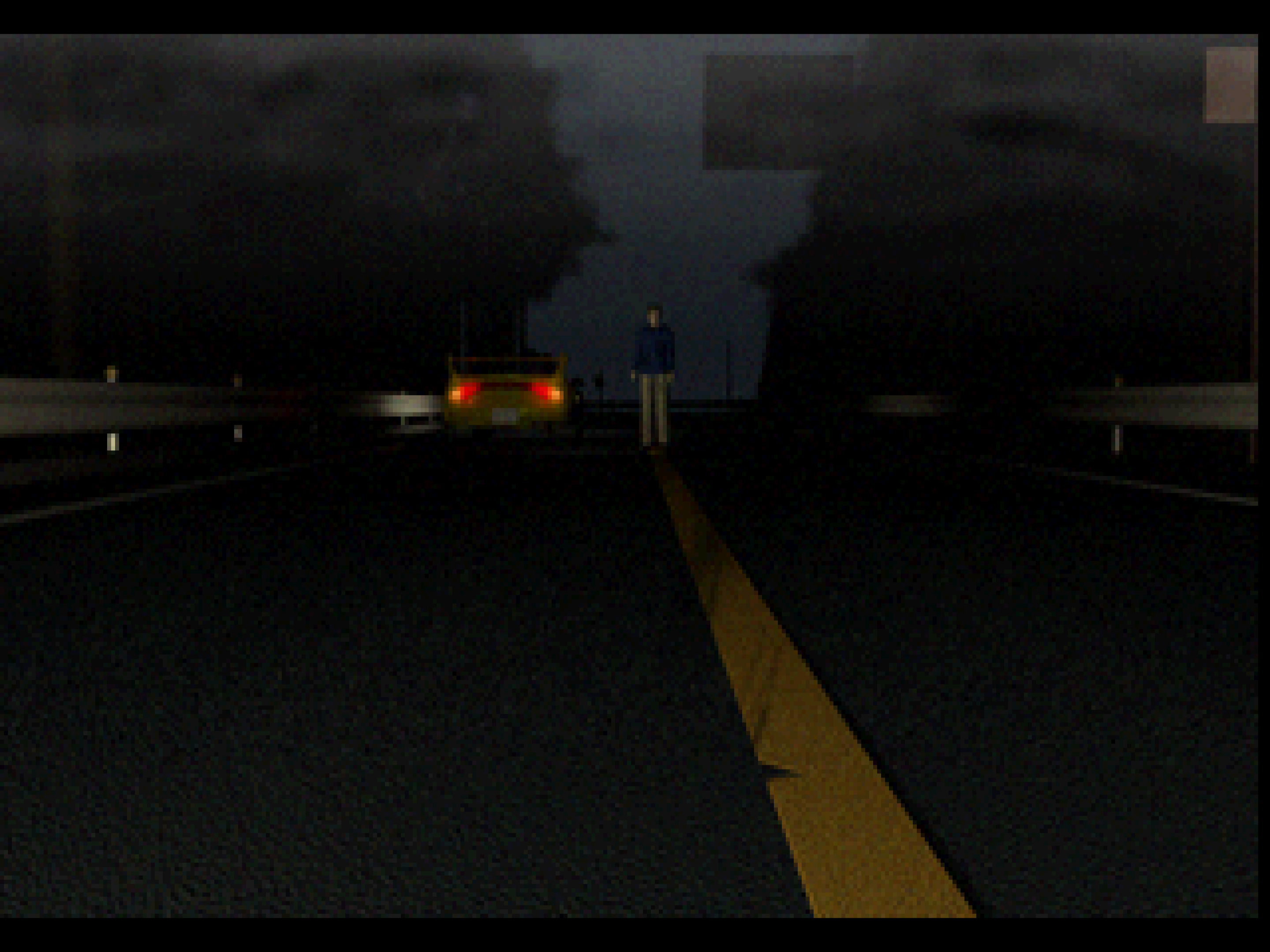
He comes around a turn and…some dude is just standing in the middle of the road?
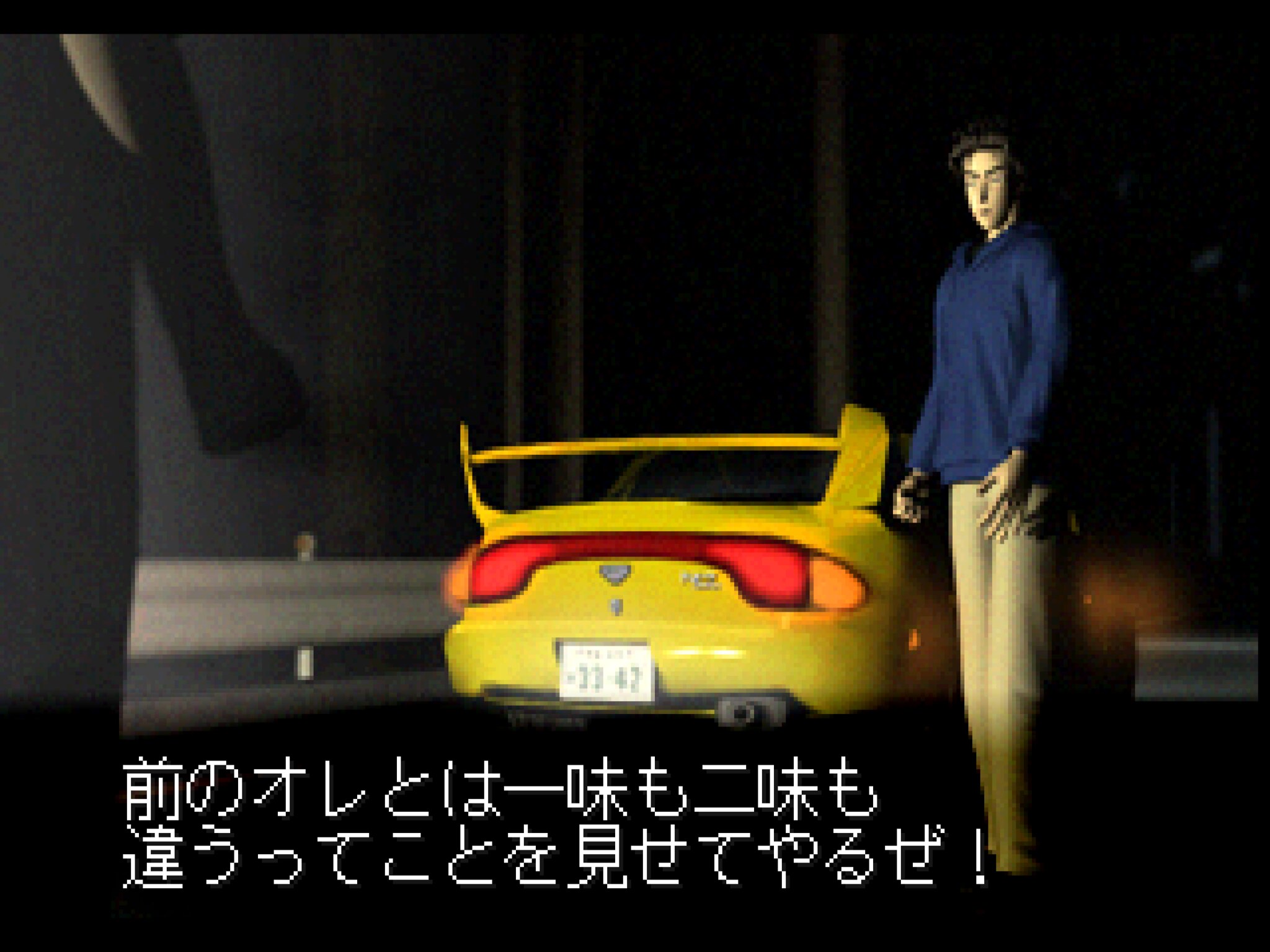
Not just any dude, it’s Keisuke Takahashi! What the hell was he doing just chilling on the touge, waiting for Takumi? He’s determined to prove that he’s leveled up his skills since he lost to us the first time. And on a side note, what is going on with the RX-7?? That thing looks weirder than Sayuki’s chest.
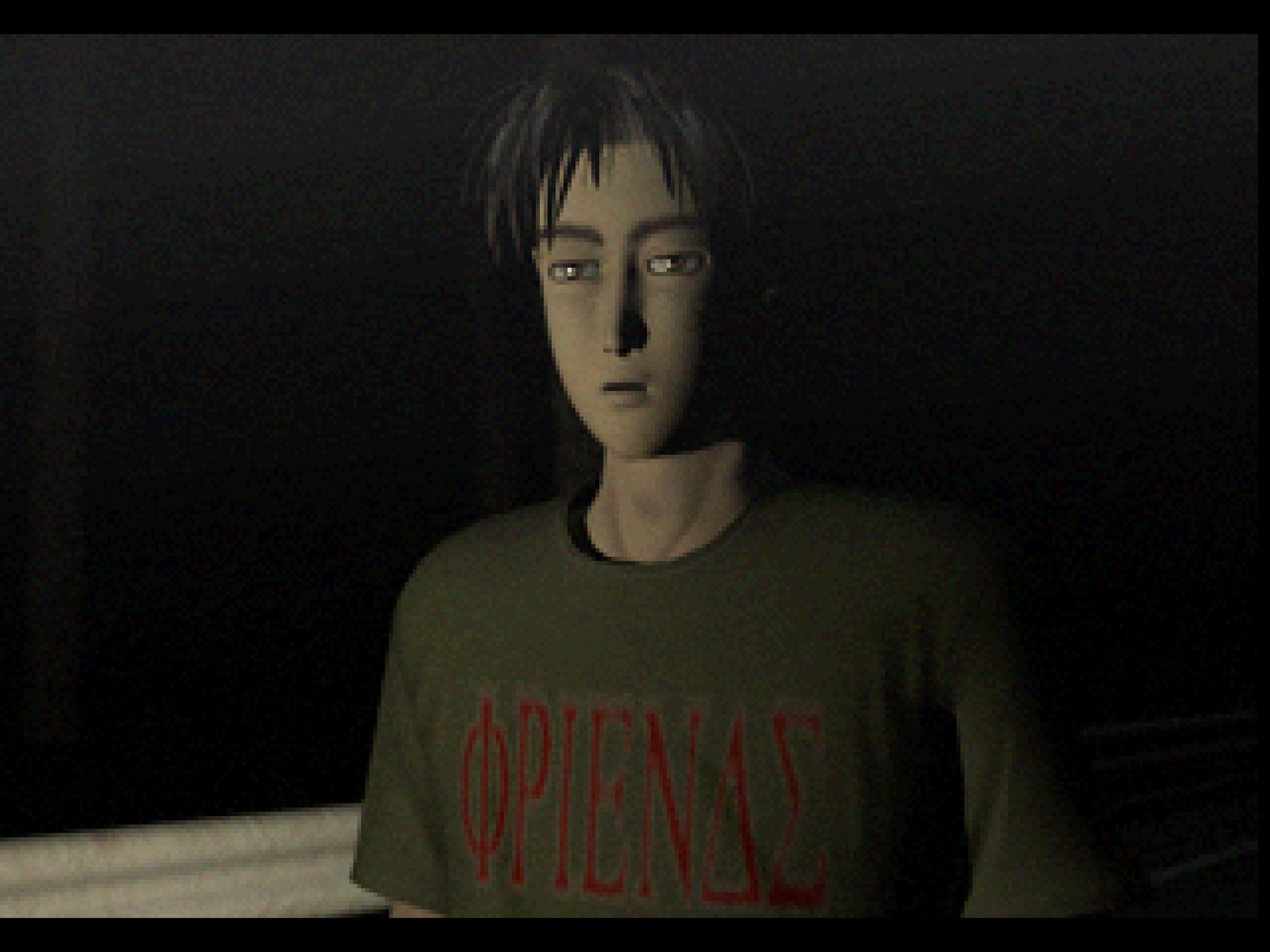
Takumi’s “it’s too early for this shit” look of disbelief. He still accepts the race invite, though.
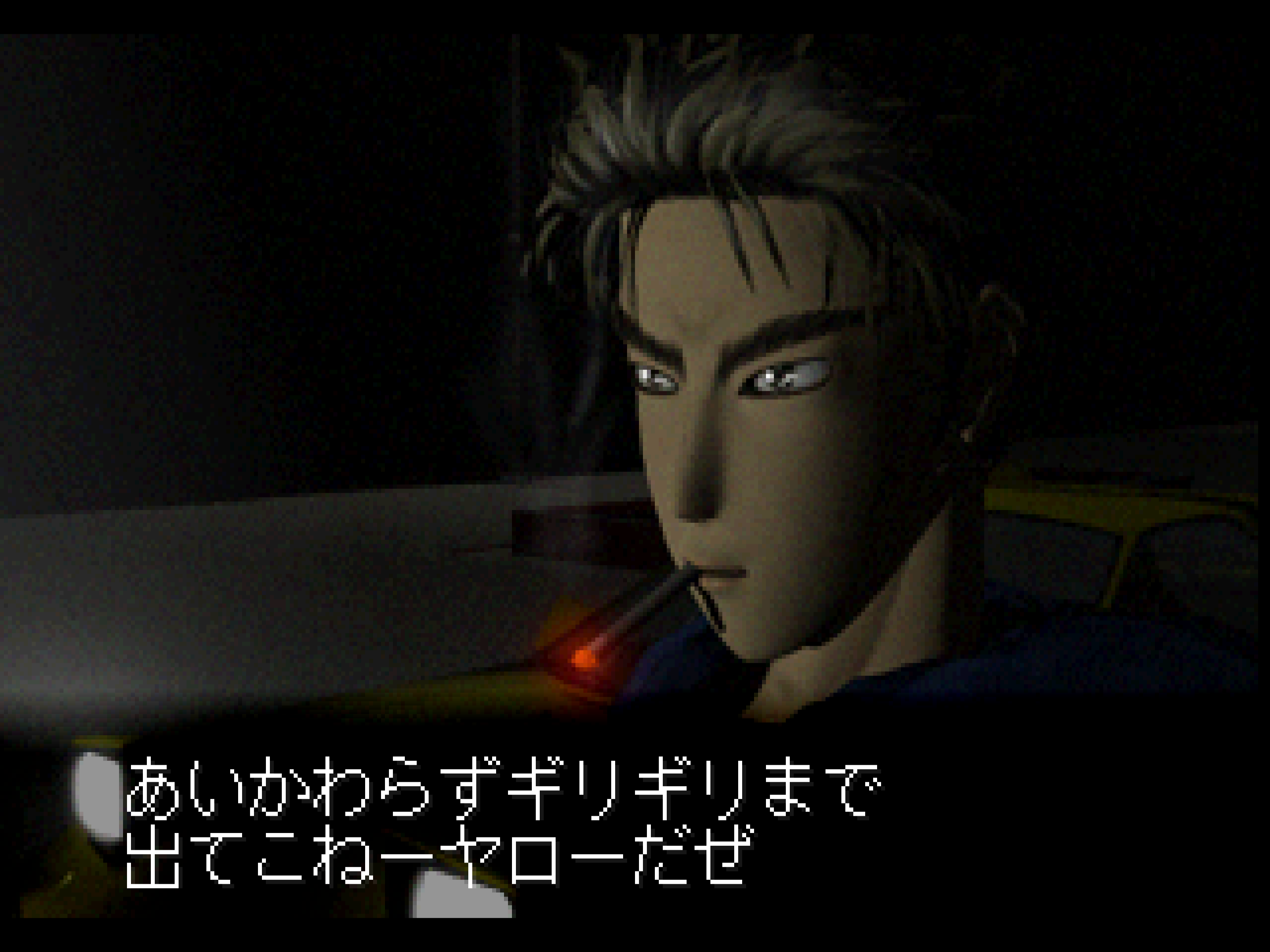
Saturday, 10 PM, Usui Touge. Oh for fucks sake, another “will he or won’t he show up” scene. You know, I do love the amount of smoking in this game; you just don’t see that anymore.

Keisuke looks a bit more…disgusted this time around.

Of course, the irony here is that in the manga, the two times Takumi races Keisuke Takahashi were on Akina. Thankfully for the sake of some gameplay variety, this races takes place at Usui.
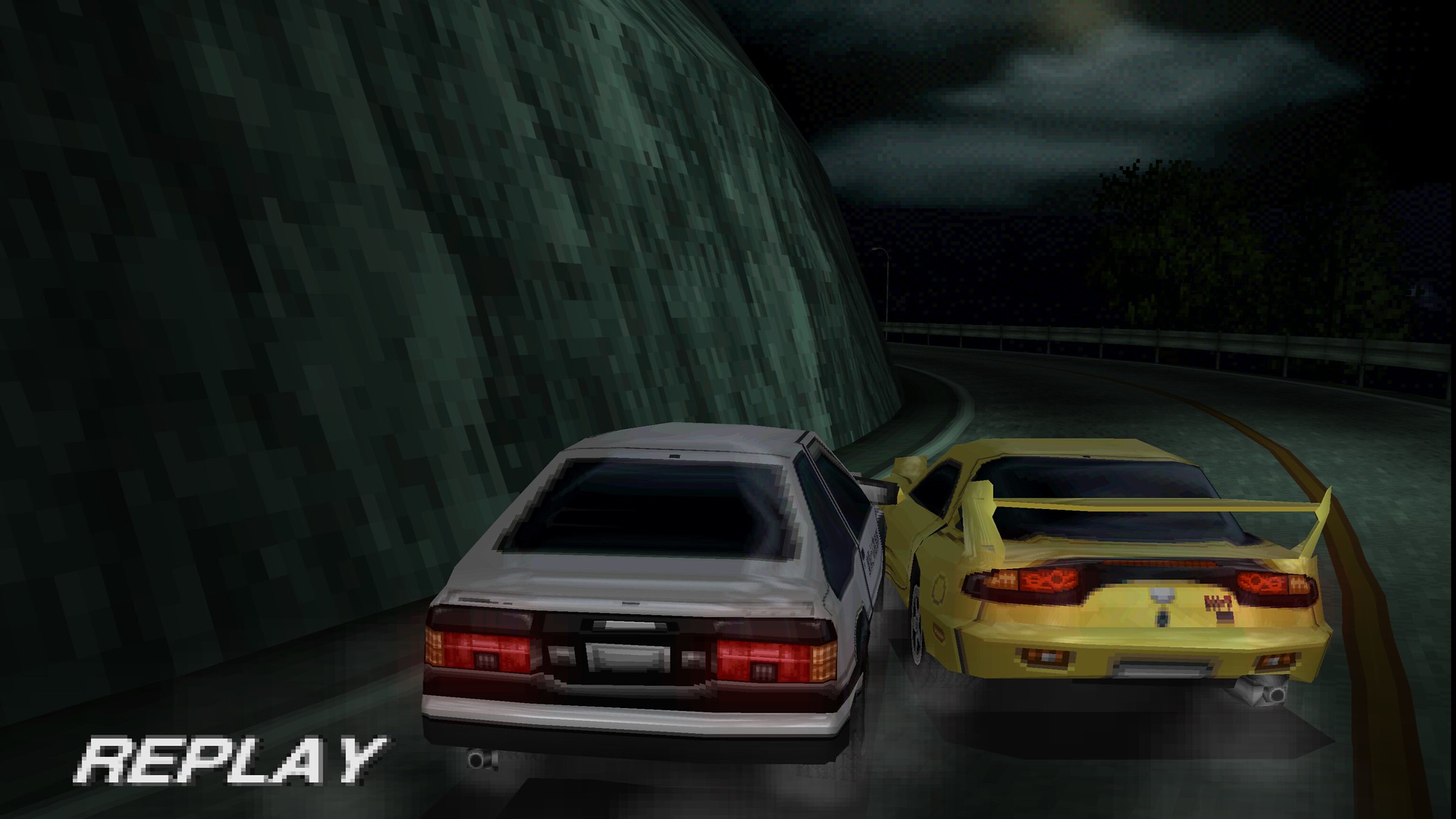
There doesn’t really seem to be any opponent AI; if you go for any gap that exists they will just Senna you into oblivion. As mentioned earlier, the collision physics are pretty good, but since you are sliding through the turns, it’s easy to bonk the inner wall and either spin or just slow way down. Virtually all racing games of this era have an element of high speed “Operation“; keeping it off the barriers is a core gameplay challenge.
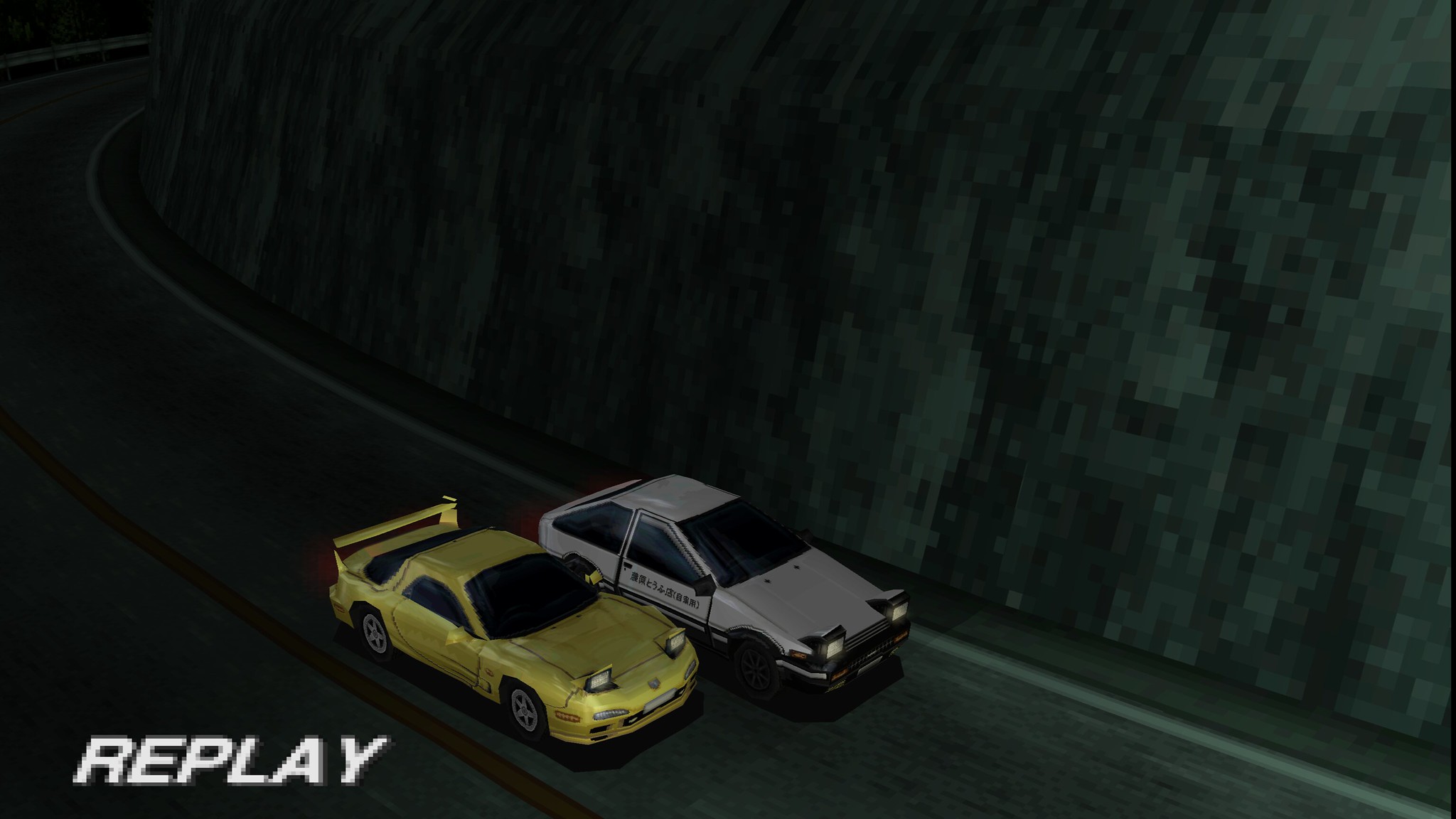
Due to the miracles of emulation, the classic “Fujiwara Tofu Shop” text written on the side of the car is readable even with the car that small in the frame. I always wonder if any of the developers back then had any idea, even imaginary ones, about such a thing being possible.
So the big payoff for this arc: you beat Keisuke Takahashi again, and he becomes yet another driver to lose to Takumi and come to the important realization that it’s not about the car, but about the driver. This is a major theme of this game. Nakazato can’t believe his GT-R lost, but then he realizes that he was the one who lost. Sudou makes fun of Takumi for driving the AE86 because of its age, and suggests that he upgrade to a suitable car. Even Takumi himself is an underdog, being so young and having no “racing” experience.
That’s what I love about Initial D in general though, and what I thought the manga portrayed very well. Ultimately it’s a tale of a pair of underdog heroes–Takumi and the AE86–on an adventure of teaching lessons. Unlike a typical main character, Takumi himself doesn’t change much. His journey is one of gaining strength through discovering ever more powerful opponents; most of the character development is with those characters grappling with first, the existence of Takumi Fujiwara, and second, what it means to lose to–wait, hold on a second. I just got a tap on my shoulder. Why am I going into the end-of-game rant if the game isn’t over yet? Wait, what?
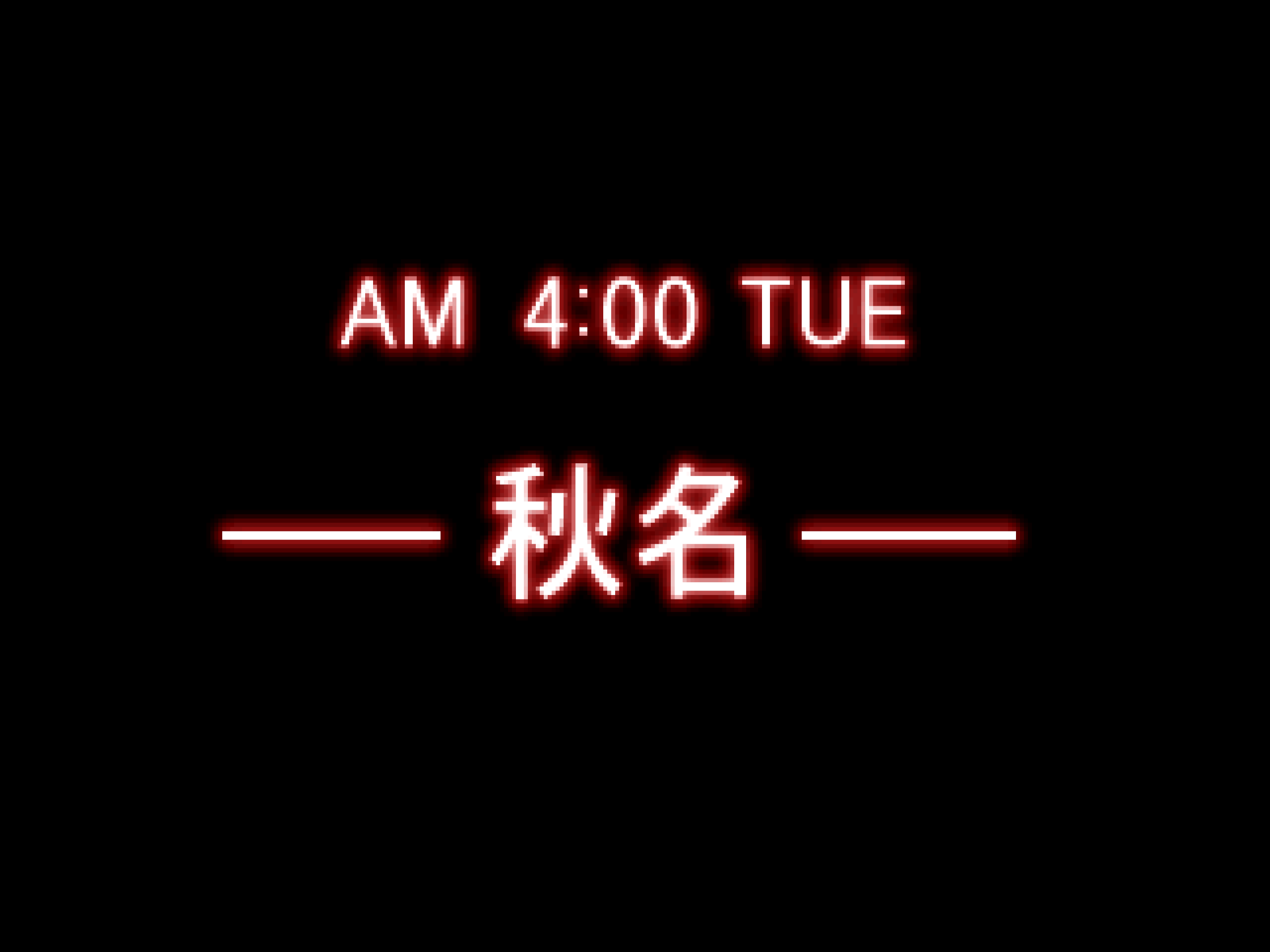
It’s 4 AM on Tuesday again. I suspect this is the exact same title card as earlier. With all the unique loading screens, this is an odd choice. Is there something special about Tuesday mornings?

Ol’ dead-eye Takumi, just zoning out.

Pop-up headlights? Is that..? Okay let’s pull over.
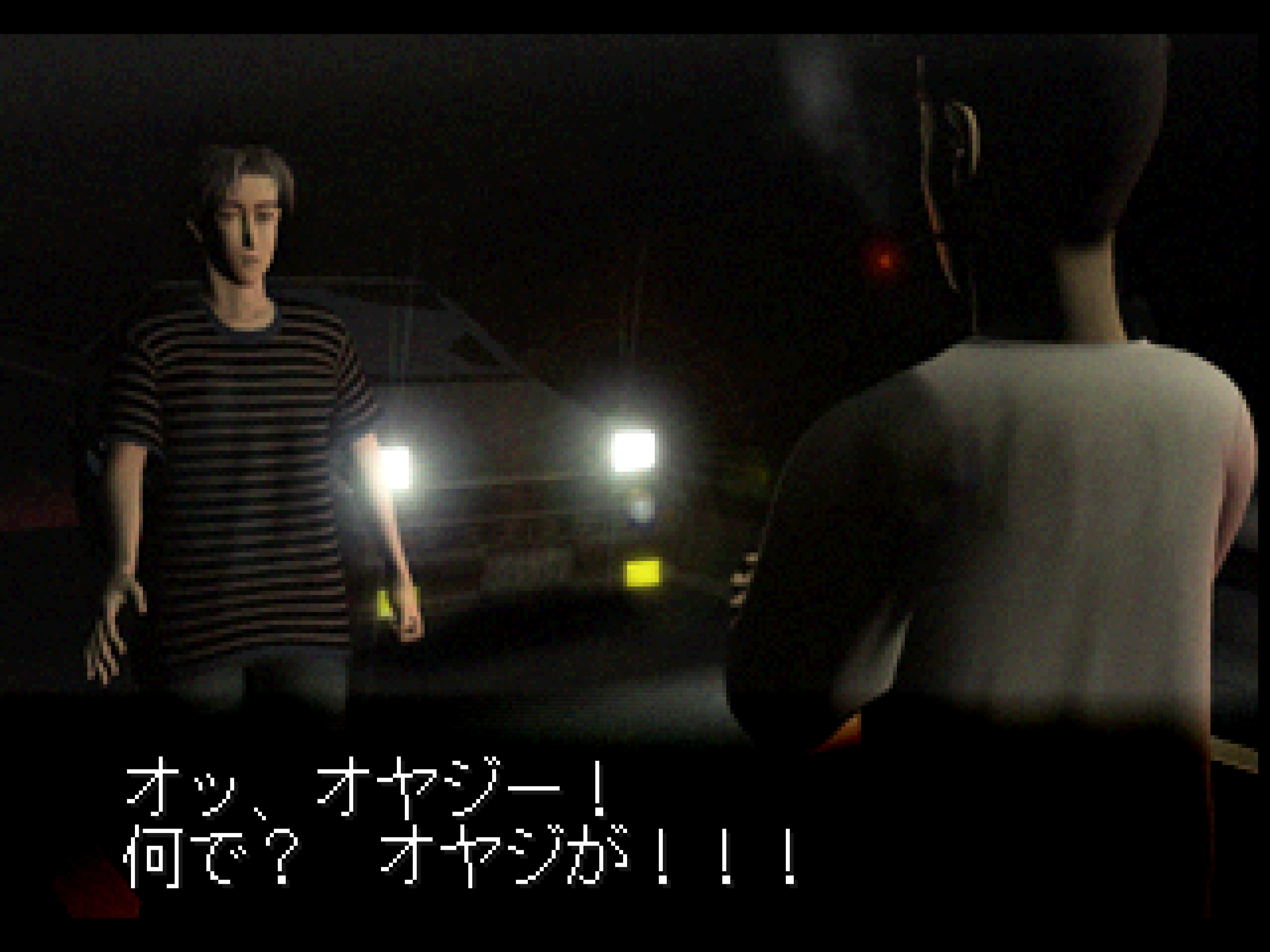
Wait…what?
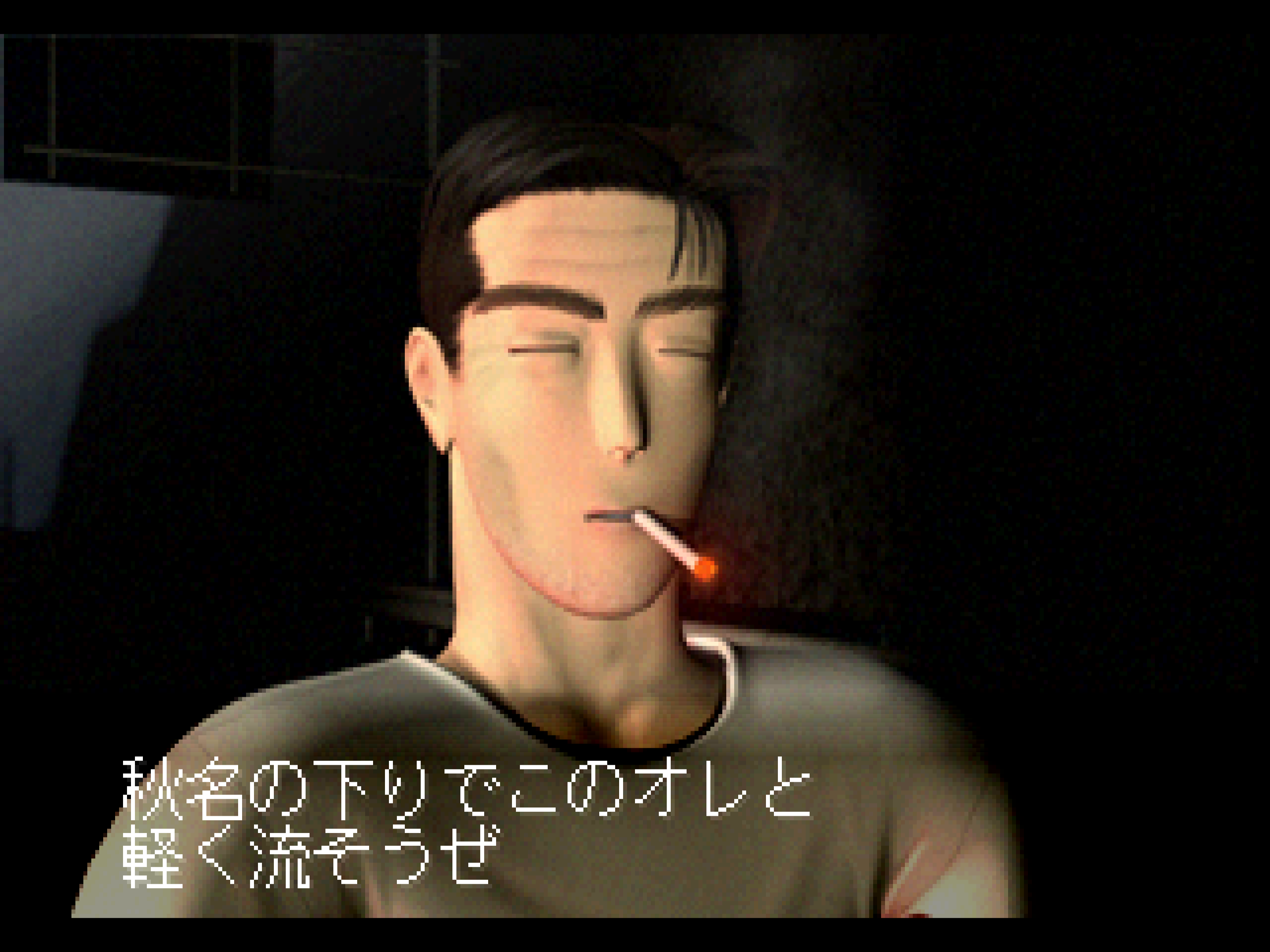
Between the Saturn and Playstation versions, this particular race has the same concept: in another scenario completely unique to these two videogames, Bunta (Takumi’s dad) shows up in another zenki panda Trueno and challenges Takumi to a race. In the Saturn version, he pops up in the AE86 at what looks to be the Mt. Akina parking area and challenges Takumi in front of the whole crew. In the Playstation version, he intercepts Takumi while driving at 4 AM and it’s just the two of them.

Did Bunta buy another identical AE86 for tofu delivery? Why did he chase down Takumi when they both live under the same roof? He could have just asked Takumi to race before he went out. And what’s the deal with how Bunta never opens his eyes, anyway?
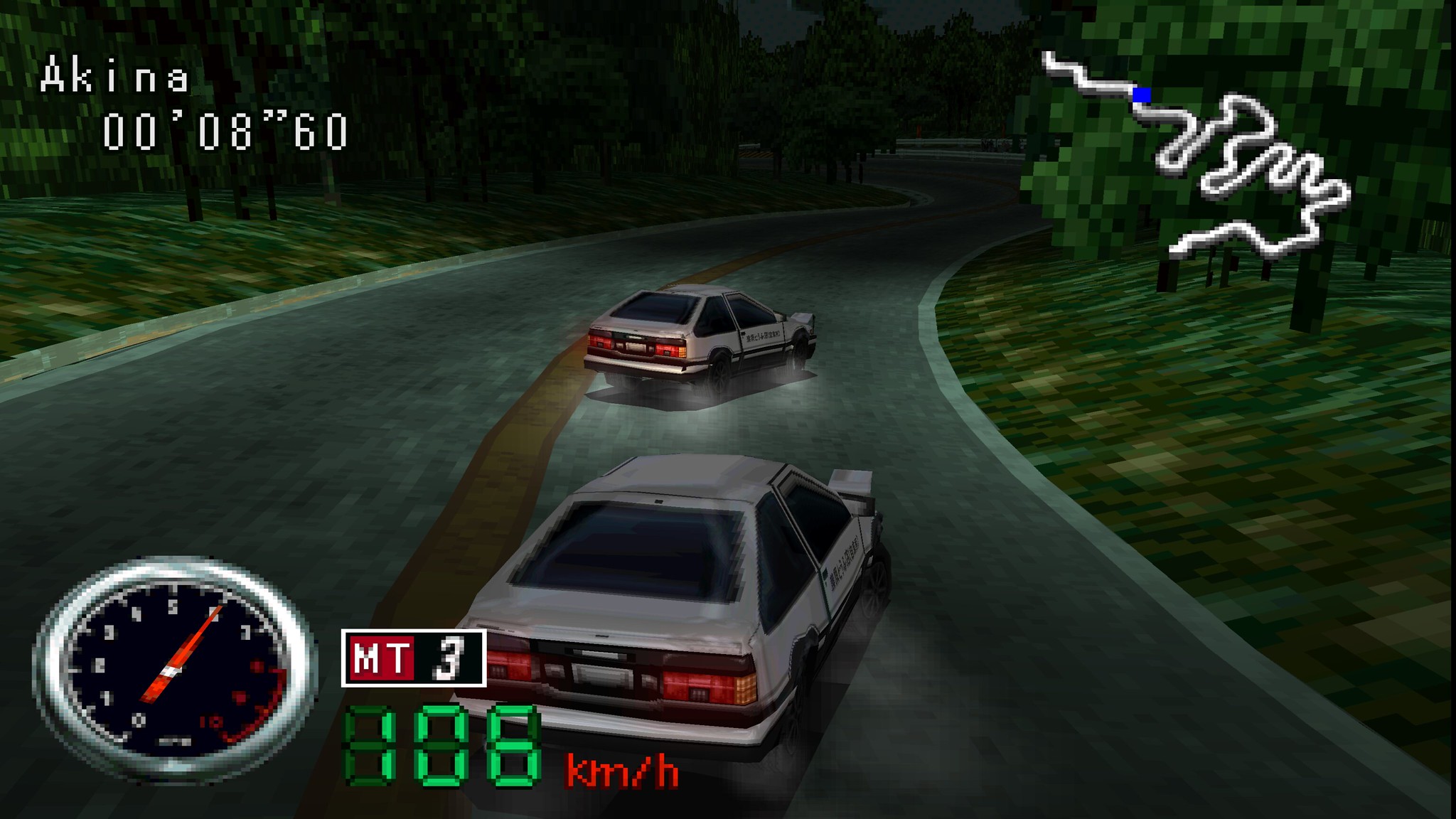
Just doing some tandem drifts with my dad on Mt. Akina, no big deal.

Before a race starts, you can rev your engine and the game automatically dumps the clutch and removes the brakes when the lights turn green. There’s actually some precision involved in getting a good launch; too low on the revs and you bog down, too high and you just spin tires. There’s a pretty good butter zone where you accelerate nicely, and if you get it just right like I did in this screenshot you can actually beat your opponent off the line.

It’s not just to the apex; your opponents will slam into you at track-out too. I really think the opponent AI doesn’t consider the player’s position at all.
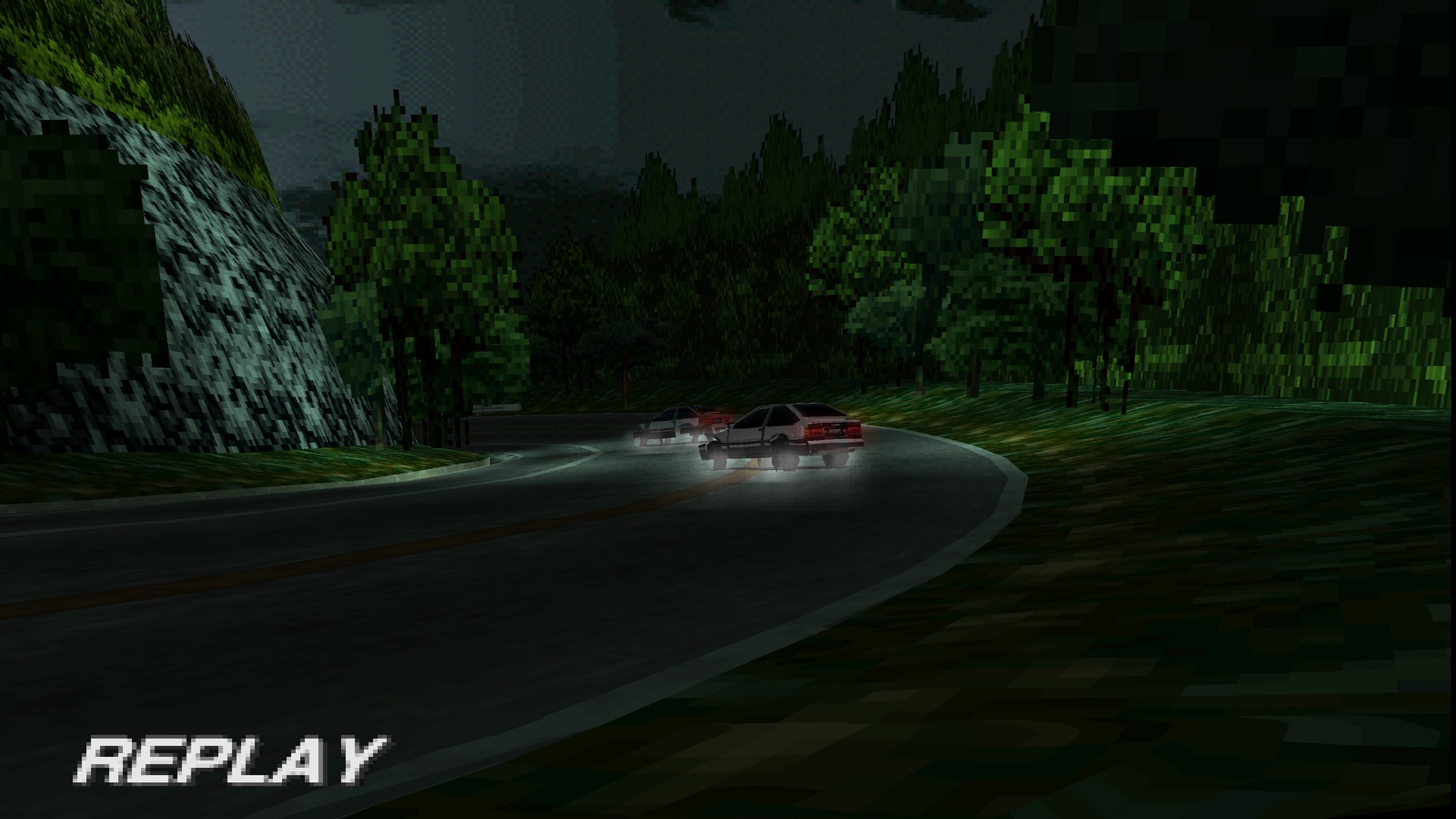
One game I will certainly write about is Gran Turismo 2. Among many other reasons, it has probably the coolest list of cheats of any Playstation game. One of them is the elimination of LOD’s, so it shows the full resolution car models at any distance. I completely understand why they exist, I’m just a little bummed that these cool wide angles from the replay are a bit ruined by them.
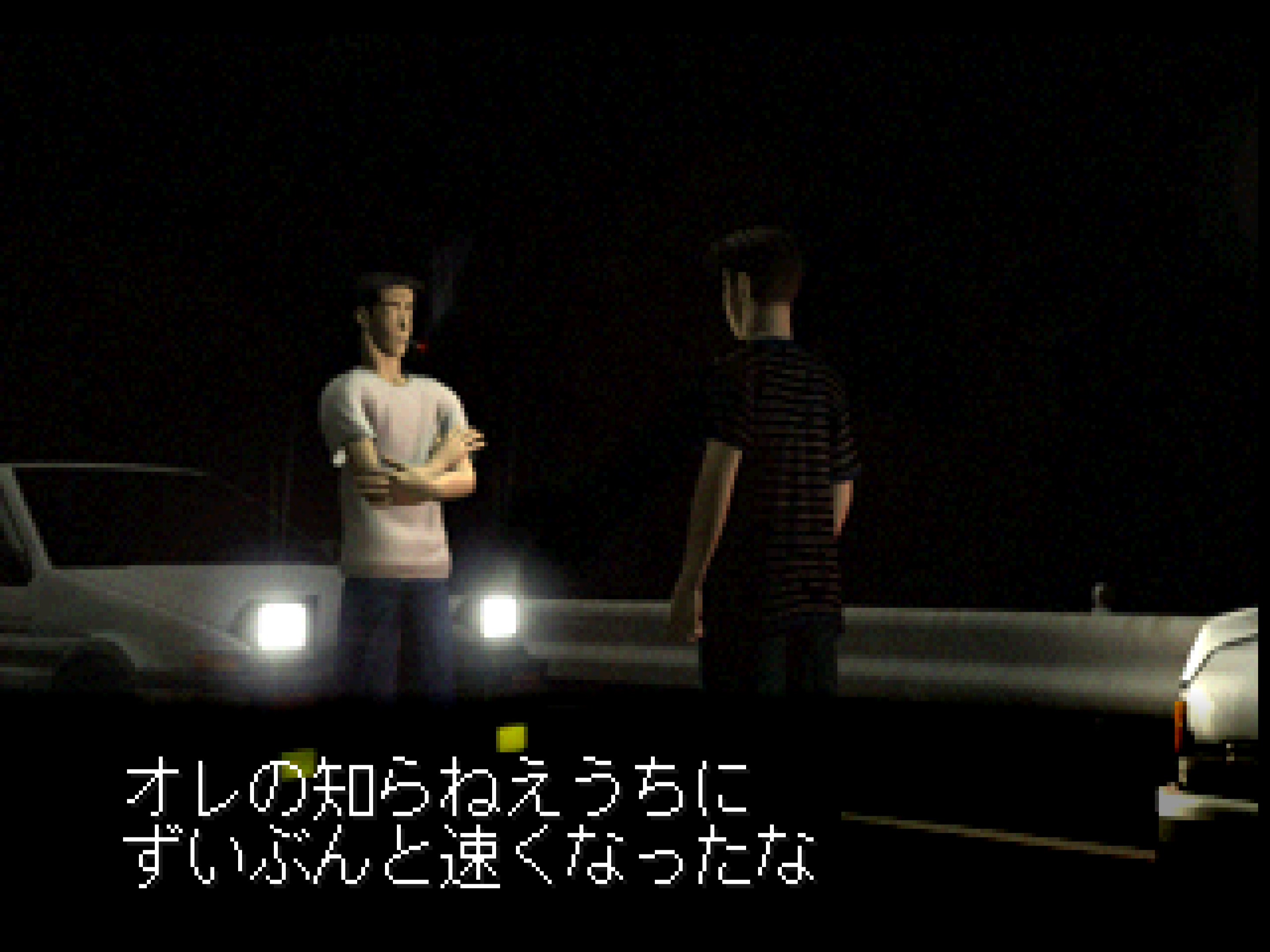
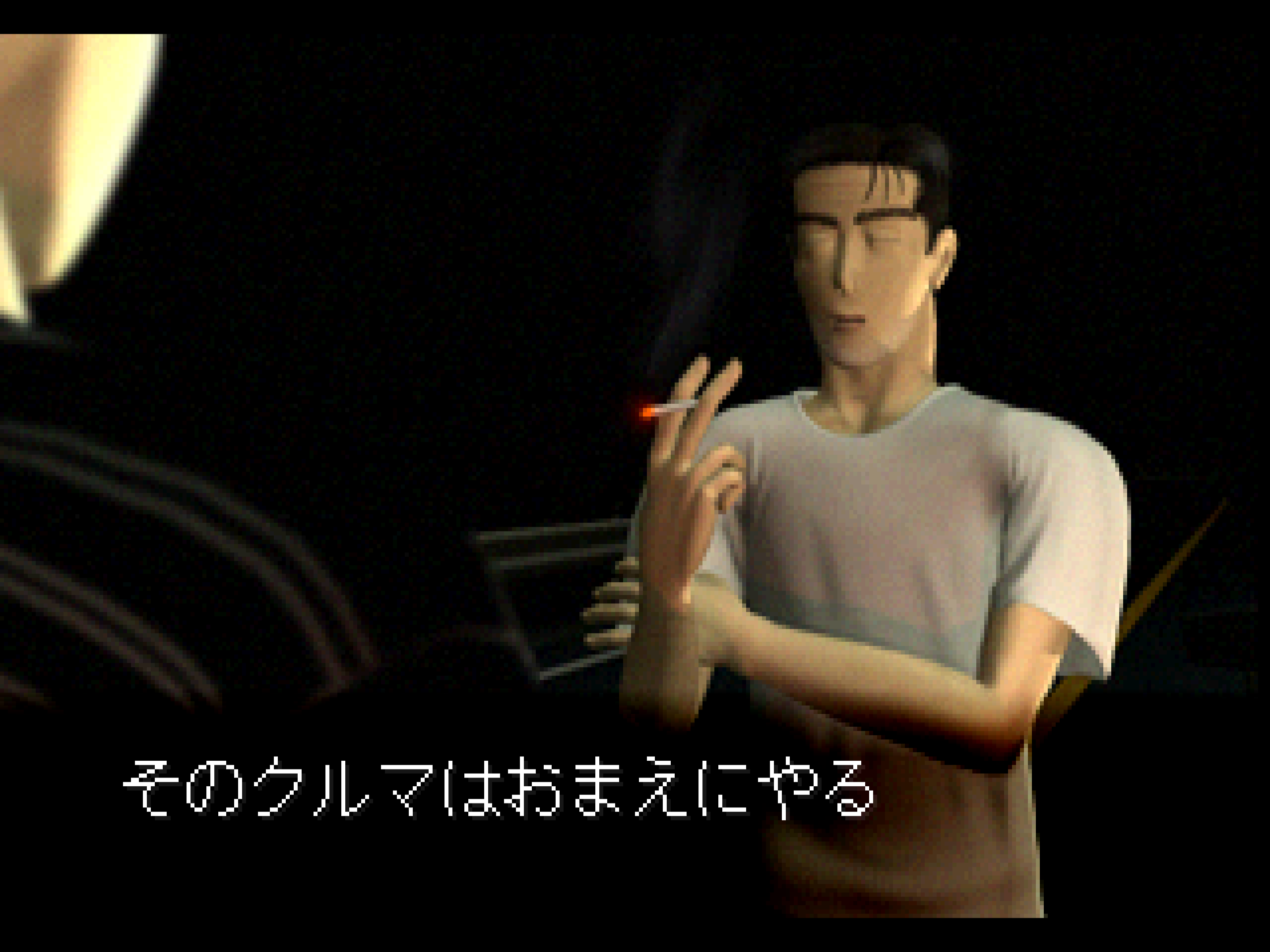
In the manga, Takumi blows the AE86’s engine while battling Sudo in the Evo, so Bunta has a racing-spec 4AGE installed in the car. At that point, Bunta reckons that the money he spent on the AE86 came from Takumi working as their store’s delivery driver, so he splits ownership 50/50. In the game, he just gives him the car. Maybe he doesn’t care since he already has another AE86!

Then the credits roll, and the first person credited is Shuichi Shigeno, appropriately.

But when the credits end, this pops up…
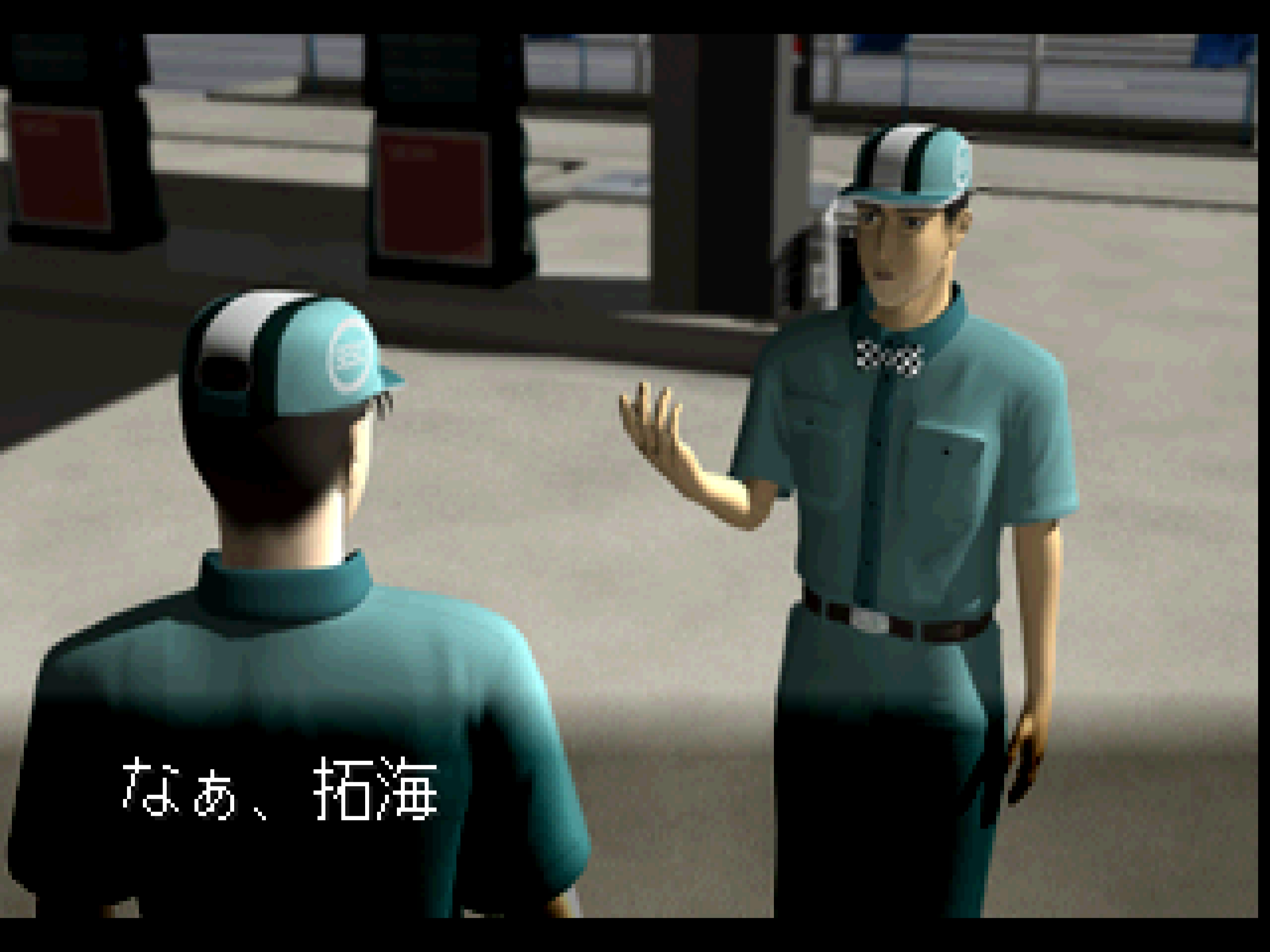
At work, Iketani comes up to Takumi and suggests they race each other, because Iketani is still the leader of the Akina Speed Stars after all.

Back to Akina again, nothing particularly special there. Iketani is pretty slow in general, so by this point in the game there should be nothing stopping you from beating him in one attempt.
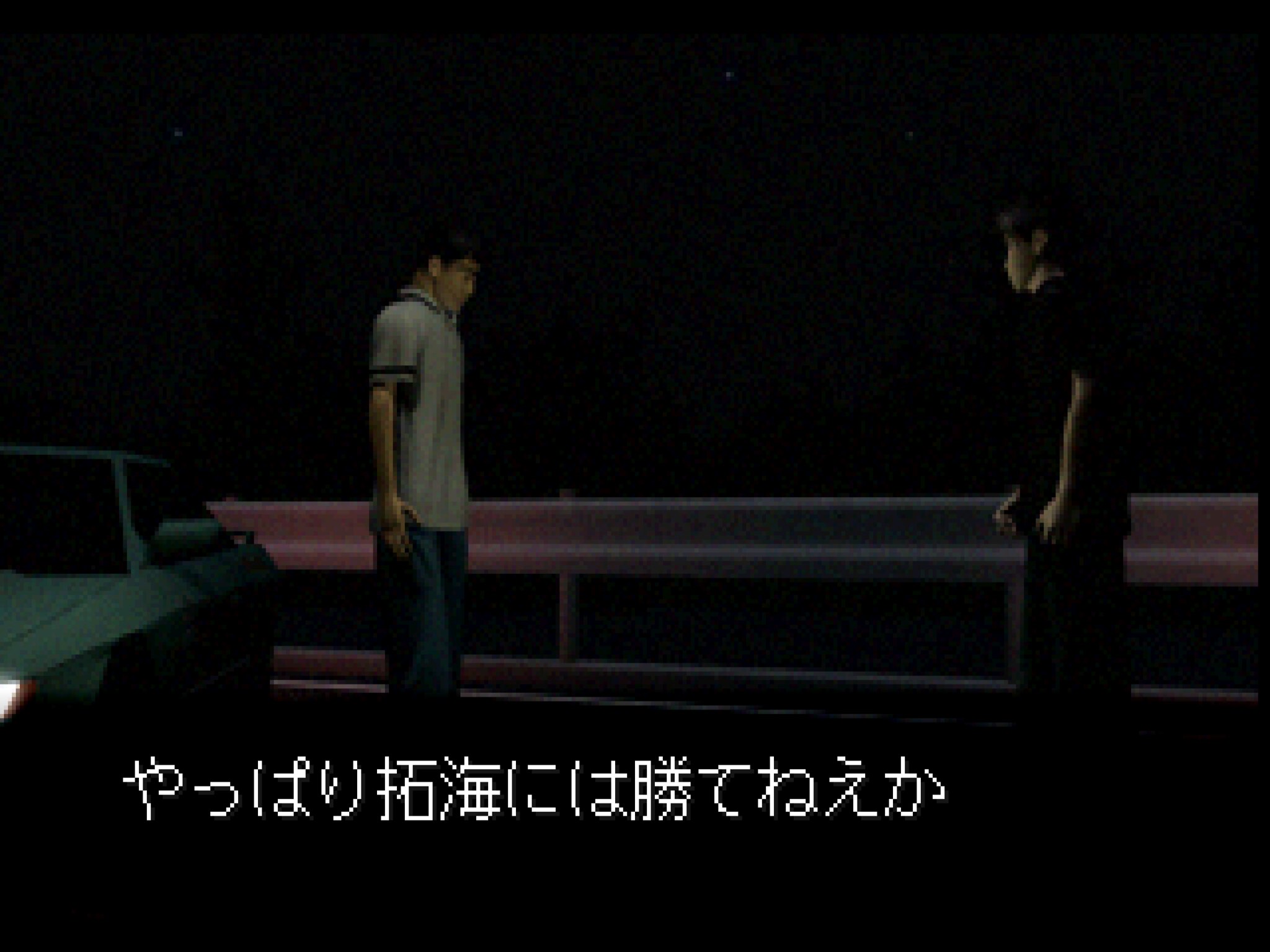
This is an odd scenario. Not only is Iketani slow, but he’s had a front row seat watching his friend Takumi destroy every driver he’s faced. Did he really think he had any hope to beat Takumi on the Akina downhill? Is he blinded by overwhelming confidence, or the Dunning-Kruger effect? That’s another theme of Initial D, where the opposing racers vastly overestimate their own skills due to their ignorance.

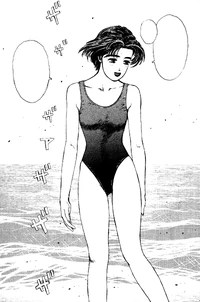
Ahh finally, we get to see Natsuki Mogi in a swimsuit, as she promised at the beginning of the game. This scene is actually lifted directly from the manga:

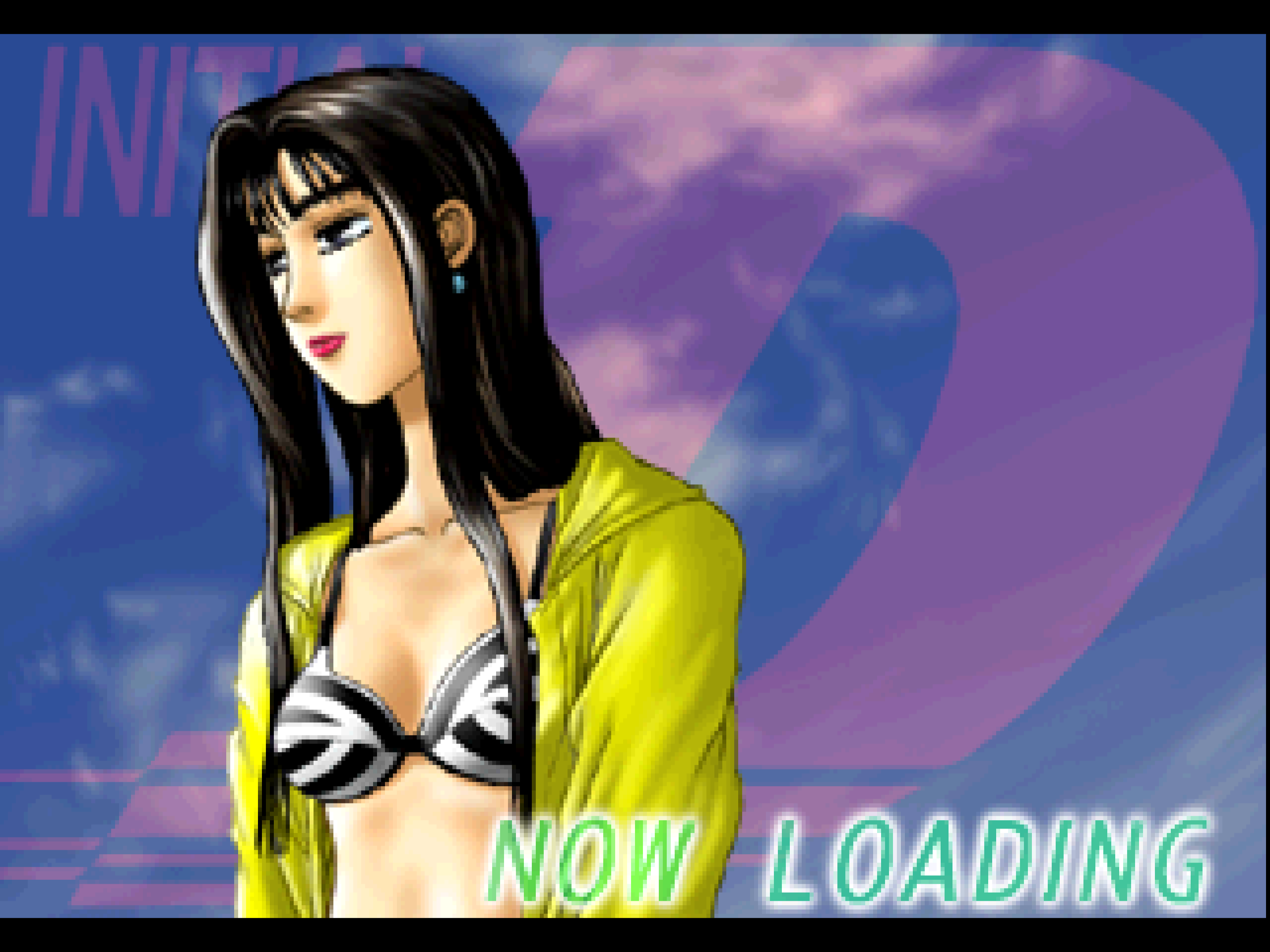
Some of the loading screens are pretty funny…

…and some feature fan service.


Playstation supported up to 660 megabyte CD’s, but had only 2 MB of RAM and 1 MB of VRAM! So you spend a lot of time looking at loading screens while the double speed CD drive does its job. Luckily, via emulator some games can have their CD access sped-up to shorten the wait; I played this whole game with “Read Speedup” and “Seek Speedup” both set to Maximum (which is the safest setting after “None”; crashes are more likely by picking a different multiplier because Maximum waits for the previous action to finish before moving on, whereas the multipliers always act at a multiple of the stock rate).

There are some other things to do in this game. The oddly-named “Practice” mode is actually three levels of three challenges that ramp up in difficulty. You start off with single corners, then move on to larger parts of the track, until the very last mission which is the full Akina Downhill course.
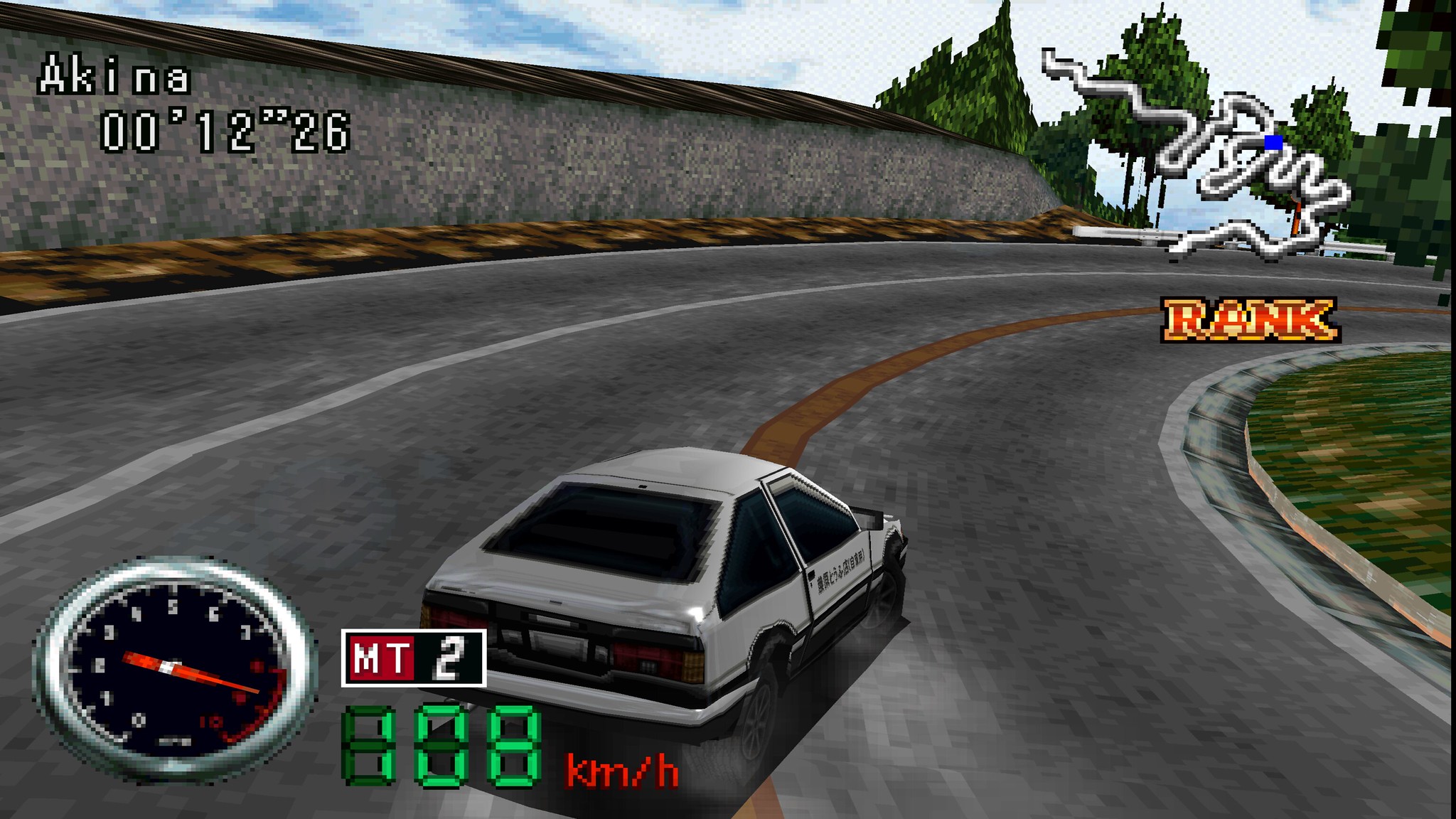
Akina in the sunshine! This part of the game takes place during the day, so you get blue skies and harsh shadows (on your car anyway).

There’s even a little lens flare action going on.

Normally I’m pretty fastidious about doing the “training” or whatever mode before playing any racing. I’ve always loved how you have to get your licenses in Gran Turismo. But I’m really glad for this game that I just jumped right into the story mode instead of going here first. All nine missions are in the exact same location: Akina. Most of the missions in the story mode? Akina. And you only drive the AE86 in all of those. Since I had already done the whole game before this, it was pretty easy to breeze through Practice mode.
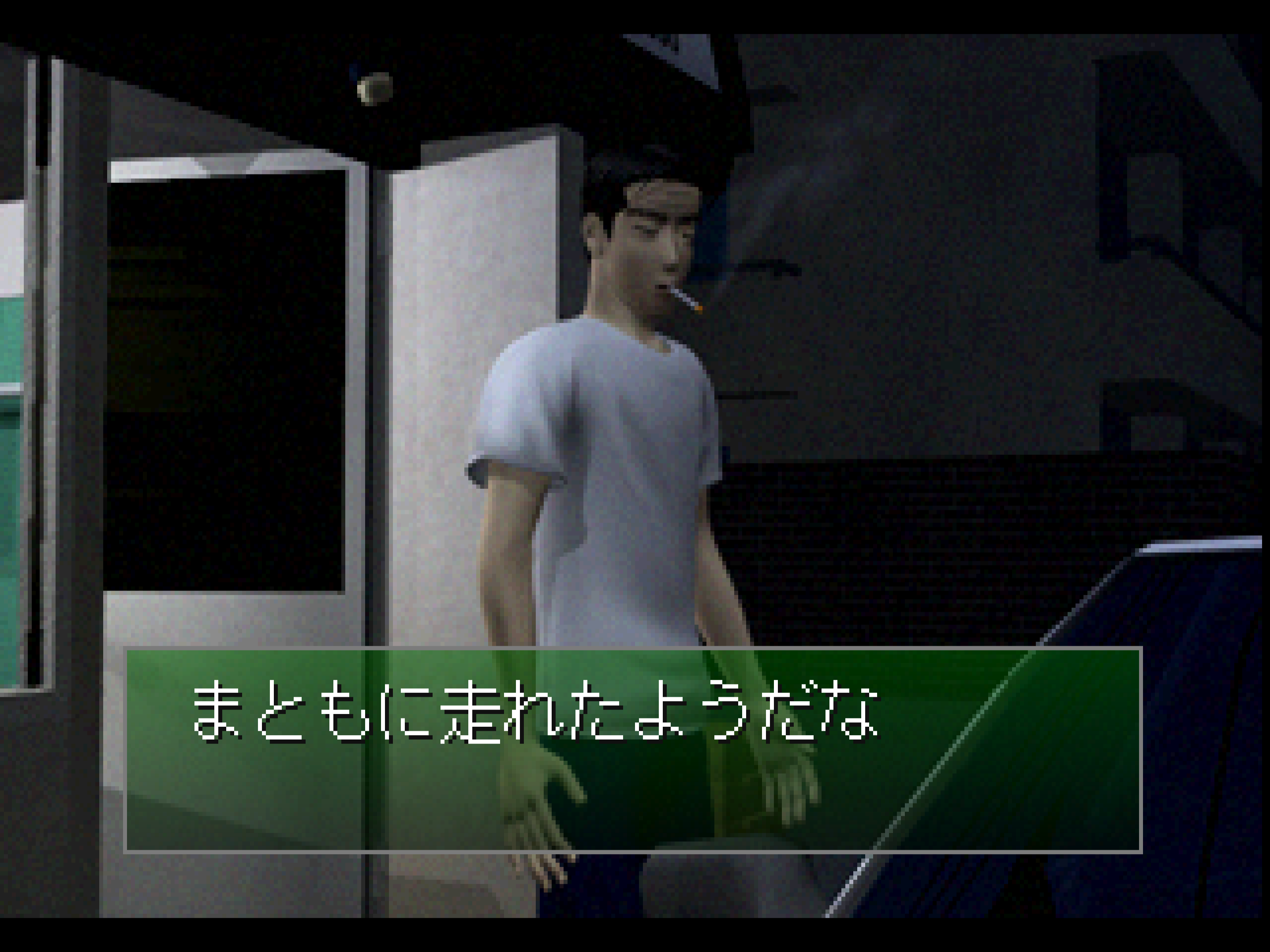
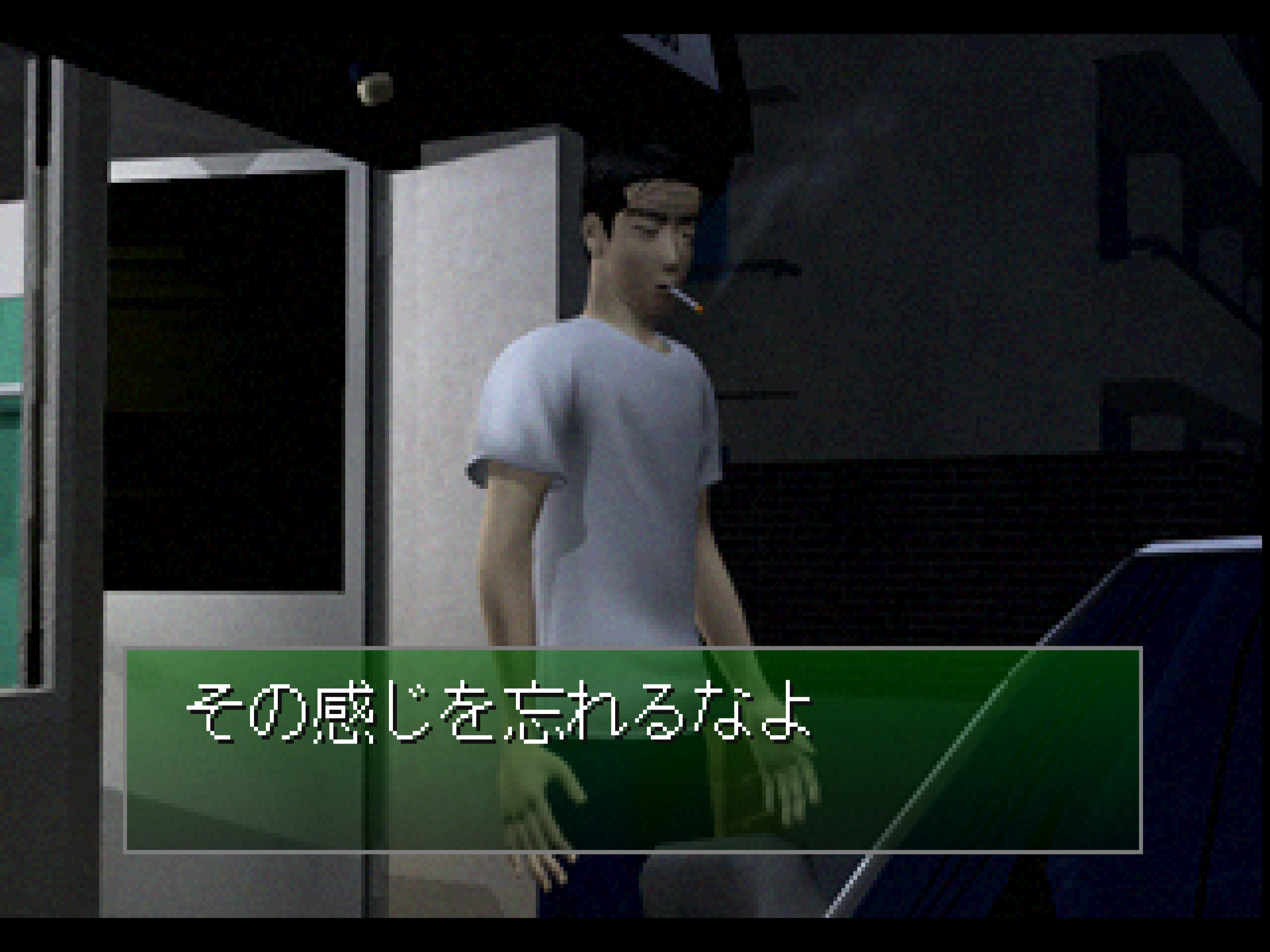
Bunta always has a comment or two after the missions. Getting an S rank brings out the old man’s pride.

The next mode is Free Running, which has a sub-mode called D-Check.
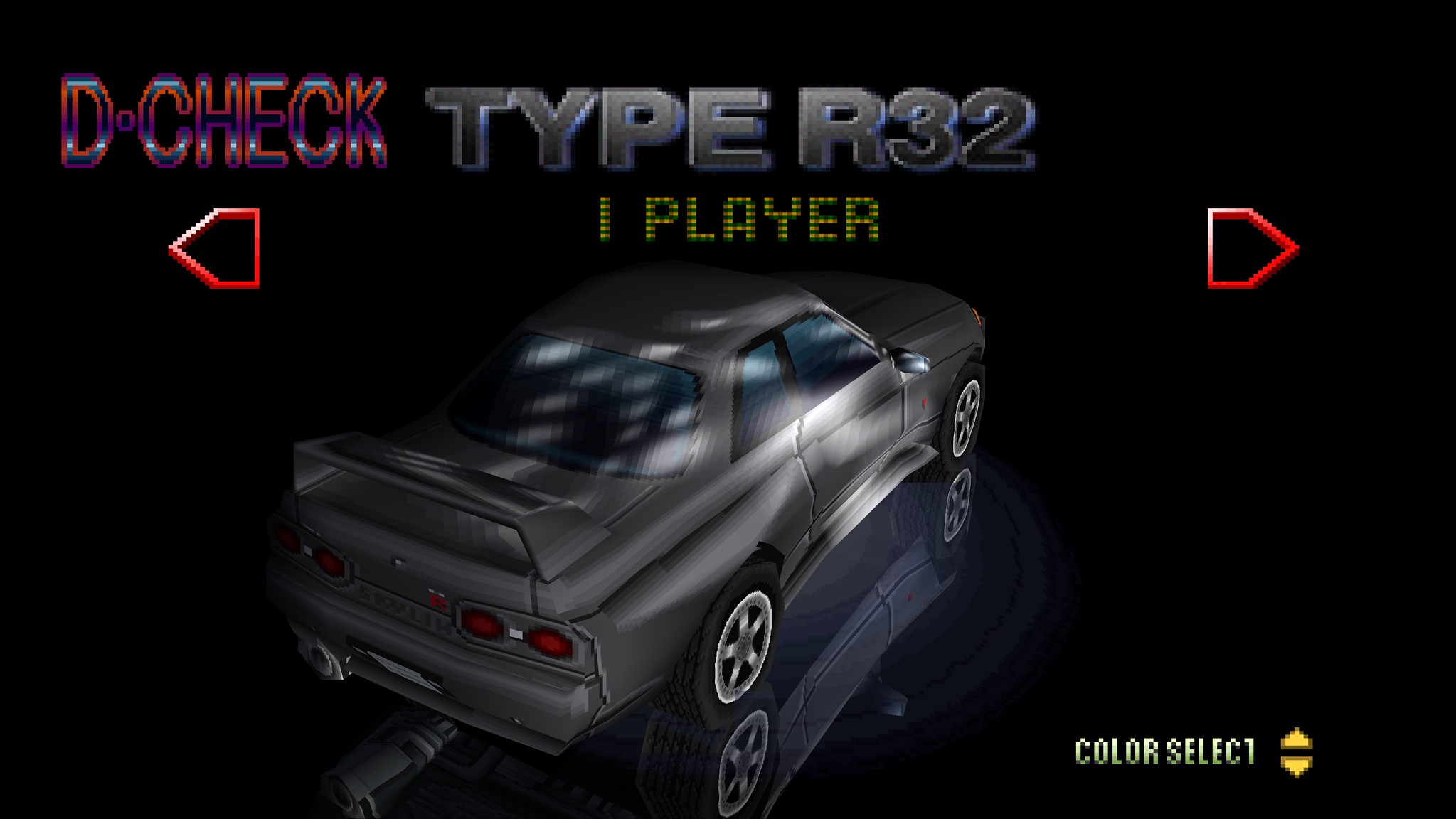
This is where you can play the other cars you’ve unlocked by doing various things in the game, like finishing Story Mode.

Unfortunately, here you can really see that the model accuracy is not quite Gran Turismo level. It’s still fun to play with different colors though.
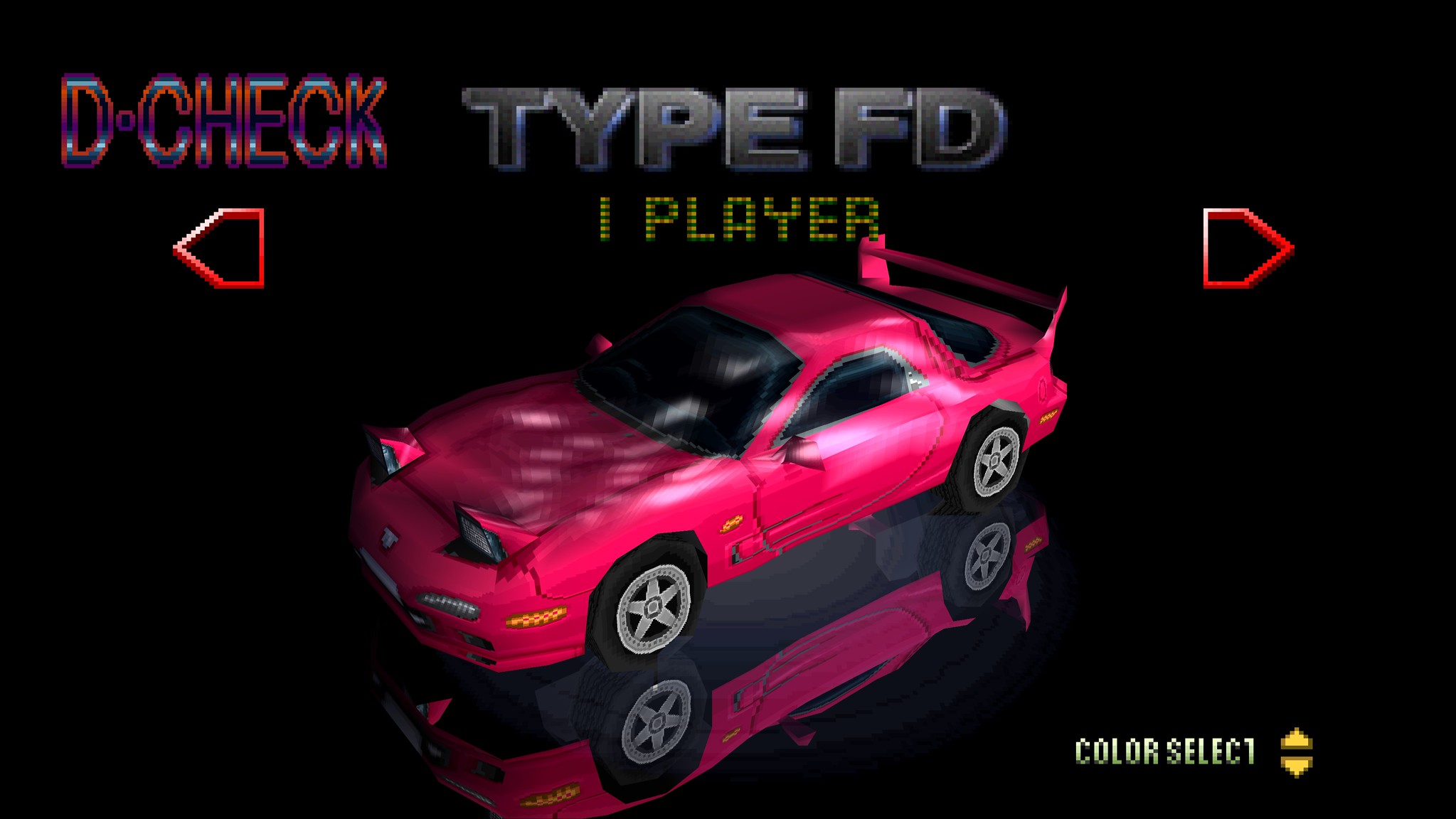
Wow this kind of Ruby Star looking color looks great on the FD. I’m going with this.

And we’re back at Akina, of course.
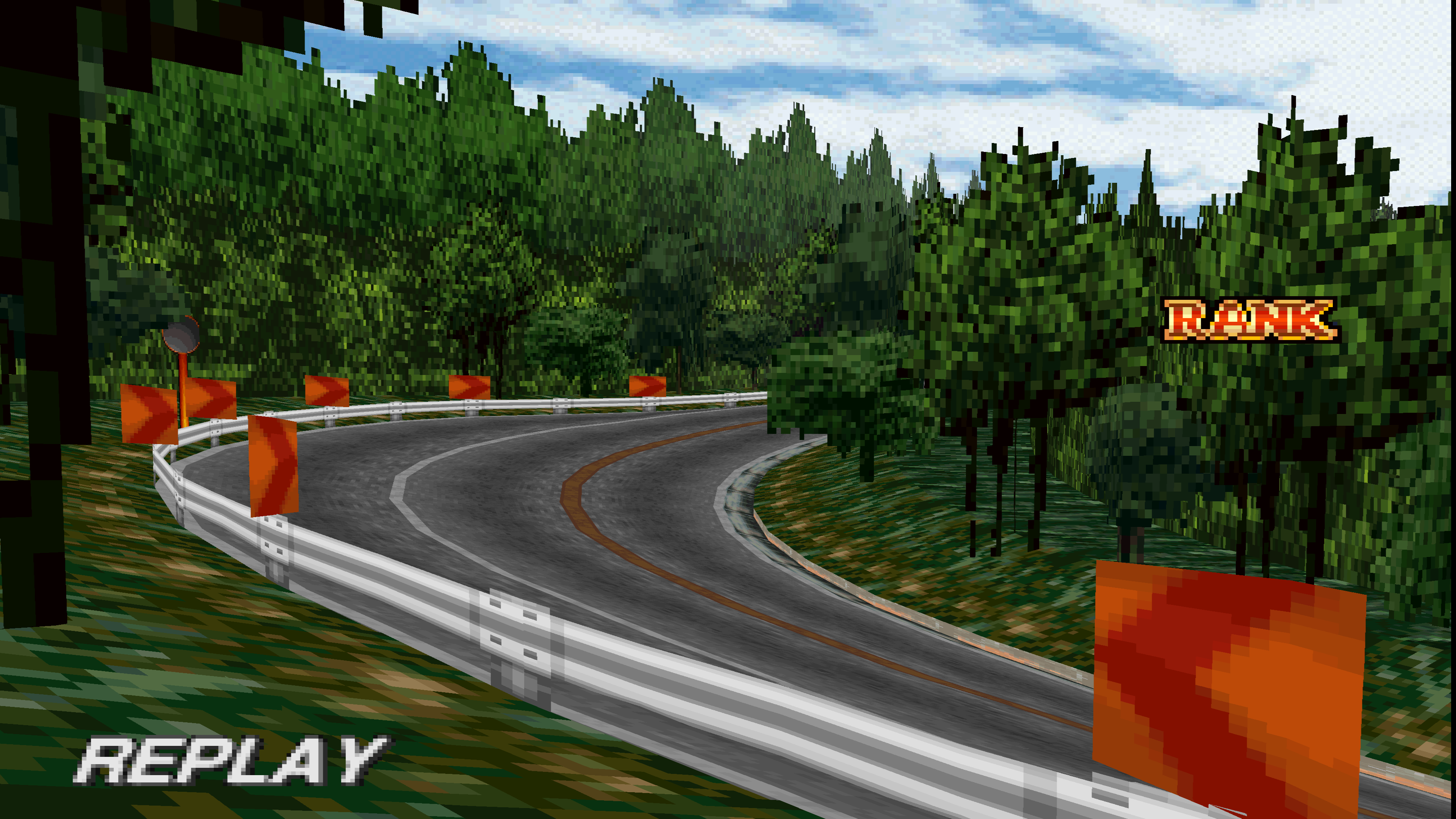
Even though you spend so much of the game time on Akina, and replays roll automatically when you cross the finish line, camera angles are sparse. In addition, sometimes you are left with no action as the camera angle changes well before or after you arrive.

It seems to actually be possible to do the gutter hook trick, with the car definitely rotating more when you get it jacked up on the gutter like this.

The saving grace for this game is the drifting. Most racing games break down when you go outside the bounds of intended behavior, and drifting is the clearest example: once you exceed the limits of grip, few games let you slide around and explore that area. With Initial D, that’s where the gameplay lives. And what happens if you exceed those limits? In the above screenshot I threw it in way too fast, with huge angle–and it behaved roughly like it should have. I scrubbed off speed with the gratuitous angle, then was able to power out of the turn while drifting.

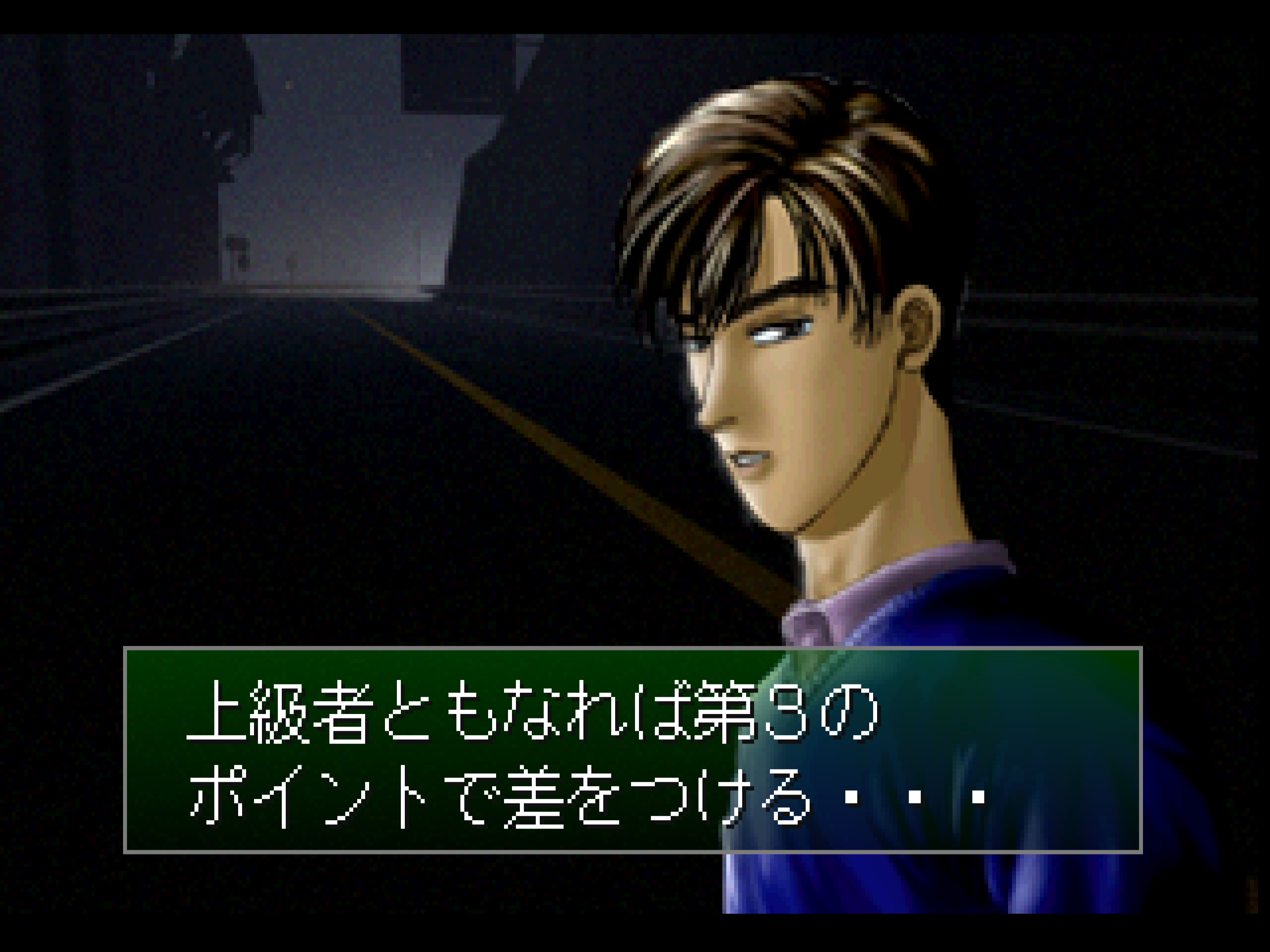

Uhh, no I don’t really understand what you’re saying, Ryousuke. I had to look up the phrase 第3ポイント, which means “The Third Point”, to see if it had any significance. To my surprise, all of the results on Google are talking about this dialog from Initial D! It seems like this is one of those mysterious, classic lines that’s been sparking debate for decades. According to multiple Japanese sources, the original quote is actually 「ストレートで速い走り屋は初心者。コーナーを極めて中級。上級者ともなれば、ストレートでもコーナーでもない、第3のポイントで差をつける。そのポイントを極めることこそが、オレの最速理論のメインテーマだ」 which is mostly the same, but adds more nuance. I would translate it as, “A driver who’s fast on the straights is a novice. Cornering is decidedly mid-level. To reach the advanced level, it’s not about the corners or the straights, but about telling the difference with The Third Point. It is precisely the reaching of that limit of that point which is the main theme of my theory of speed.”
There’s a Japanese blog with some interesting theories; it makes me feel better for being confused, because for their theory on the meaning of “The Third Point”, they throw out everything from the laws of physics to the philosophical meaning of driving on public roads. I’m also a bit hung up on the expression 差をつける which has a couple of different meanings; “to establish a lead” (like a detective, I think) or “to distinguish between.” Personally, I feel Ryousuke is talking about “glue”; it’s easy to go fast on straights and a little harder to go fast in the turns, but to be a high level driver you need to put everything together. “The Third Point” is the transition between straights and corners, and maximizing that is what Ryousuke theorizes is the key to speed. What do you think?
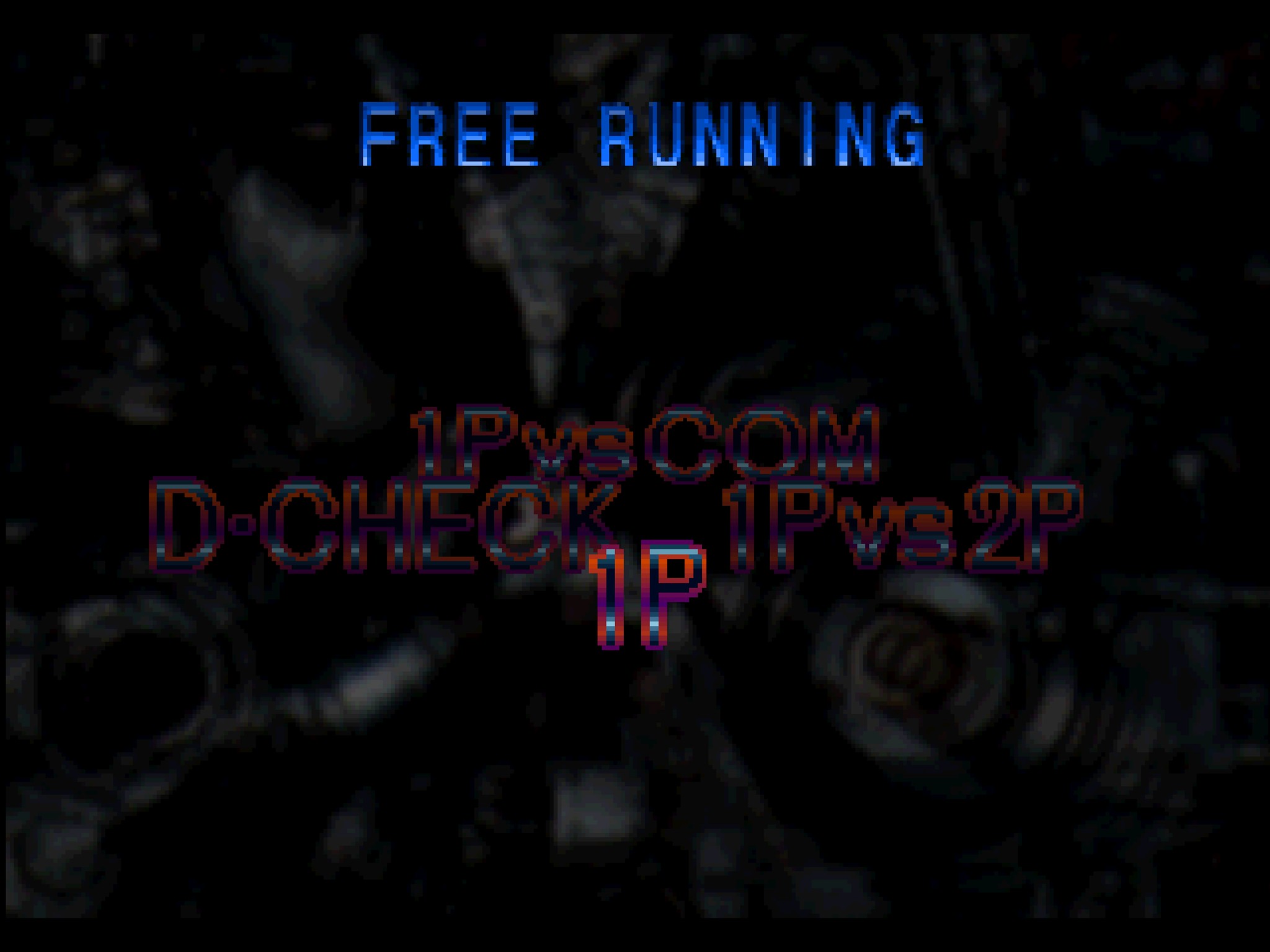
There are also some free modes where you can either do a race (against COM or a real-life friend) or time trial.

You can choose the “official” version of each car, denoted when the character portrait is shown.
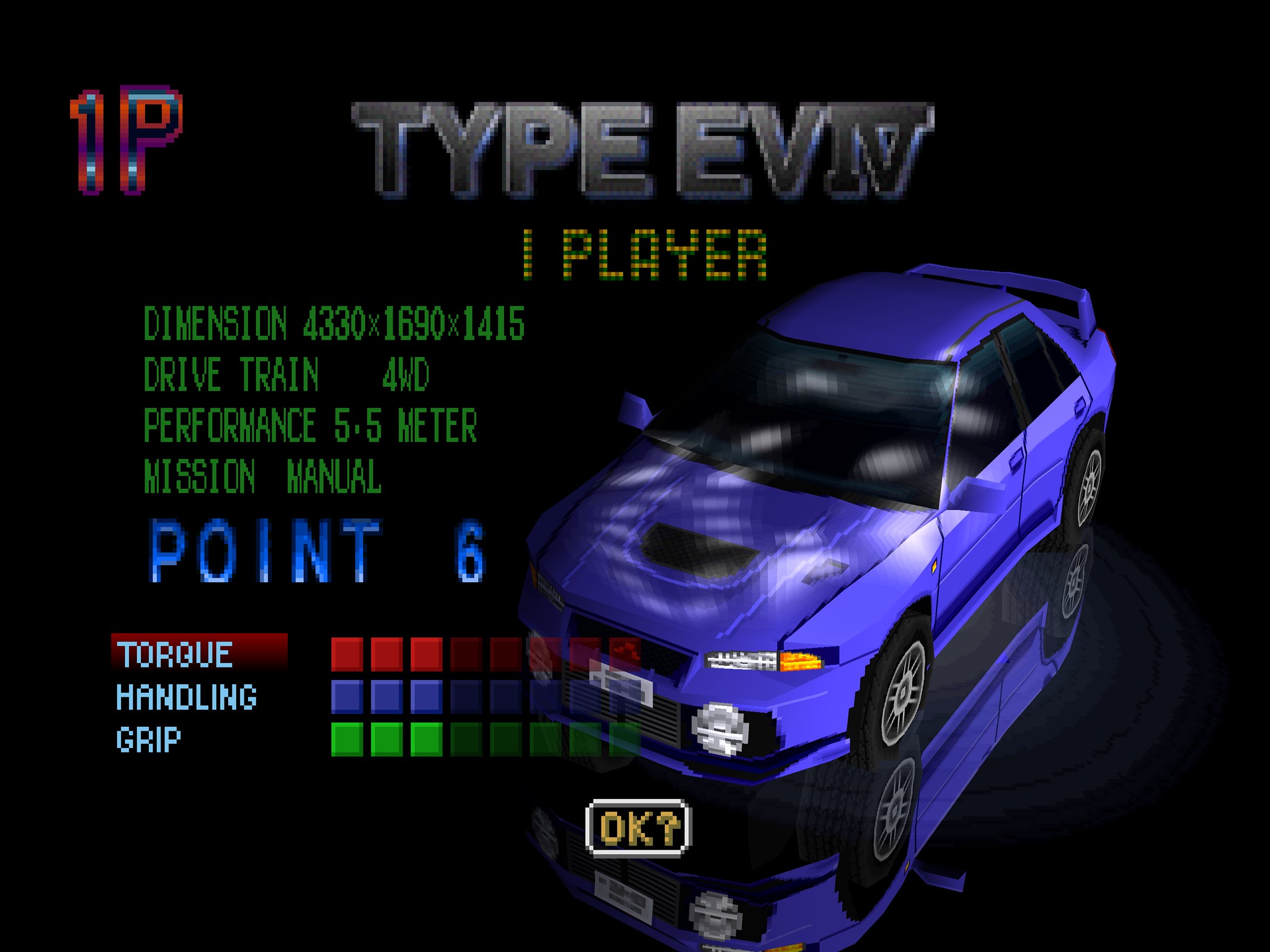
Or, you can change the color. After that, you get 6 additional stat points to use on top of the 9 defaults.

Finishing each level of Practice mode gets you an additional track, making a total of three extra tracks. Well, it’s like Ridge Racer where it’s actually one location, but with different routes to make up different courses (and the third one is run the opposite direction).

It’s an interesting course that gives off some European Alps vibes.
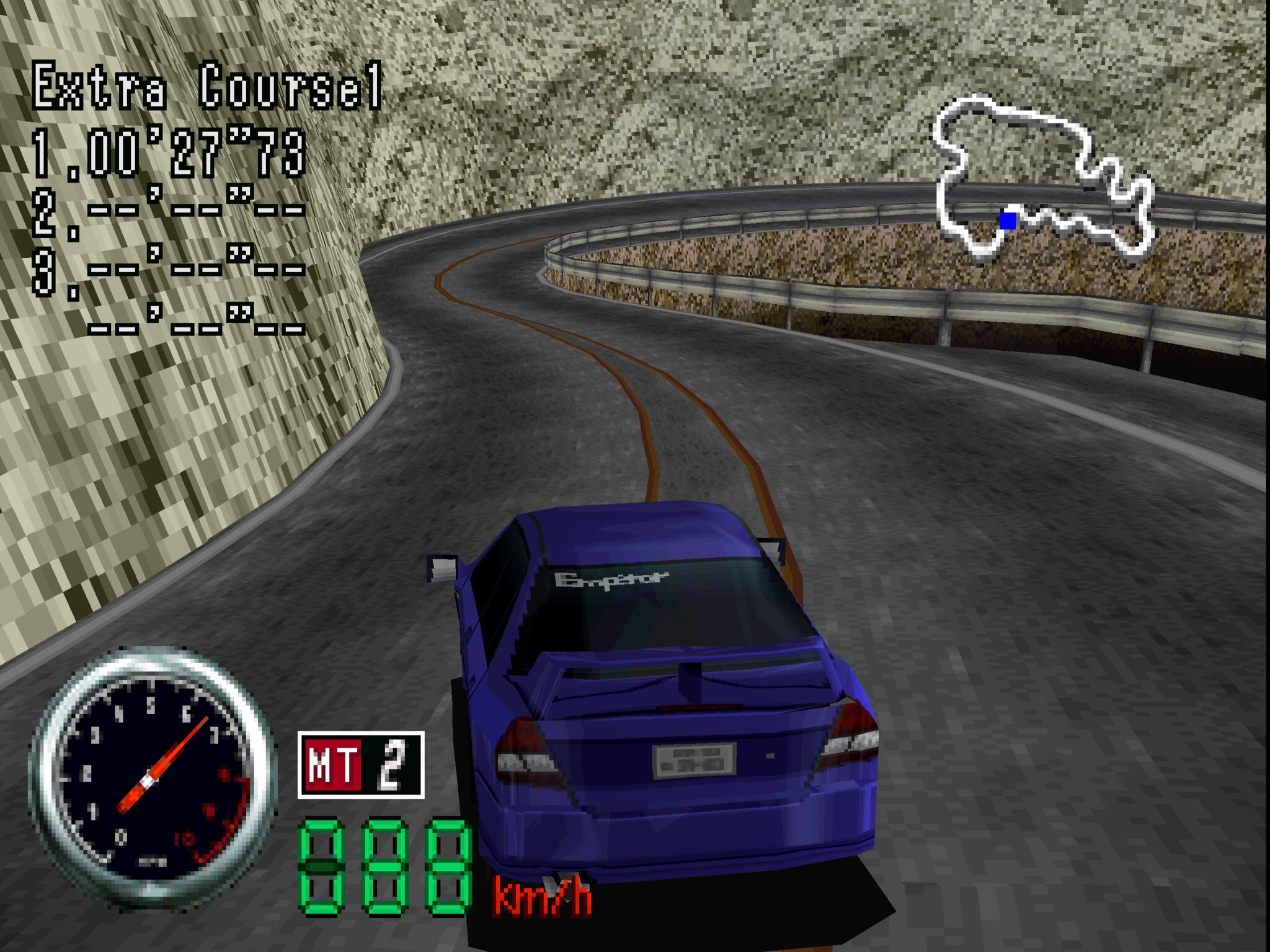
Lots of cool elevation changes.

No darkness to hide behind here, and the draw distance is actually pretty good. I love seeing a road unfold in front of you like that.

While this is a cool track, the replay angles are rough. The track was cleverly designed with tunnels and walls to block your view, so they didn’t have to render too much background.
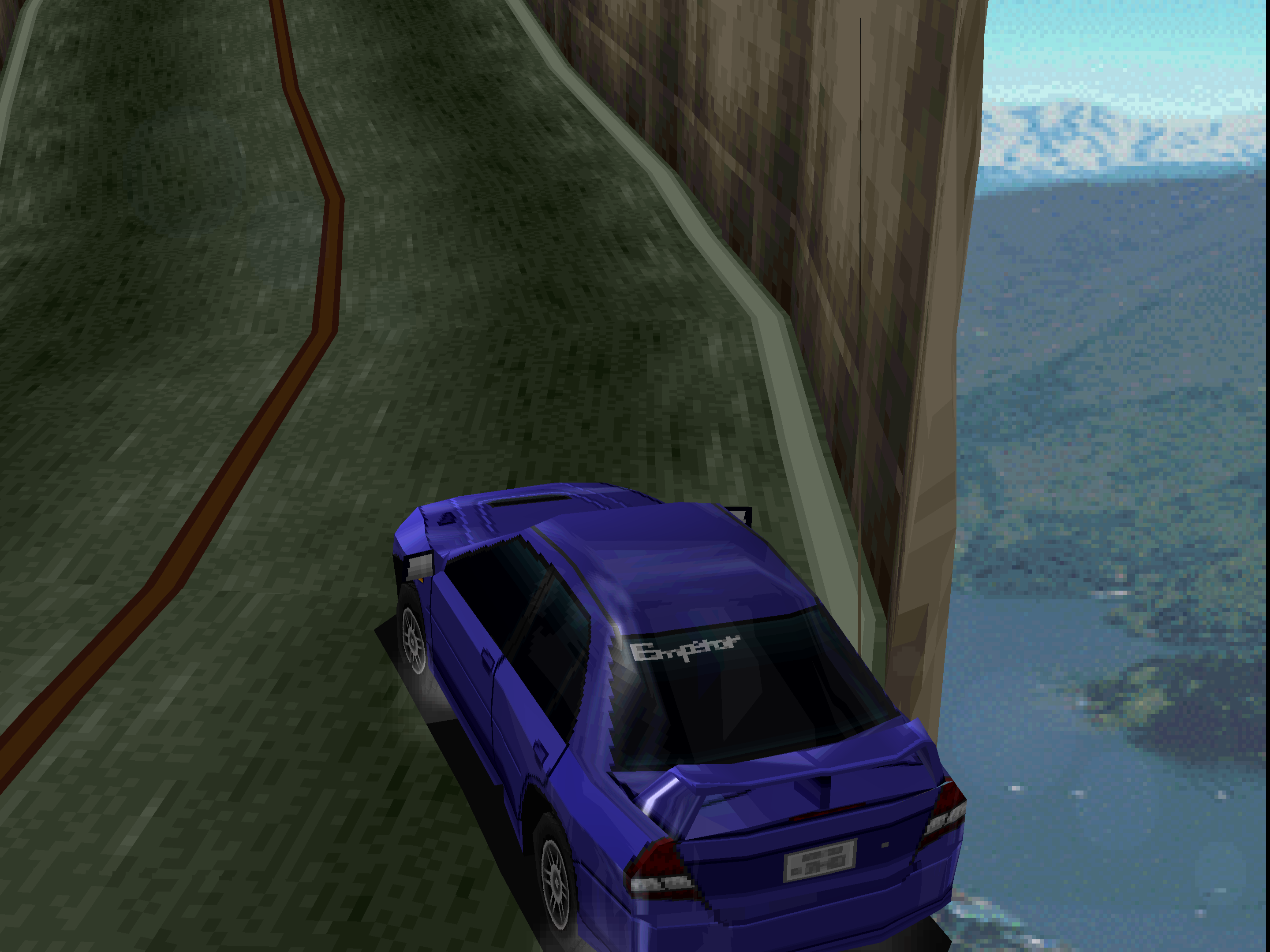
However, getting to the edge of the track frequently puts the replay camera over the edge, which is a bit disconcerting. This sums up a lot of the game to me: it feels like the developers were putting in love to this game, but ran out of time on the polish stage. Another modern misconception is that videogames used to ship when they were done, or be done when they shipped, although you might get that impression because you never had to sit there and update a Nintendo 64 game. Nowadays we could get a patch to fix the replay clipping, or even add more angles. Or extra cars or tracks! The problem is that developers now lean too much in that direction, with games coming on Blu-rays that can’t even be played without a “Day One” update, or worse, games that launch with major problems that hopefully get ironed out later (like Cyberpunk 2077).
Initial D for PS1 is an under-appreciated game. From a Playstation perspective, I think it suffers from just being “pretty good at its specific niche” on a platform that has a lot of great racing games. From an overall perspective, the later Initial D games in the arcade and PS2 have significantly better graphics and controls, and are just more fun to play. Despite that, I am very surprised that there has never been an English translation made for this or the Saturn game; there isn’t much dialog overall.
I think that if more people could check out the story mode, a cult following might develop for this quirky little game, because that’s what really endears me to this game. Yeah, it’s barely a couple hours long and cuts out huge parts of the Initial D canon, leaving little dialog in the parts they did keep, which is not even voice-acted. Most of it is not even animated. But it still manages to convey the story in a way that made me want to keep playing to see what would come next, and that’s a standout quality for any game to have. It’s also very much a period piece, belonging both to the Playstation’s heyday as well as the pre-anime era of Initial D. It’s a solid trip back to 1999, and I enjoyed it while it lasted.


 Star Road
Pingback: Every PS1 Game – FoxKids.com Micro Maniacs Racing | Star Road
Thank you for the review of the PS game. A fan made their own Initial D racing game, they have a discord. Sadly I could not test it out because it only runs on Windows.
Pingback: Every PS1 Game – Gran Turismo | Star Road