
Every PS1 Game – Spyro the Dragon
I love free demos. The best one recently was Metaphor: ReFantazio. Released a few weeks before the retail game, it was the full intro to the game and more: it took me seven hours to beat. Back in ancient times, retail stores would have kiosks with a console, TV, two controllers, and a game (in the cartridge era) or demo disc (in the CD era). Like an arcade, but free! They were especially exciting for me as a kid during the 90’s, allowing my penniless adolescent self to try a variety of games that I wouldn’t normally get to play. I have crystal clear memories of being blown away by the graphics of Star Fox at Toys R Us. When I went to Sears with my mom, I always made a beeline straight for the demo kiosk to play a round of Rally Cross on Playstation or Nights into Dreams on Saturn. And when I got my Playstation in 1999, unlike any of my Nintendo consoles, it came with a demo disc. On that demo disc was an extremely popular game from 1998 called Spyro the Dragon.
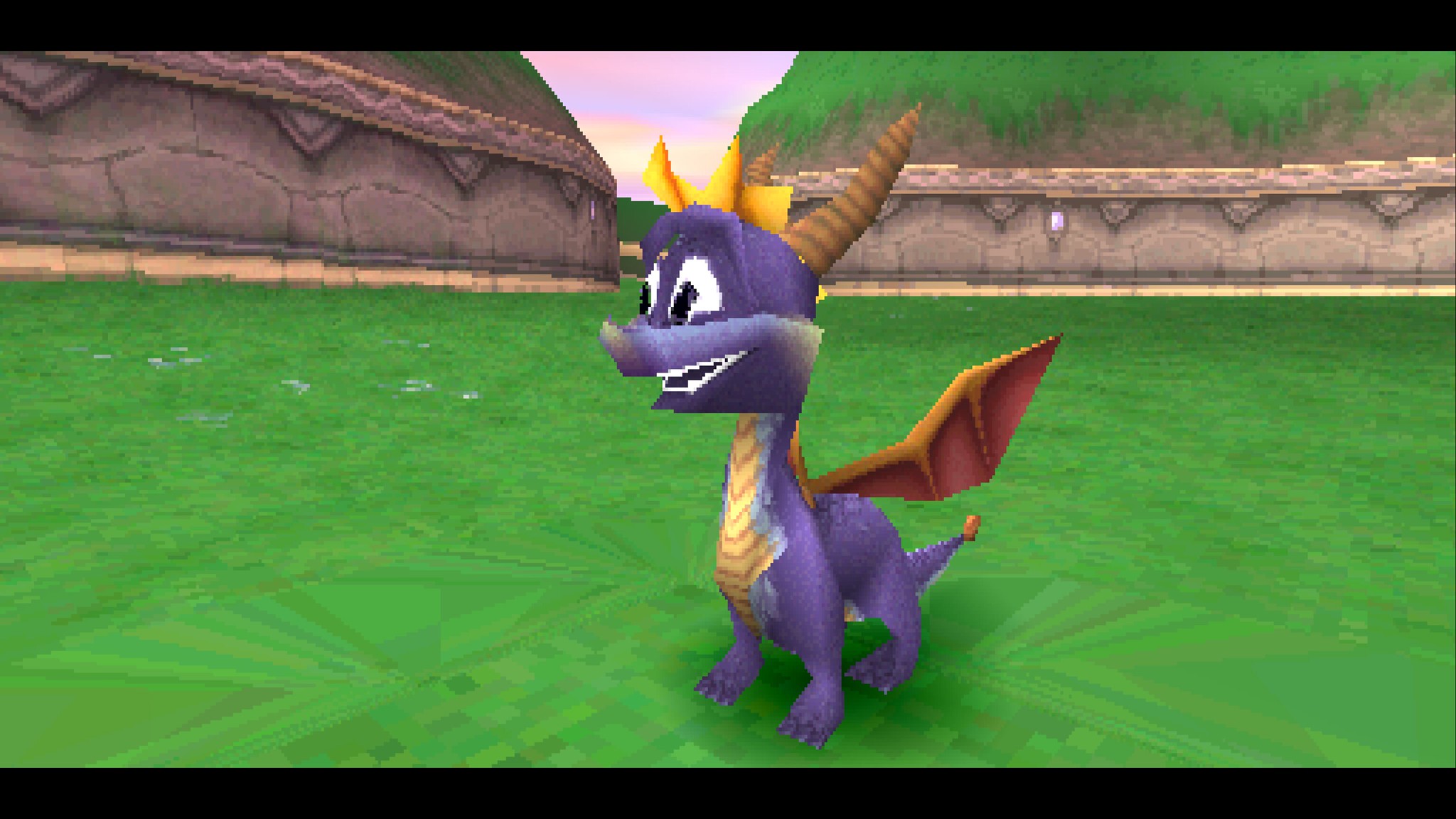
However, I found that Spyro demo to be unconvincing. Compared to the brand new Legend of Zelda: Ocarina of Time on N64, or even the three-year-old Super Mario 64, this game felt sluggish as you tediously trudged through the bland demo world. The point of the game seemed to be just walking around and finding dragon statues. Yawn. But that wouldn’t be the end of my Spyro story.
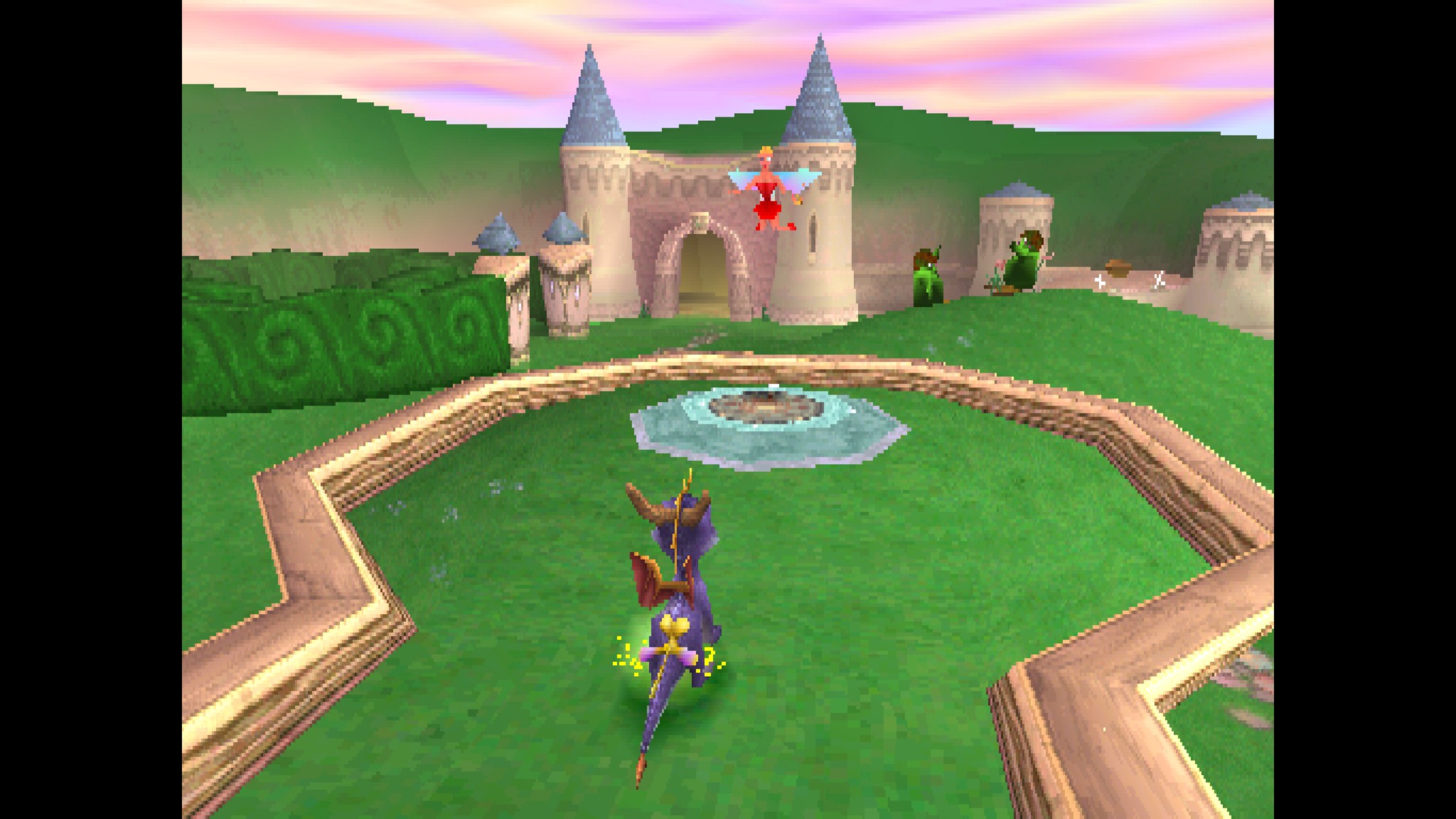
Five years ago, with a bid of $11.17, I won an eBay auction for this game. On my first play of the full game, I found the beginning to be just as boring as I remembered from the demo, so it went back on the shelf. Something about this series recently piqued my interest, so I decided to go for it again and see how far I could really get. Certain things stood out right away: the graphics were actually much better than I remembered, displaying at an impressive 512×240 and featuring a revolutionary (for the time) Level of Detail (LOD) system that virtually eliminated pop-in by reducing the detail of objects as they got farther from the player.
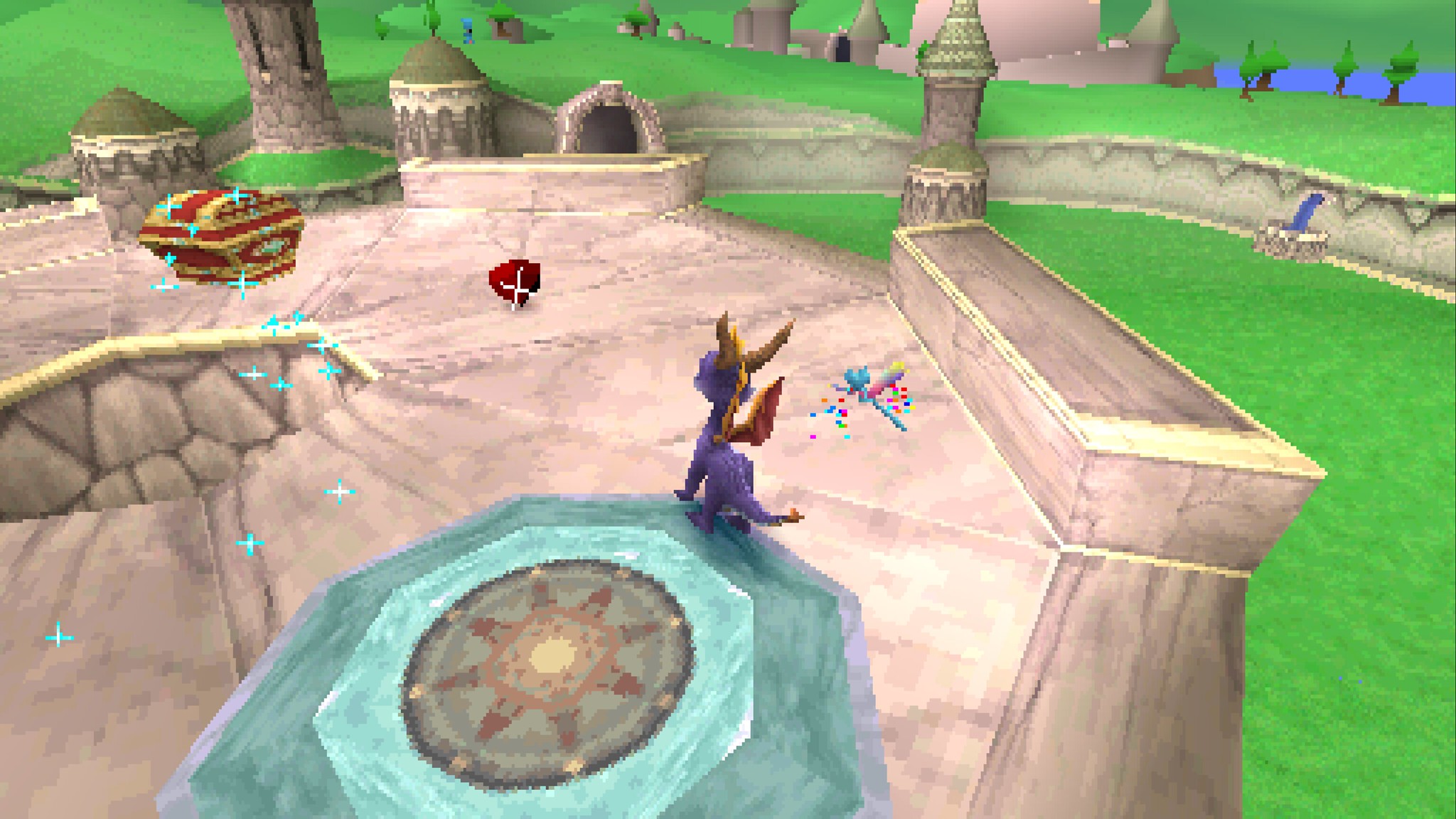
The high res graphics look great in motion, but as usual, I don’t feel like that aesthetic transfers very well to screenshots.
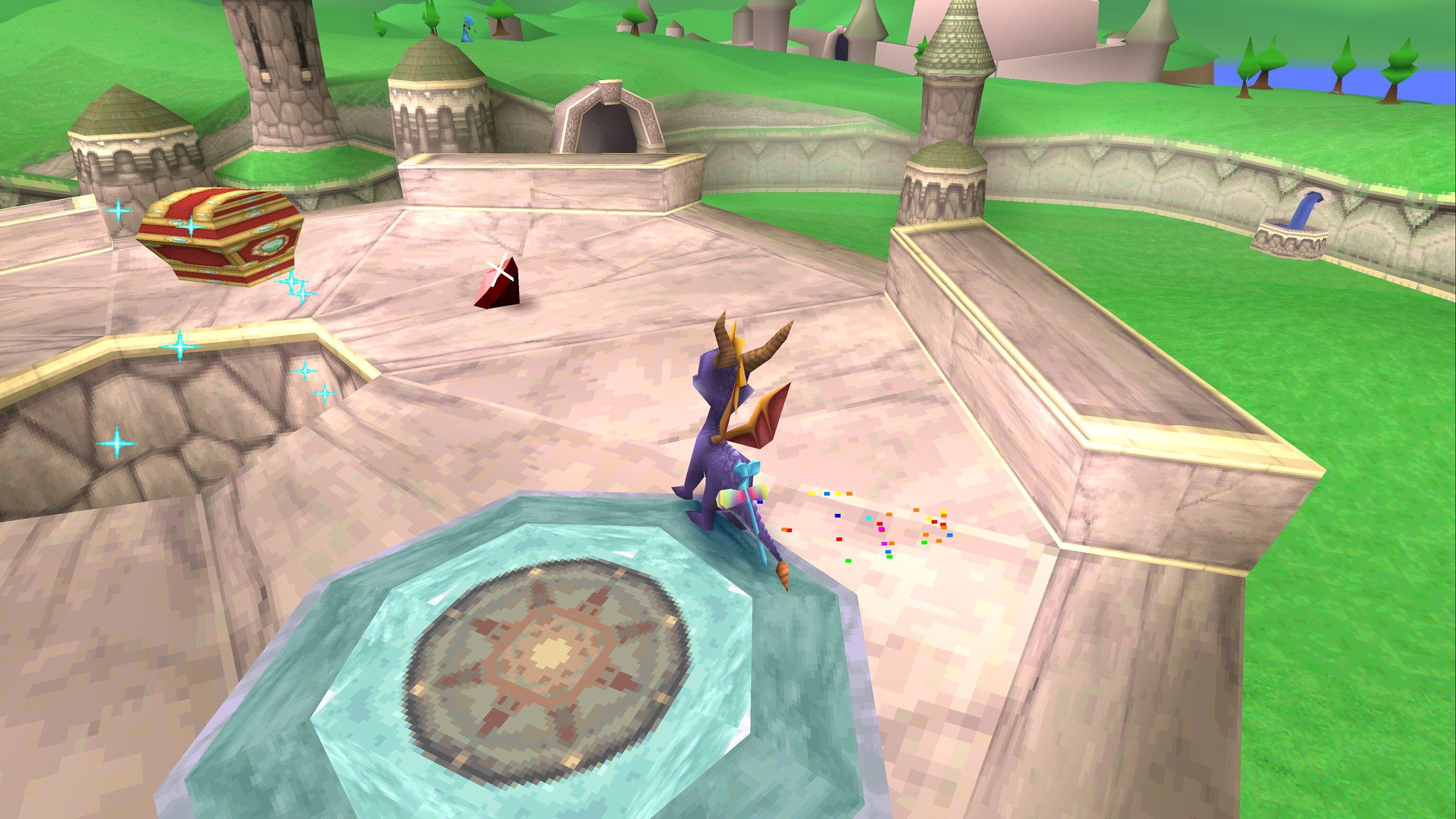
So for the rest of this article, please enjoy these 9x internal resolution, widescreen, PGXP-applied screenshots. Another fun note is there is a 60 fps patch, so playing in the emulator is a bit of mini-remaster.
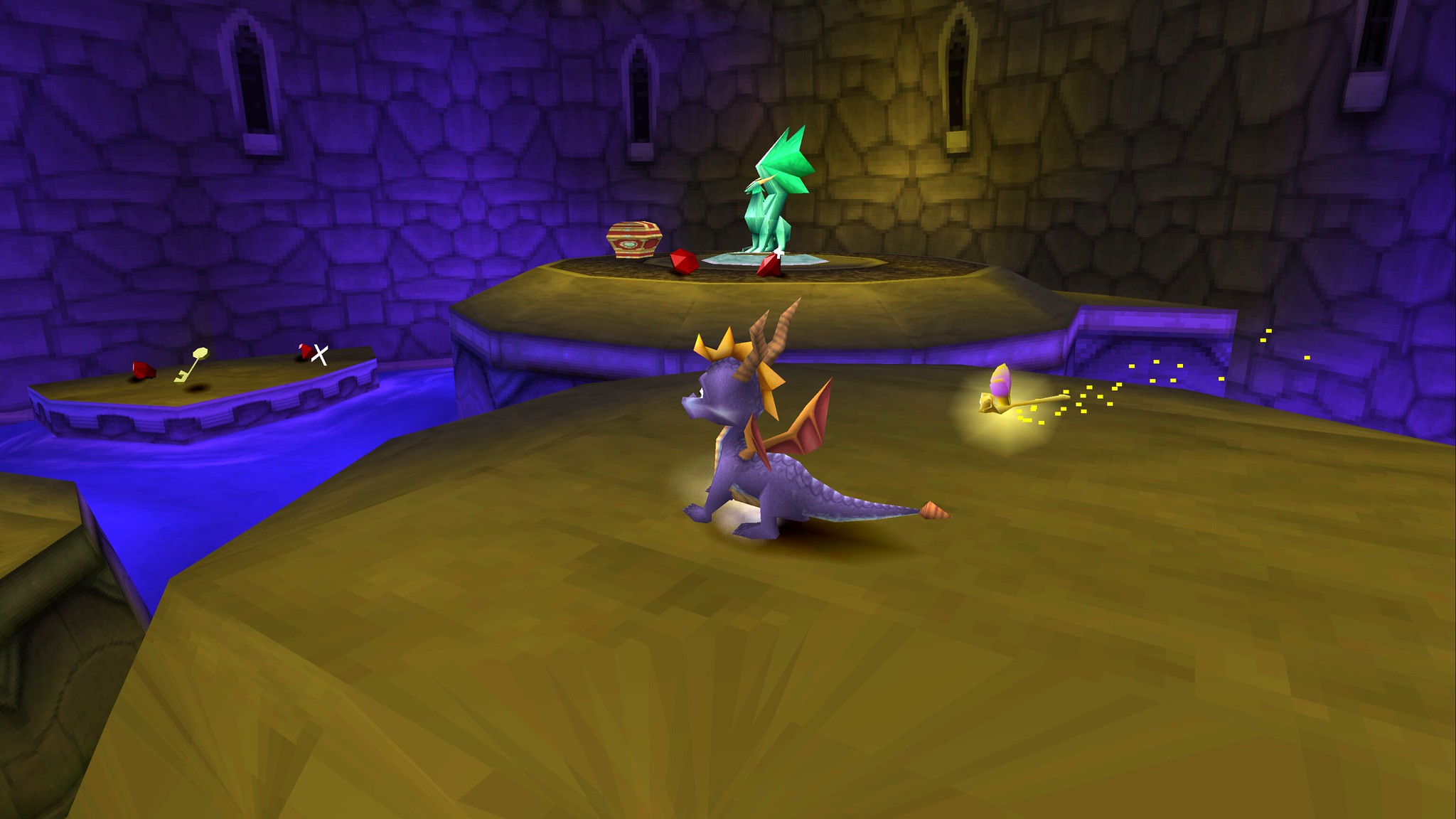
In the the Half-Life 2 documentary the developers pointed out something very interesting about their design philosophy: they intentionally worked on the intro of the game (the City 17 train station) at the very end of development. Their theory is that the beginning of the game is the most impactful for players, so it should be done at the end of the development cycle, when the developers know what the game is all about and have learned all the lessons about gameplay design and programming on the rest of the game.
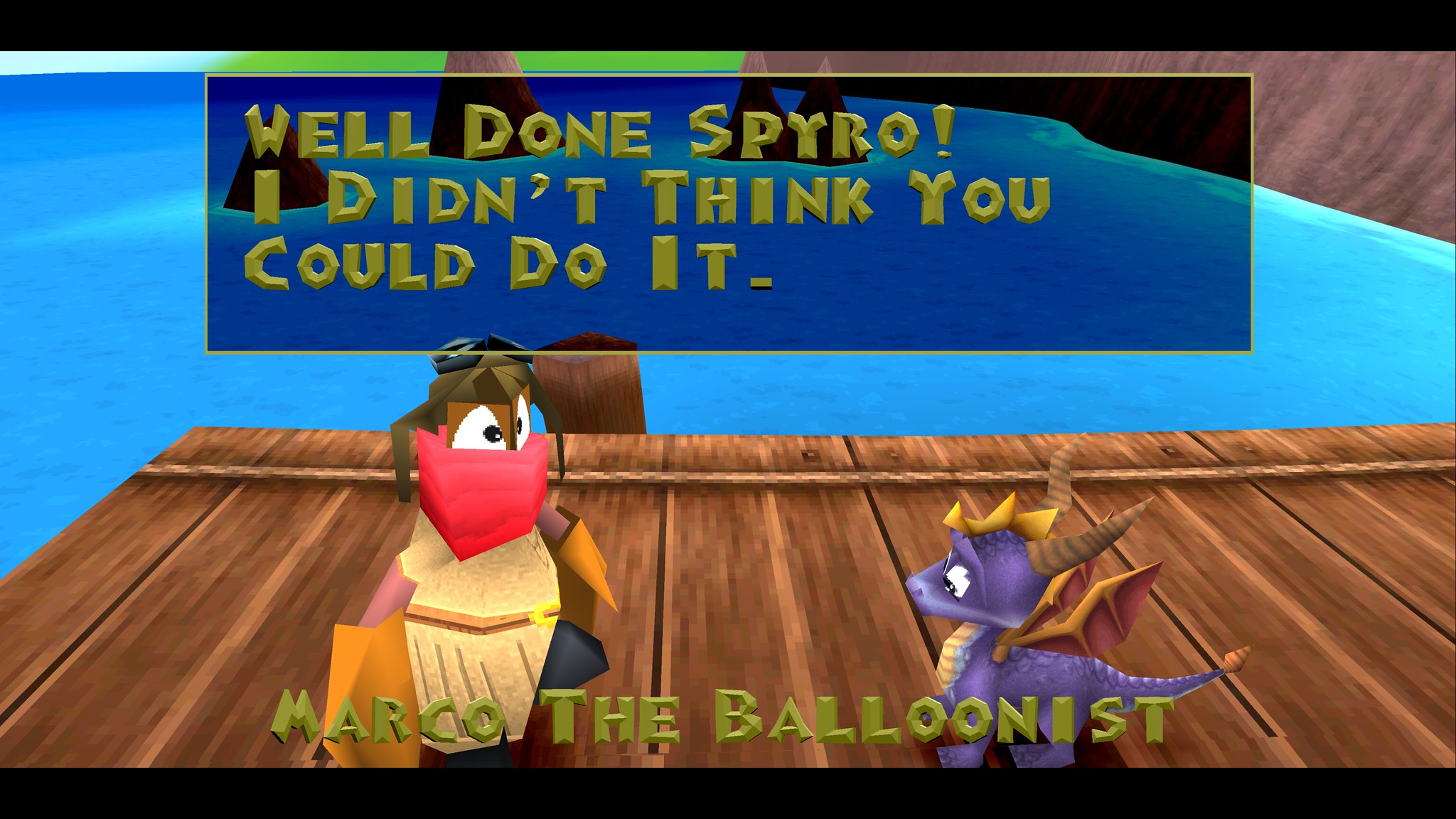
As I played, I realized that Spyro suffers from the lack of this technique: it feels like they created this game sequentially, starting with the first world and then adding on until they ran out of time.
When you finally get out of the extremely basic and somewhat bland initial world, it starts getting better.
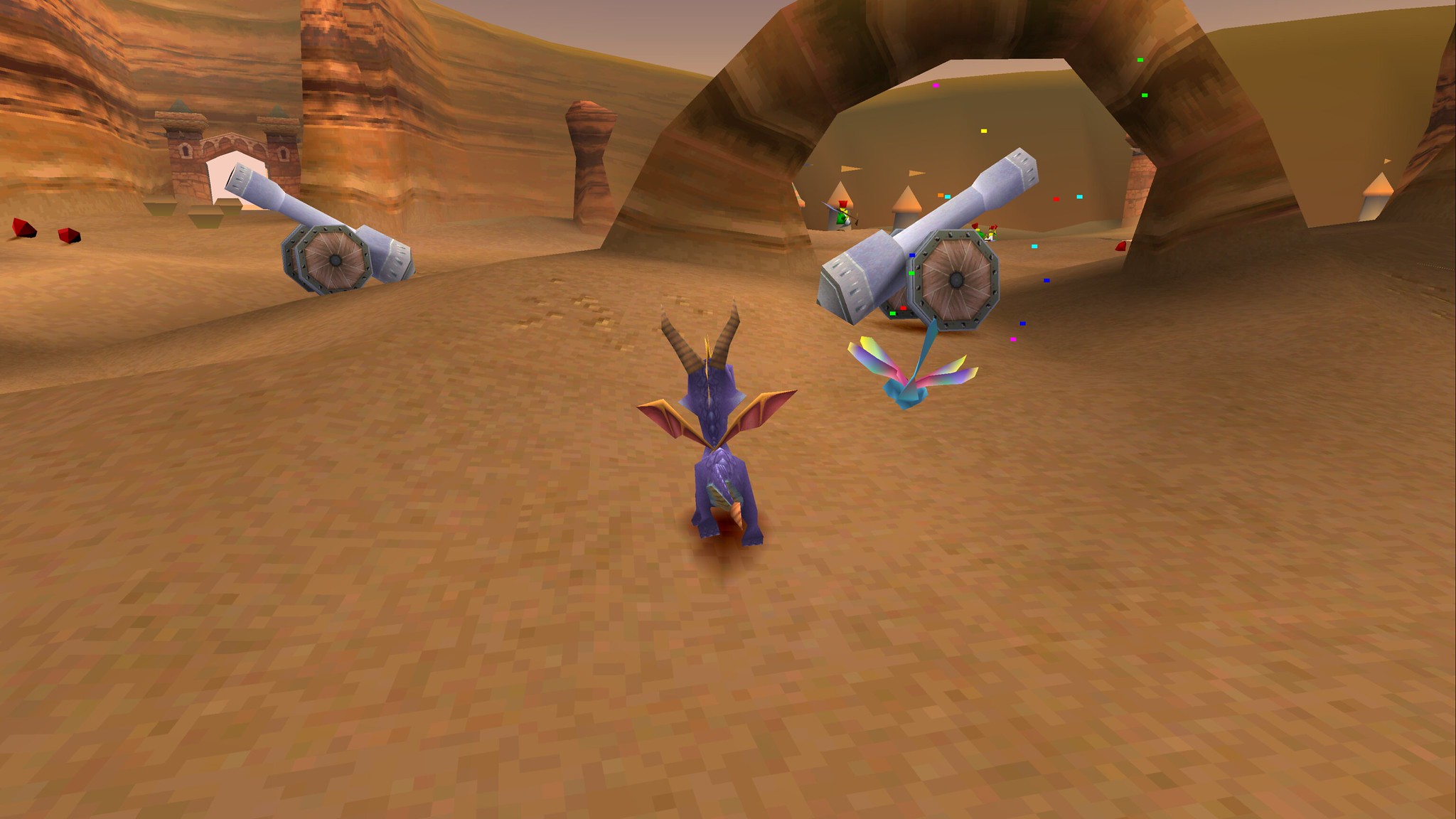
This area starts to show promise. There is more variety in the world and the baddies here, plus it’s nice to see a change of scenery.

The animation in this game is killer. You can shoot flames at objects like this cactus, and they react in a comical way that’s hard to show in a screenshot.
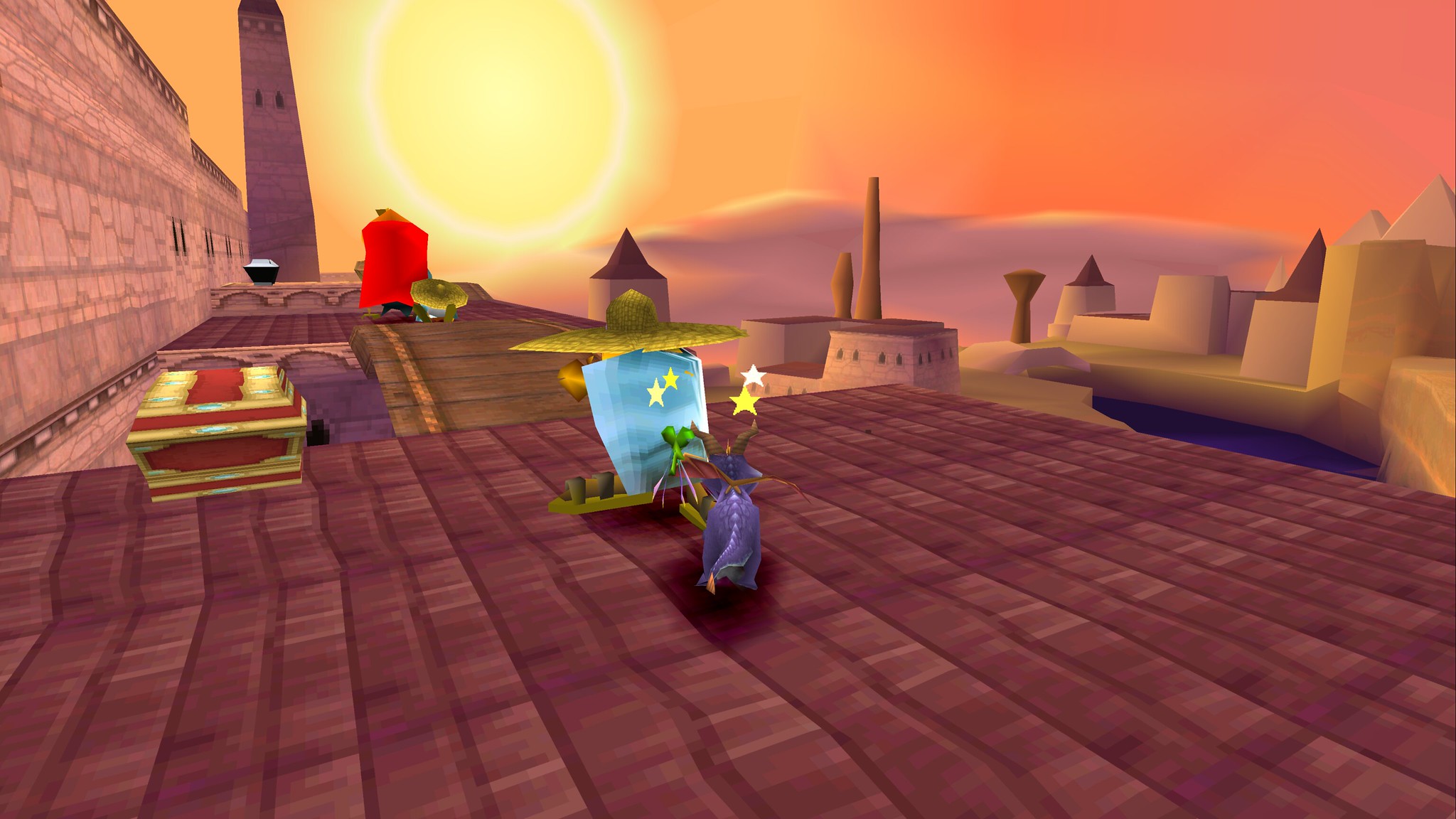
Now we’re talking! Finally we get to some interesting 3D platforming in the second world. This is where the game starts really getting good.
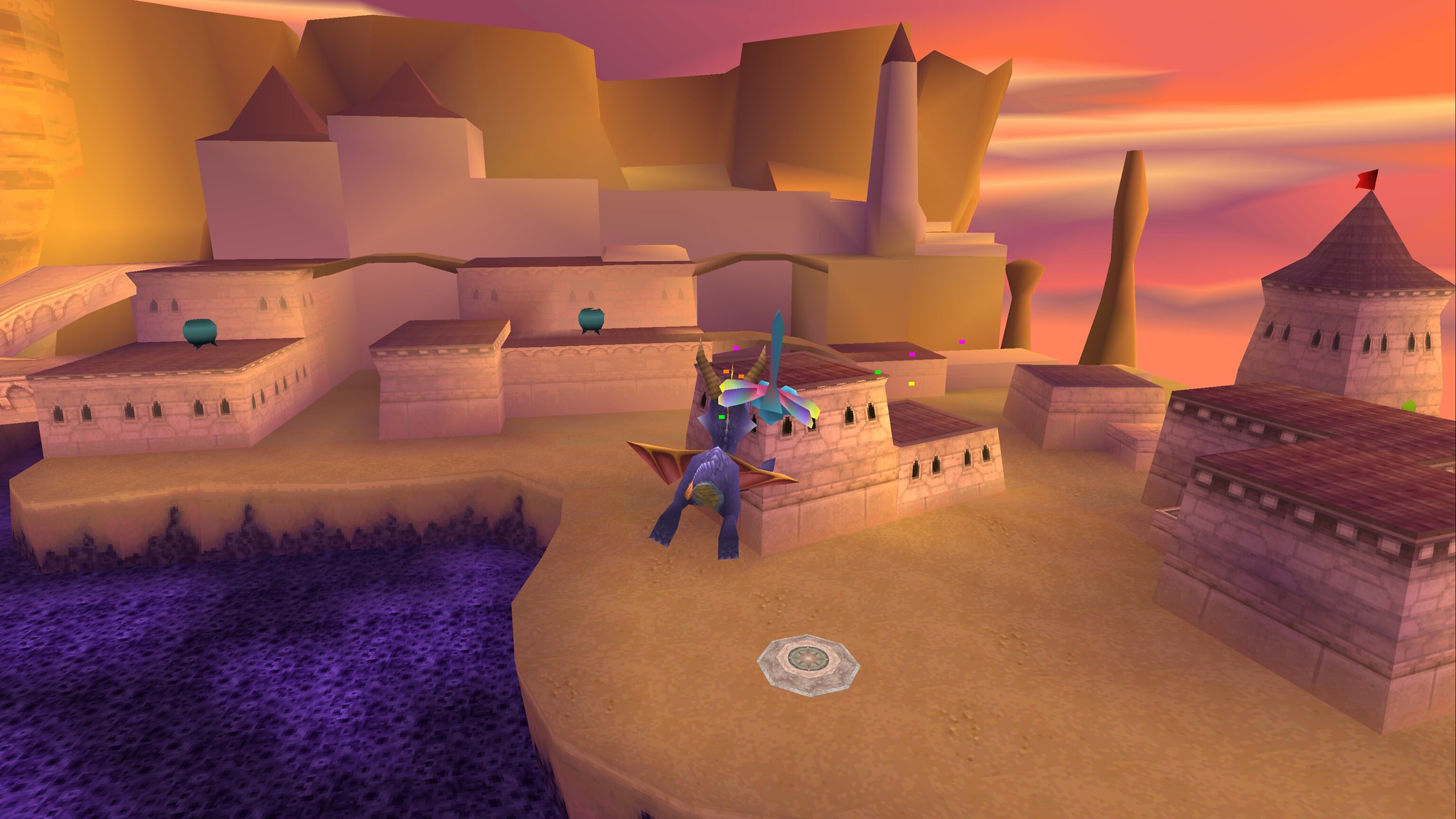
You spend a lot of time up to this point walking on the ground, jumping on tiny ledges, and generally being constrained. When you can finally explore this huge, multi-layered area, you see a small part of why 1998 is widely considered one of the greatest years in the history of video games. The Nintendo 64, Playstation, and Saturn had been out for a few years already, and that’s how long it took developers to really understand and be able to harness not only the power of this new hardware, but of the general concept of 3D gaming in general. There had been videogames with three-dimensional gameplay since the dawn of the 80’s, but it really came of age in the mid 90’s when the technology arrived that allowed creativity to flourish.
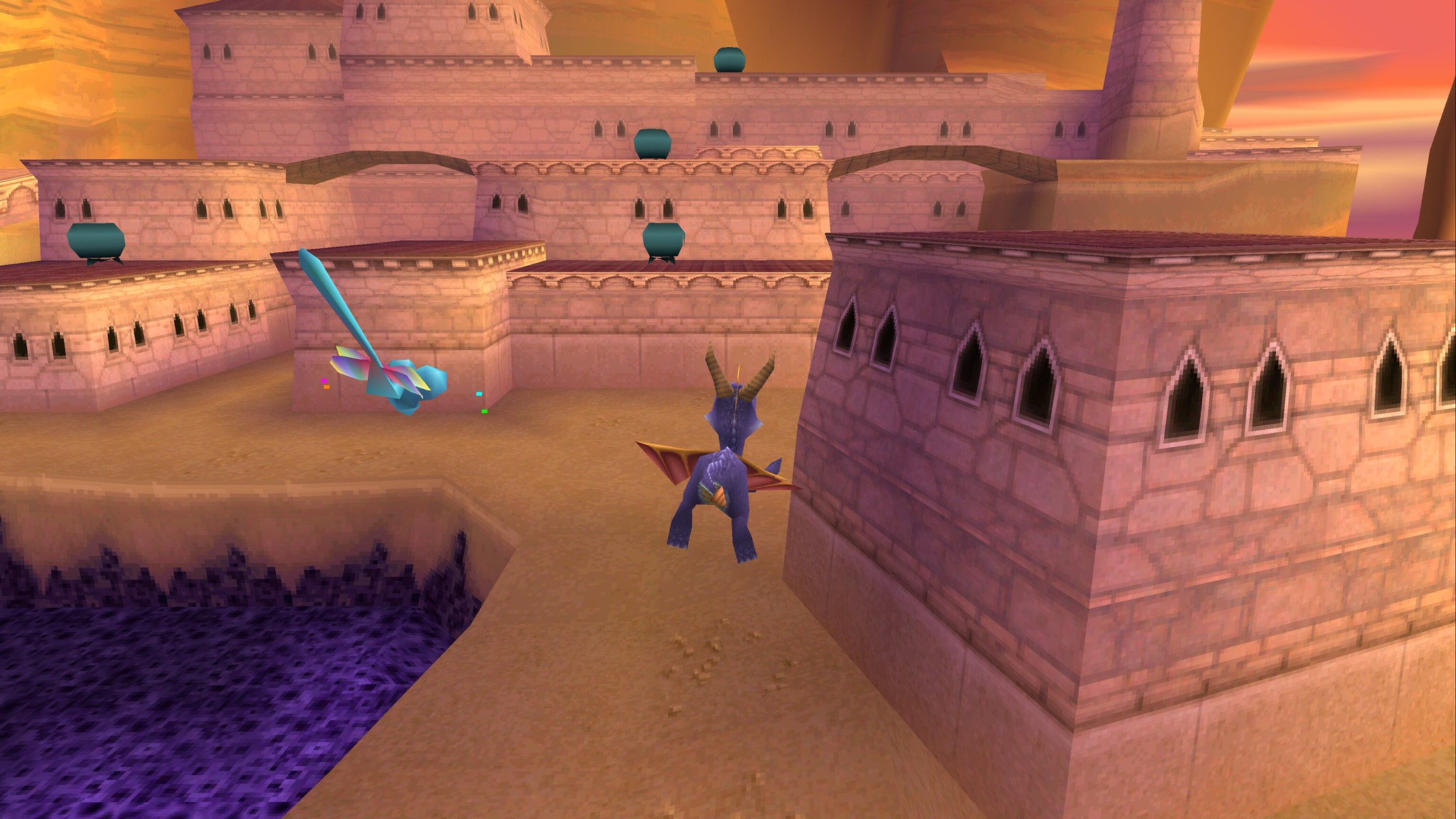
Compare the above two screenshots and see the LOD’s in action. As you get closer, details smoothly emerge. This is so much less jarring than the pop-in and fog that plagued gaming at the time.
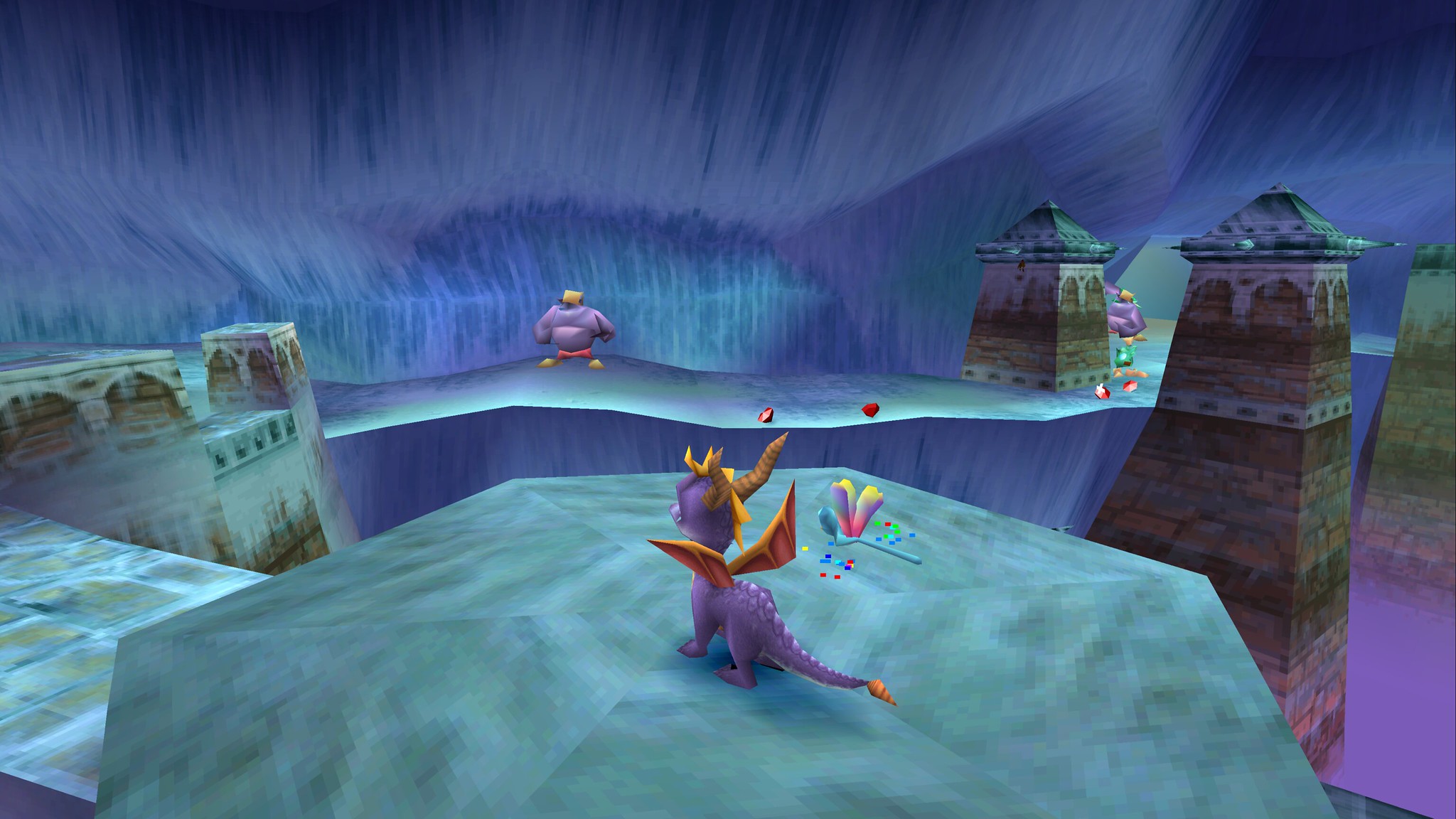
One really appealing gameplay aspect that never proves relevant in the demo is the permanence of collecting objects in the game. Unlike virtually every other game, where coins or rings you collect will regenerate (either immediately or the next time you load the level), the gems you collect in Spyro are added to your inventory and then disappear from the game world permanently. This gives you much more incentive to bother collecting these little items, even though they don’t really do anything in this game. Other than being an incentive to explore, their main purpose is to contribute to your percentage collected score; if you collect 100% of gems, dragon eggs, and rescue all the dragons, you unlock one more level. If you complete that level, you get the “true” ending.
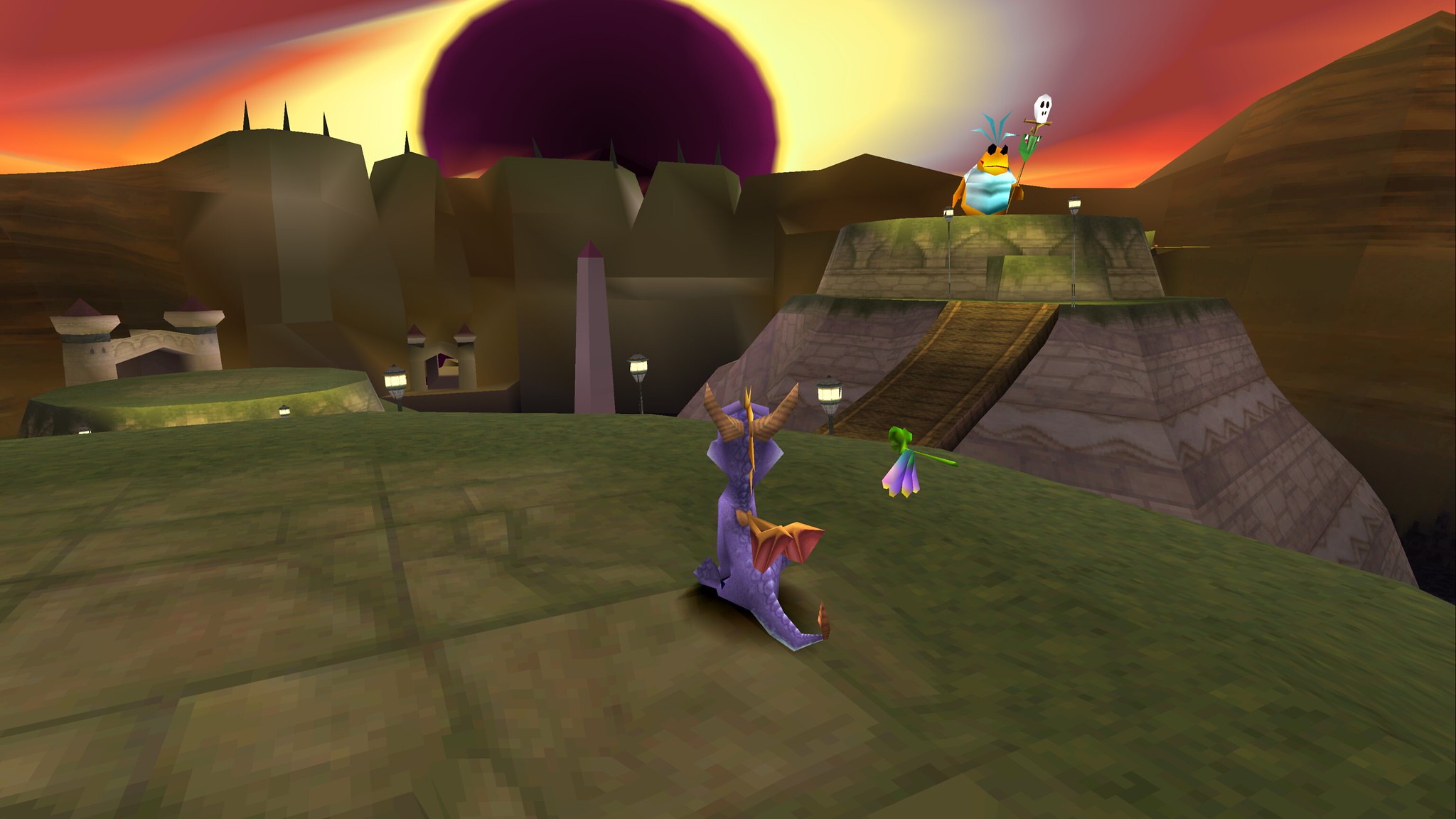
The environment isn’t the only beneficiary of the draw distance: even characters and objects are rendered from far away. This is one of the boss fights, which have their own unique levels. Like the rest of the game, they are challenging enough but not too annoying.
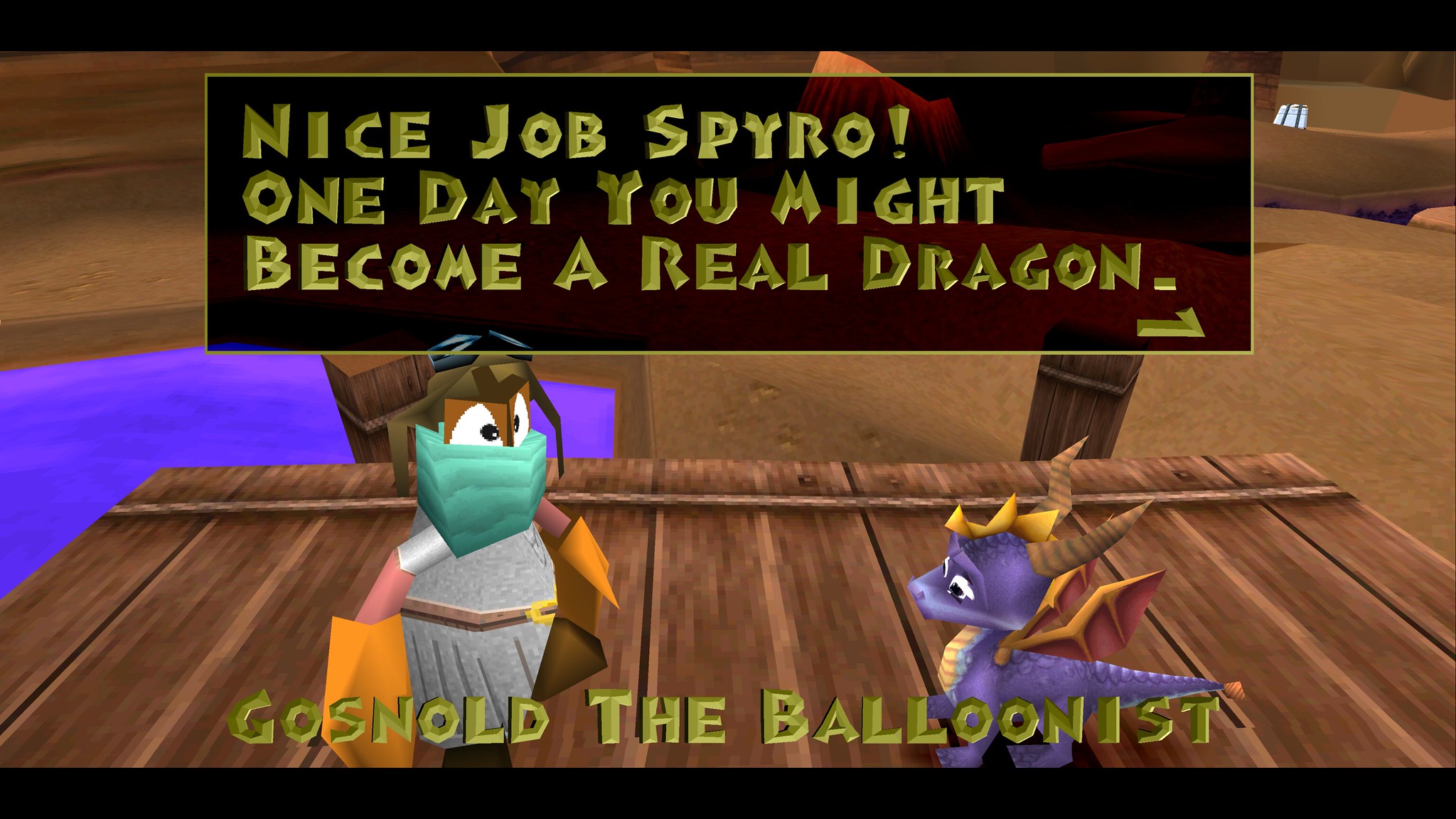
There’s a weird, kinda-Disney substory about how young Spyro is so tiny and not a “real” dragon. There’s no information or exposition about why Spyro seems to be the only young or small dragon in this entire world; it just seems like they had to pick some token reason that Spyro is “different”. Although to his credit, it doesn’t really seem to bother him.
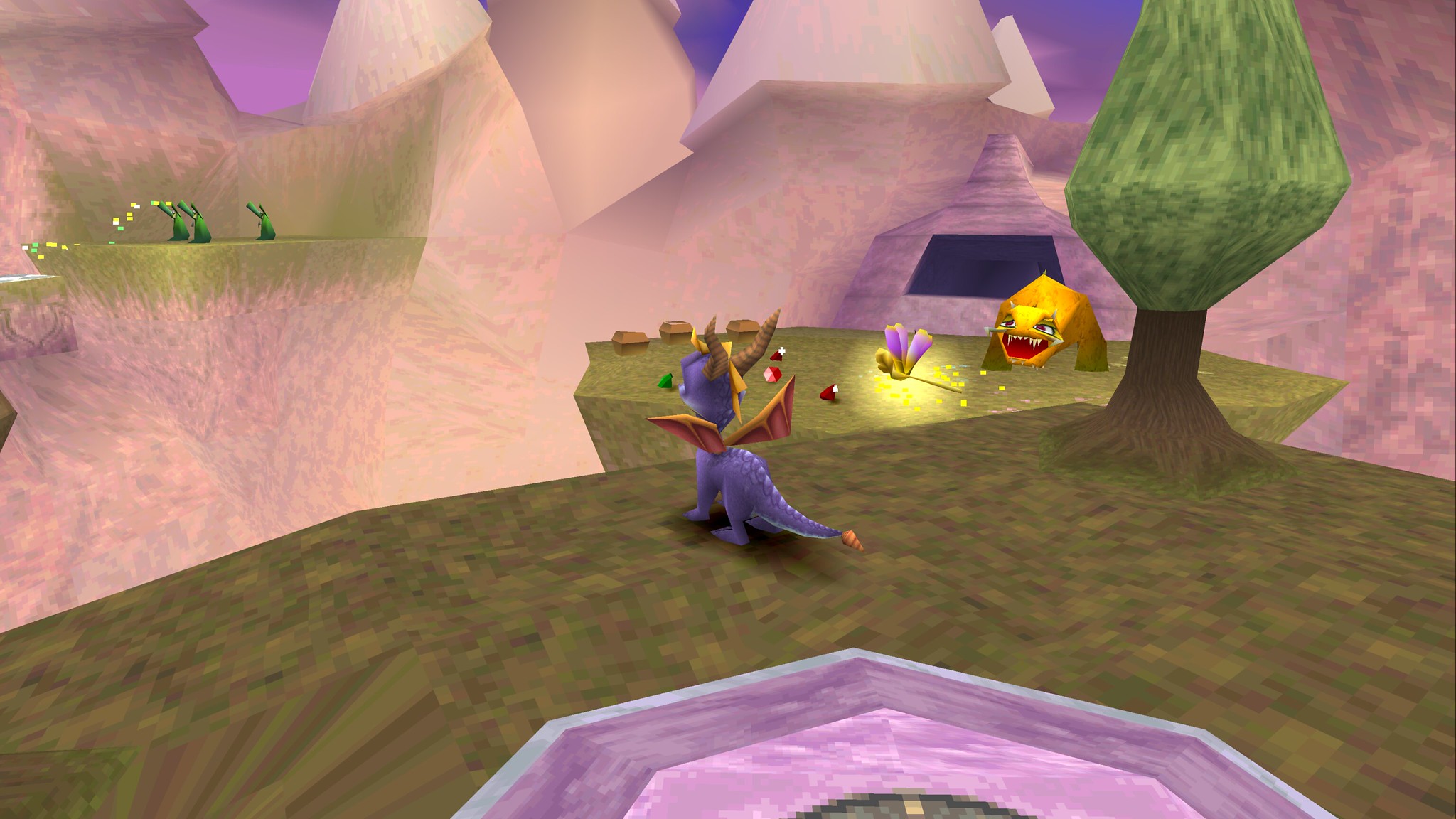
By this point in the game I was pretty hooked. The gameplay is essentially the same as in the boring demo: walk around and find dragon statues. But they keep introducing more variety in the level design and more enemies with different types of attacks, which creates that highly desirable feeling of constantly wanting to move forward just to see what’s next.
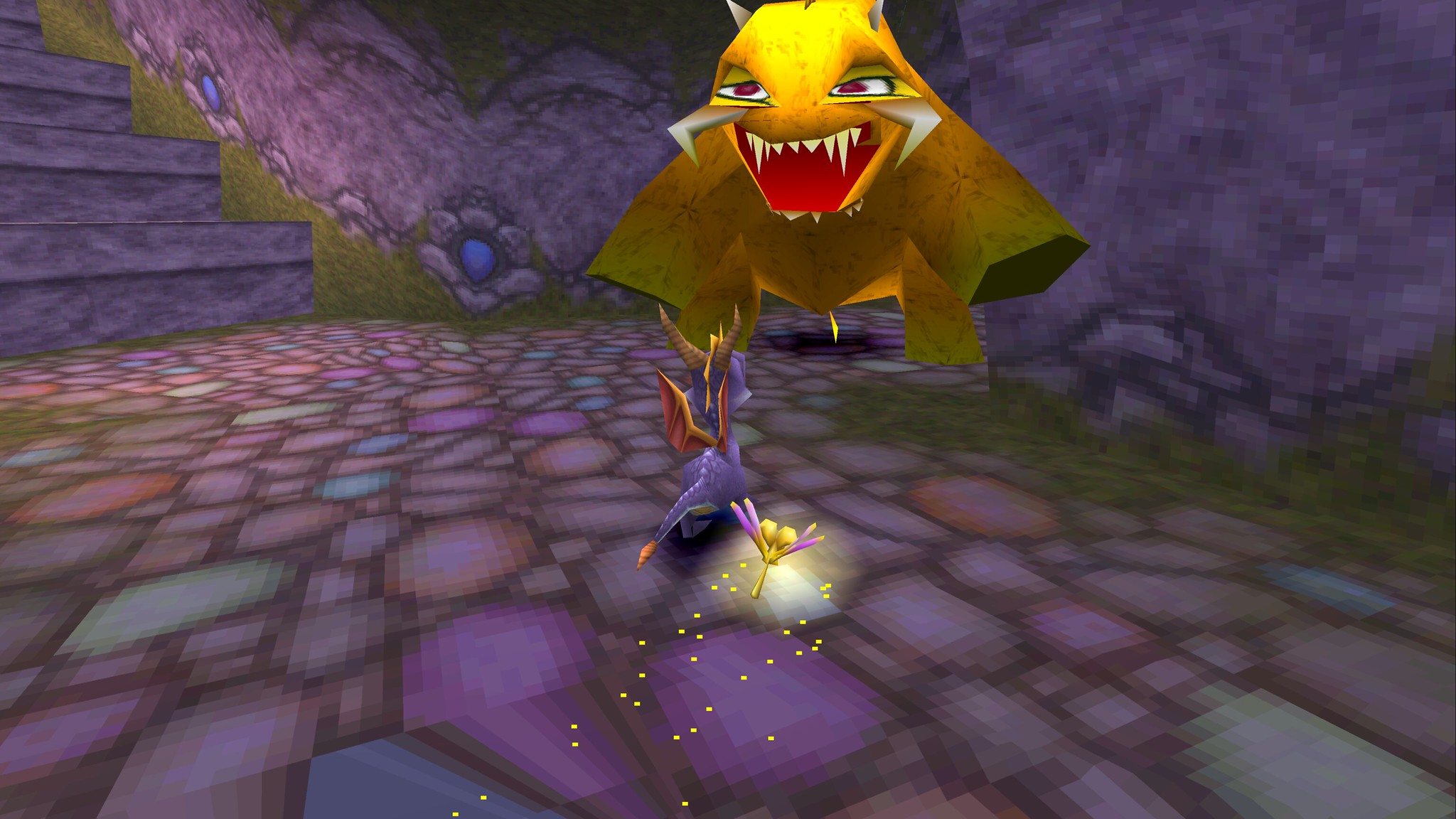
There is a fun visual style with this game. The enemies have funny designs and animations, while the environments have those great sharp textures the Playstation was known for.
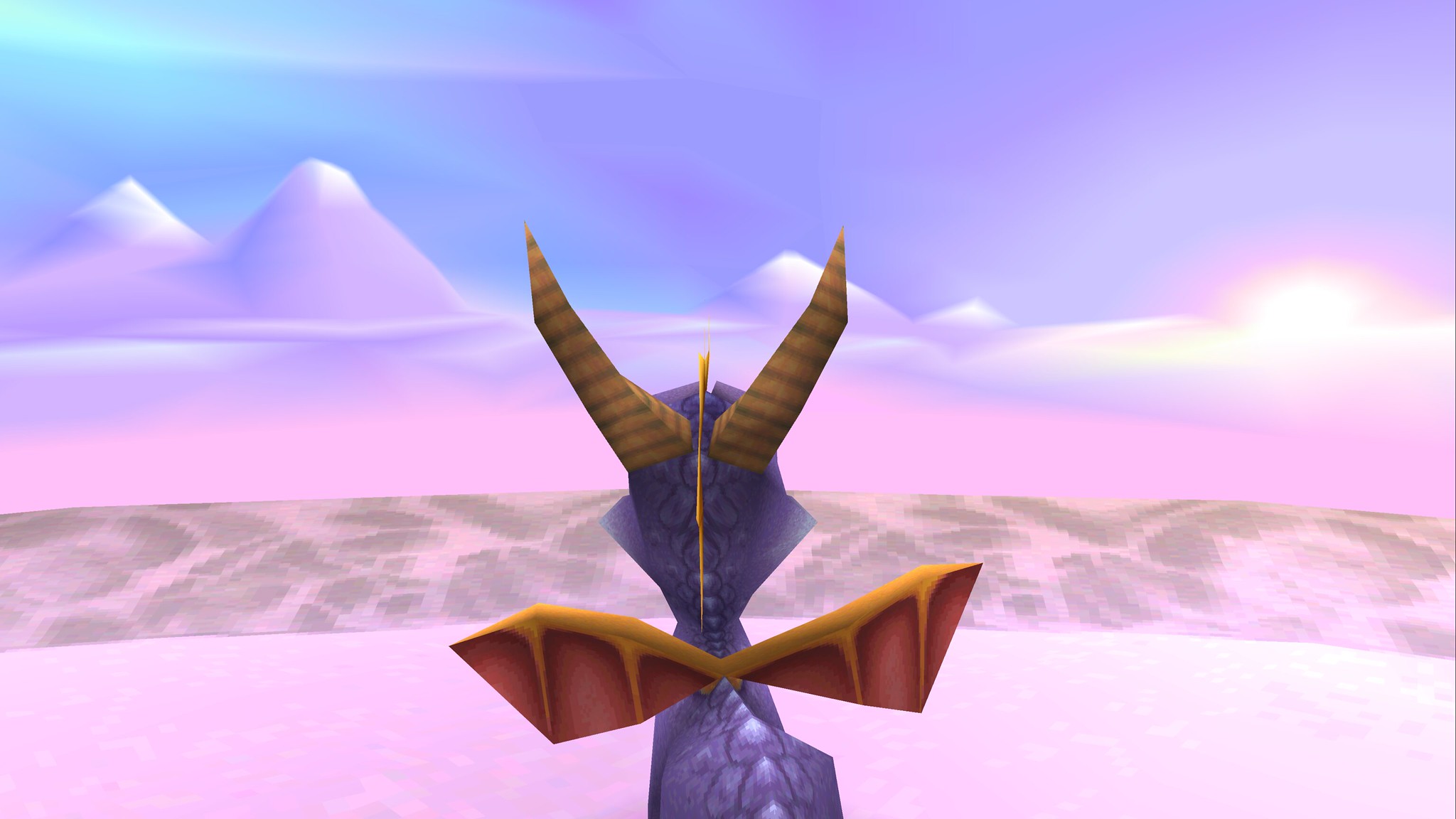
There’s a funny “first person” mode, which is really just a super close third person view. It helps to get your bearings because the normal gameplay camera is not only sluggish, it only lets you move the camera left and right–there’s no up/down control. Anyway, I just had to get a screenshot of this serenely beautiful area.
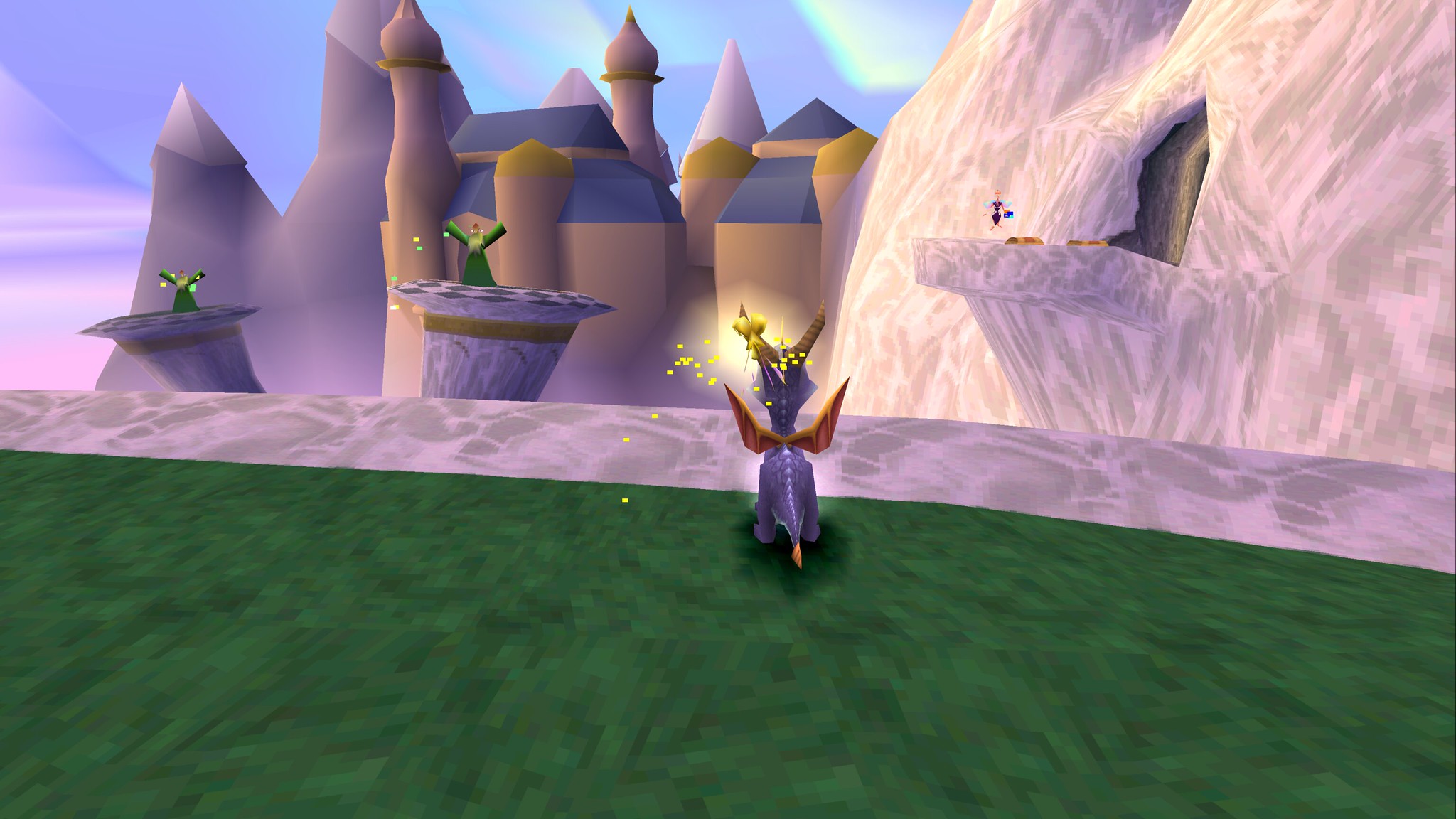
There are two camera modes: Active and Passive. Active follows Spyro pretty closely; when you turn, the camera turns. I find this mode a bit sickening, so I kept it on Passive. The camera still follows Spyro, but it’s much slower and less reactive. The L2 and R2 buttons are for camera rotation, but a little emulator trick is to bind Left and Right on the right analog stick to those controls, giving you some modern right-stick-as-camera controls.
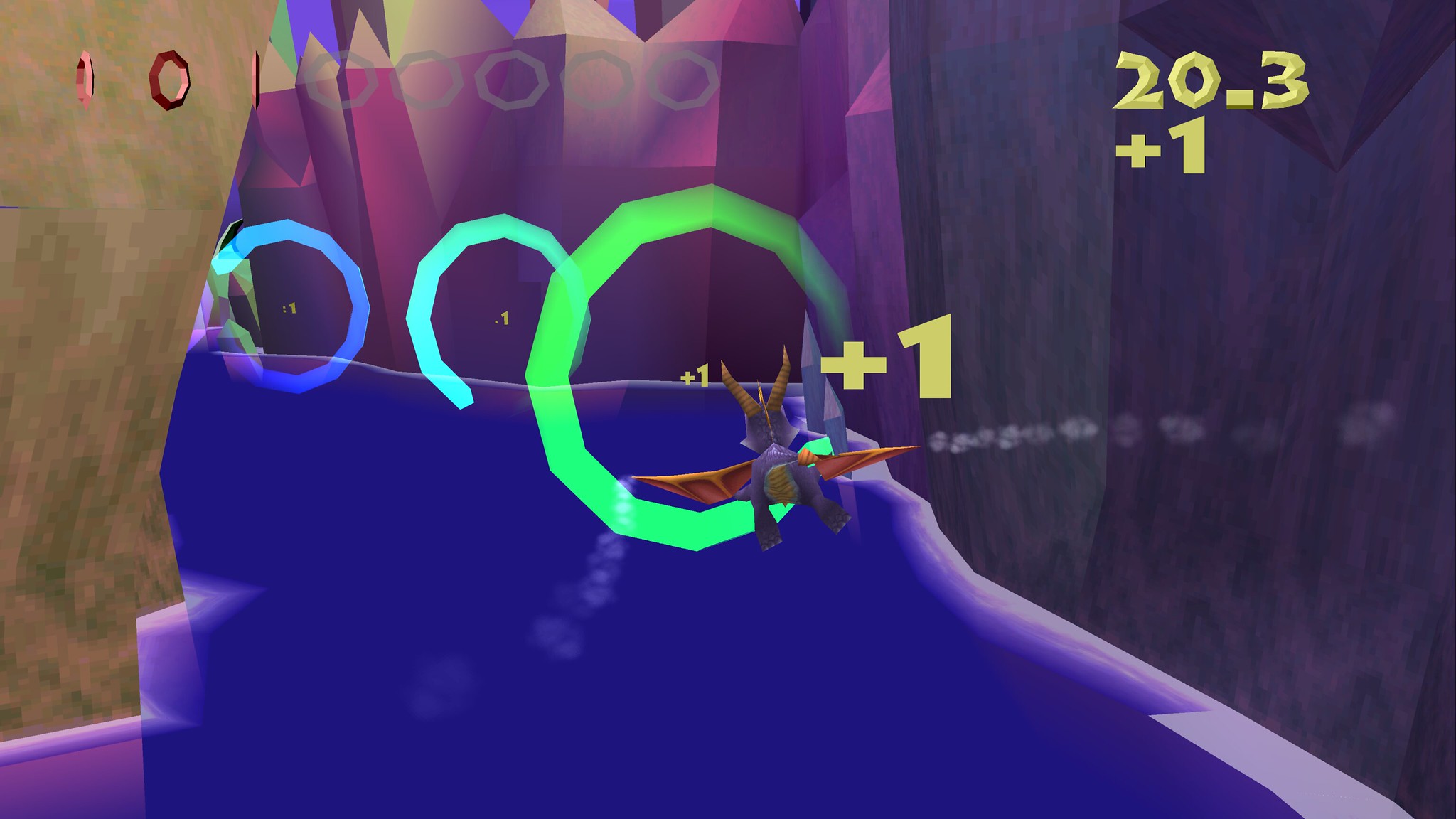
Every level in the game involves Spyro running on the ground and doing some 3D platforming. The “flying” in this game is mostly gliding; you can’t fly any higher than you jump. However, there is one level that’s purely about flying, and it’s very cool.
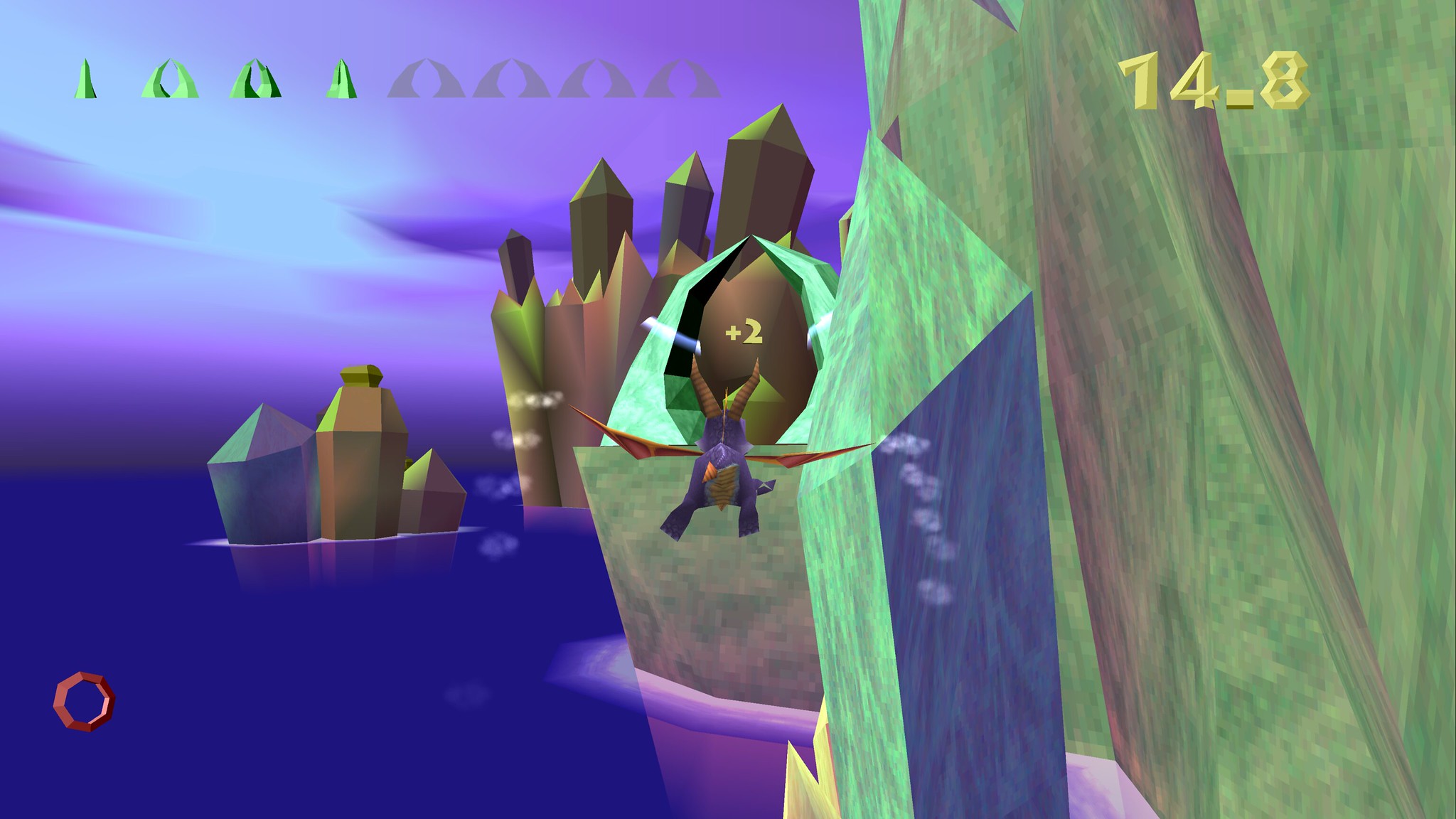
Wow! This level is so neat that it almost feels like it could be its own game. I am sad to report that this is a one-off adventure, and none of the rest of the game has anything like this.
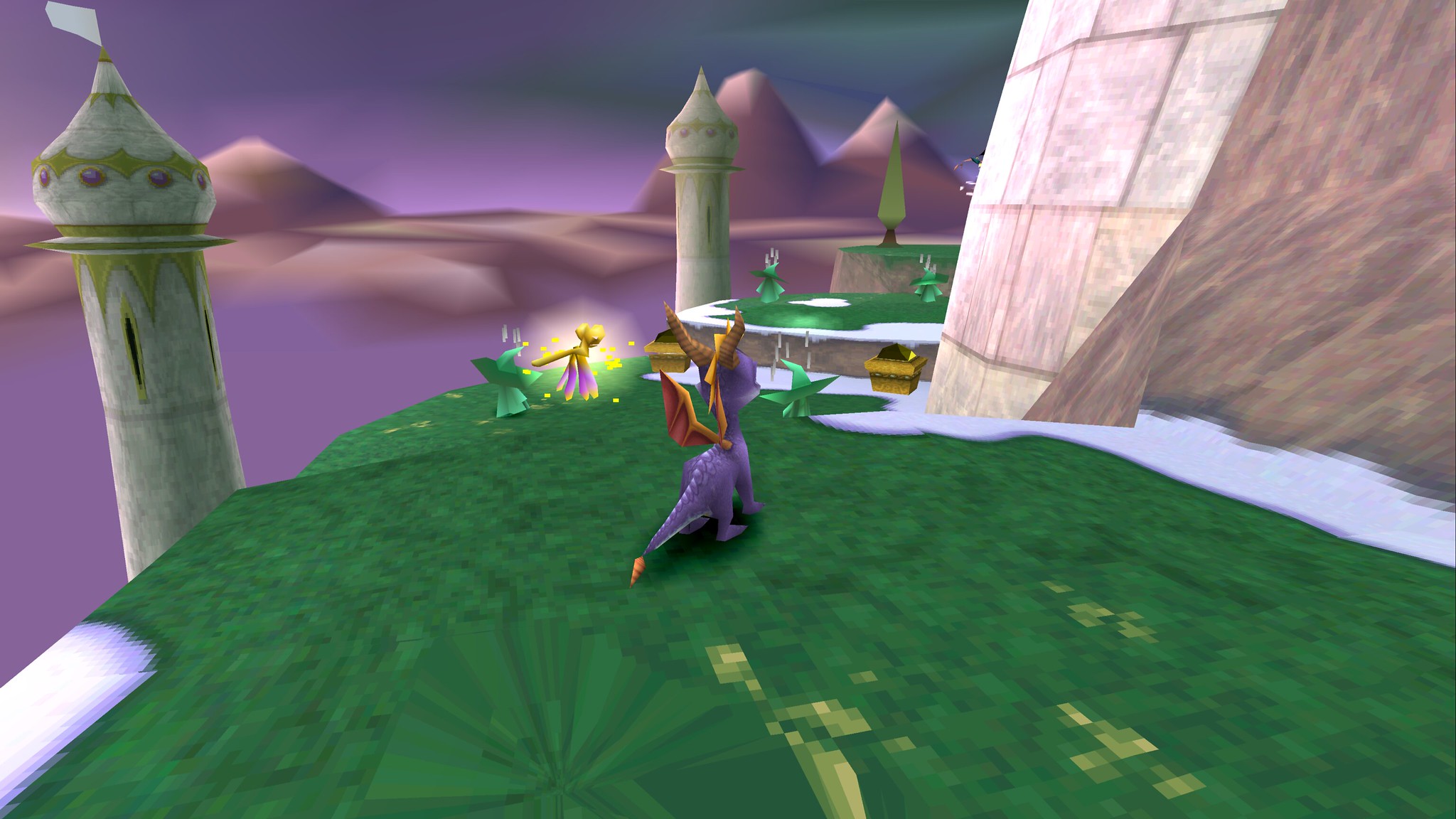
There’s a little glitch that manifests with PGXP that looks like a little black hole in the floor between Spyro and the camera. It looks kind of gnarly in screenshots, but it’s barely noticeable while playing, mainly because it keeps moving around and changing shape as Spyro moves.
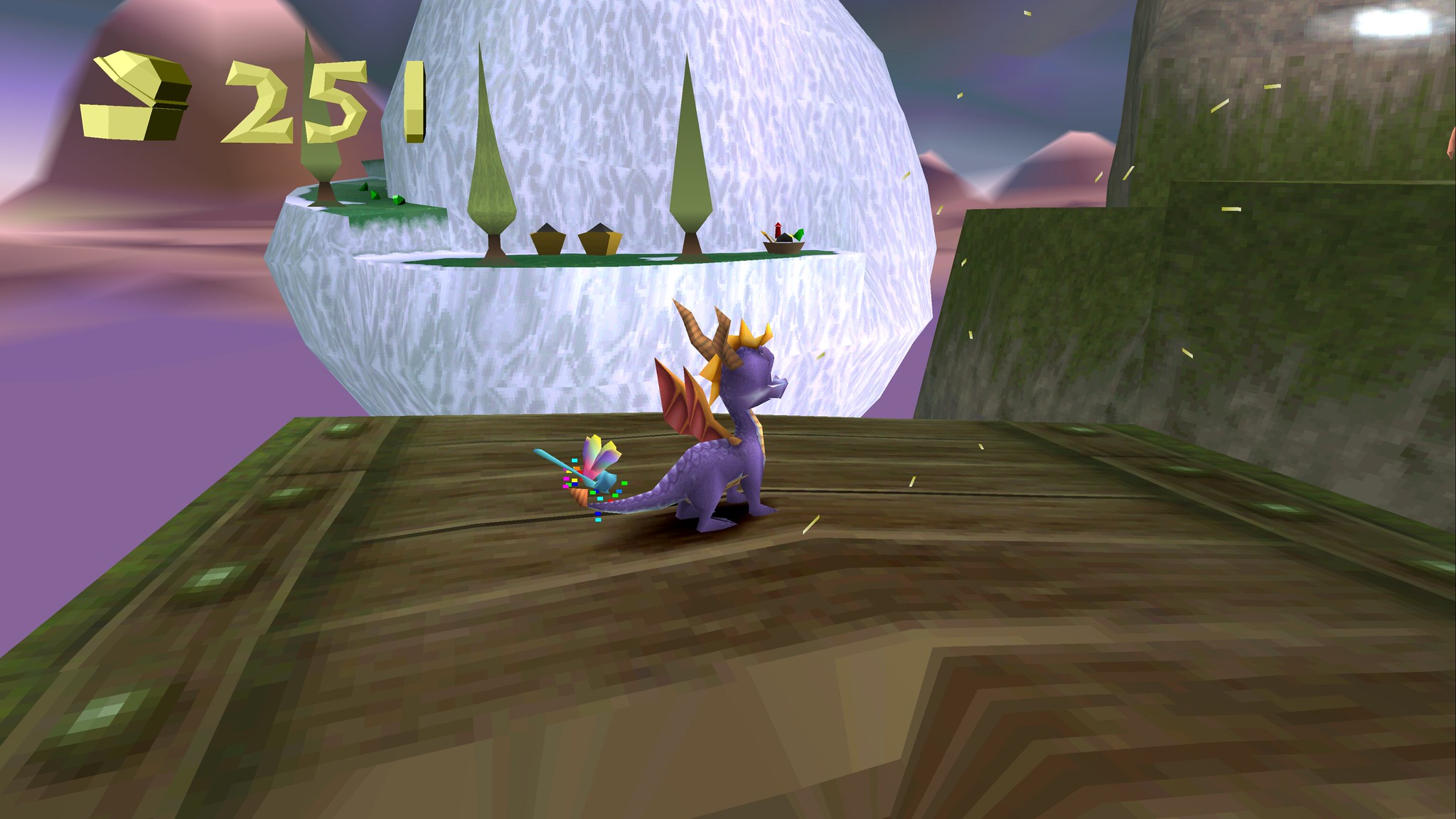
One thing that’s impossible to show in a screenshot, but still worth mentioning, is the soundtrack by Stewart Copeland. He’s mostly famous for being the drummer of The Police, and he was also in a rad band with Les Claypool and Trey Anastasio called Oysterhead. But it’s lesser known that he’s composed scores for dozens of films and a few TV shows, in addition to the Spyro series.
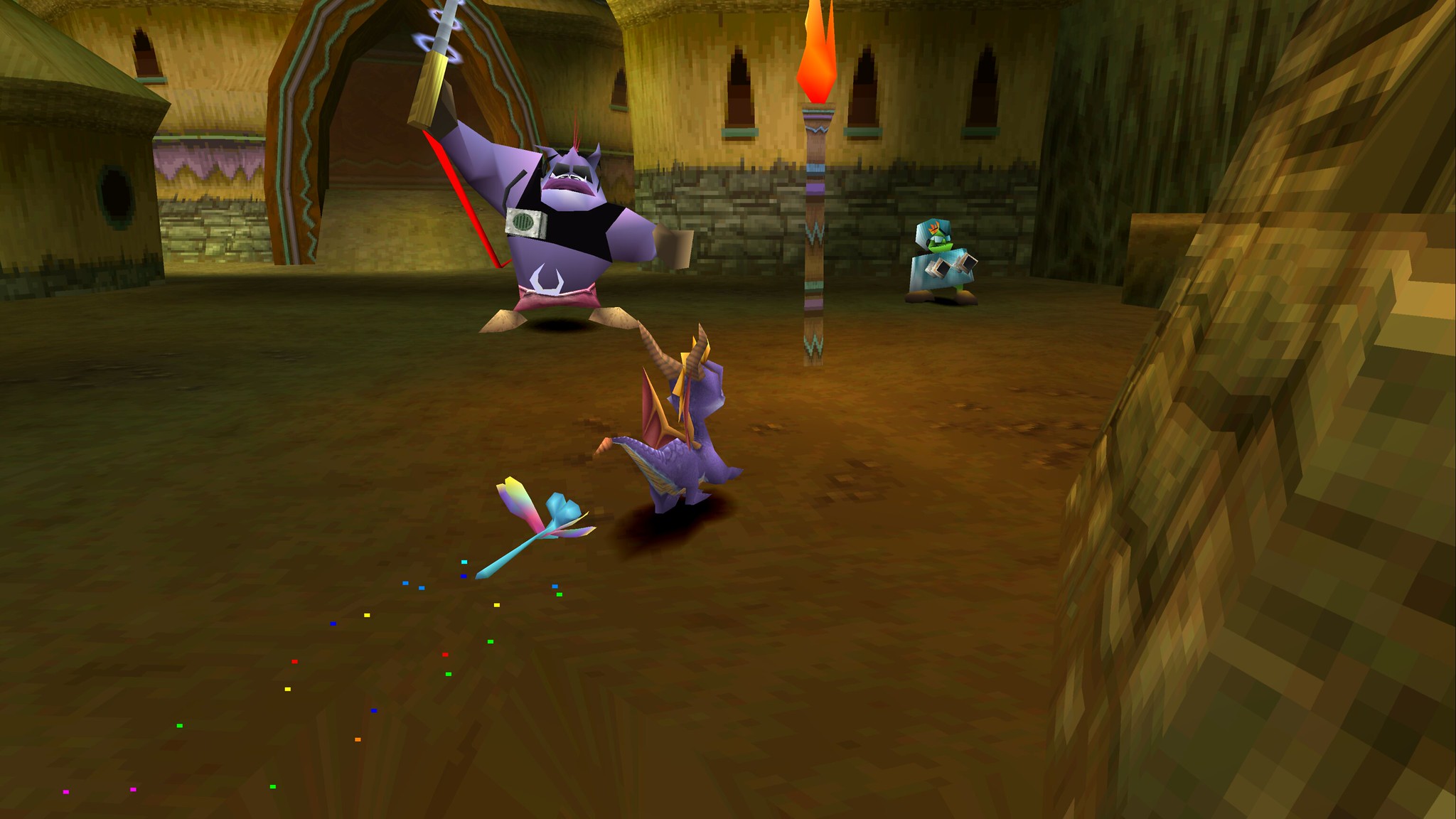
This is where the game starts to become a bit of challenge. There are more enemies with more formidable weapons, and learning their timing and weakness is now essential.
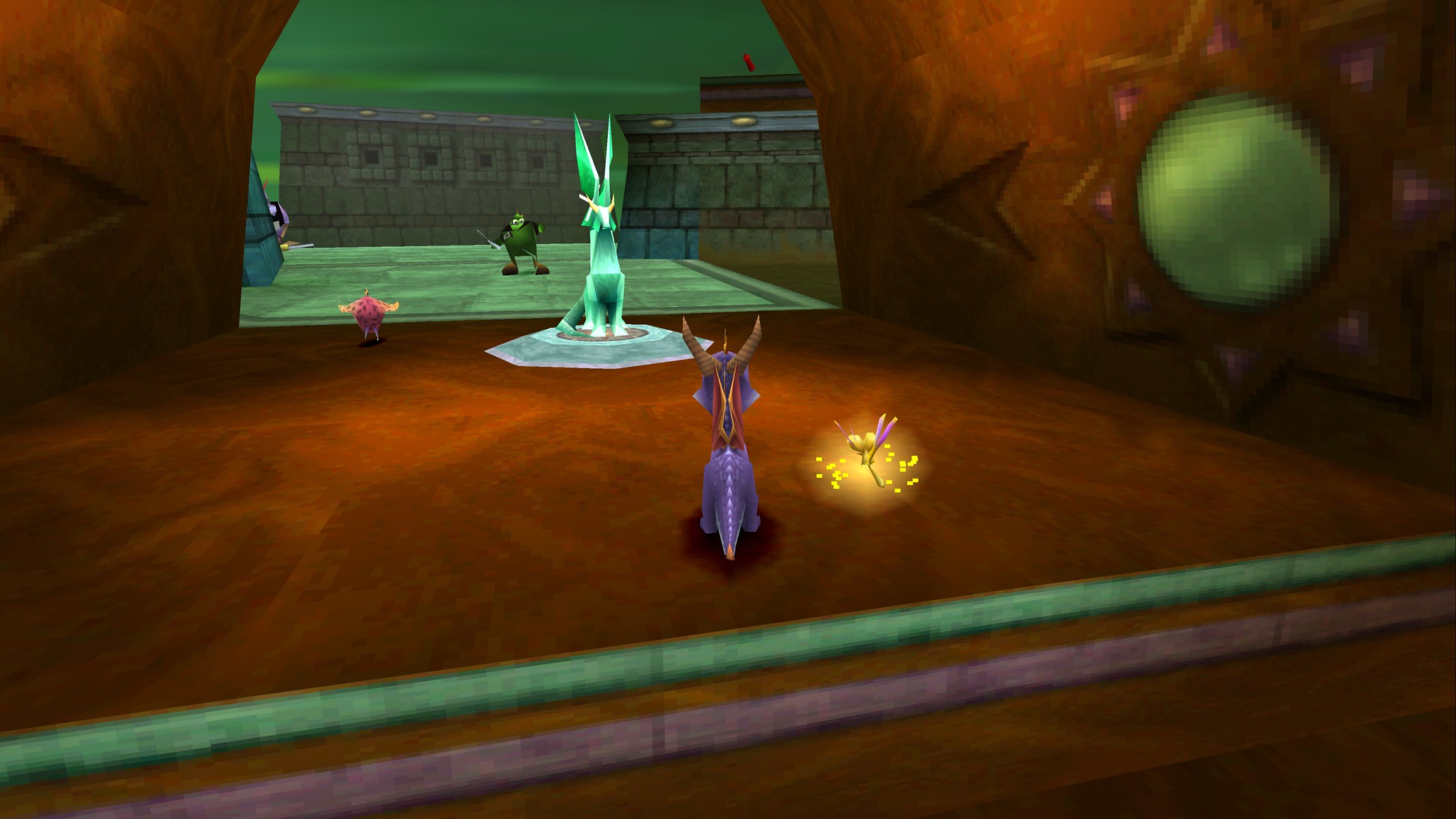
Overall though, this game is pretty easy by 90’s standards. The biggest challenge is dealing with the slightly tricky controls and slow camera.
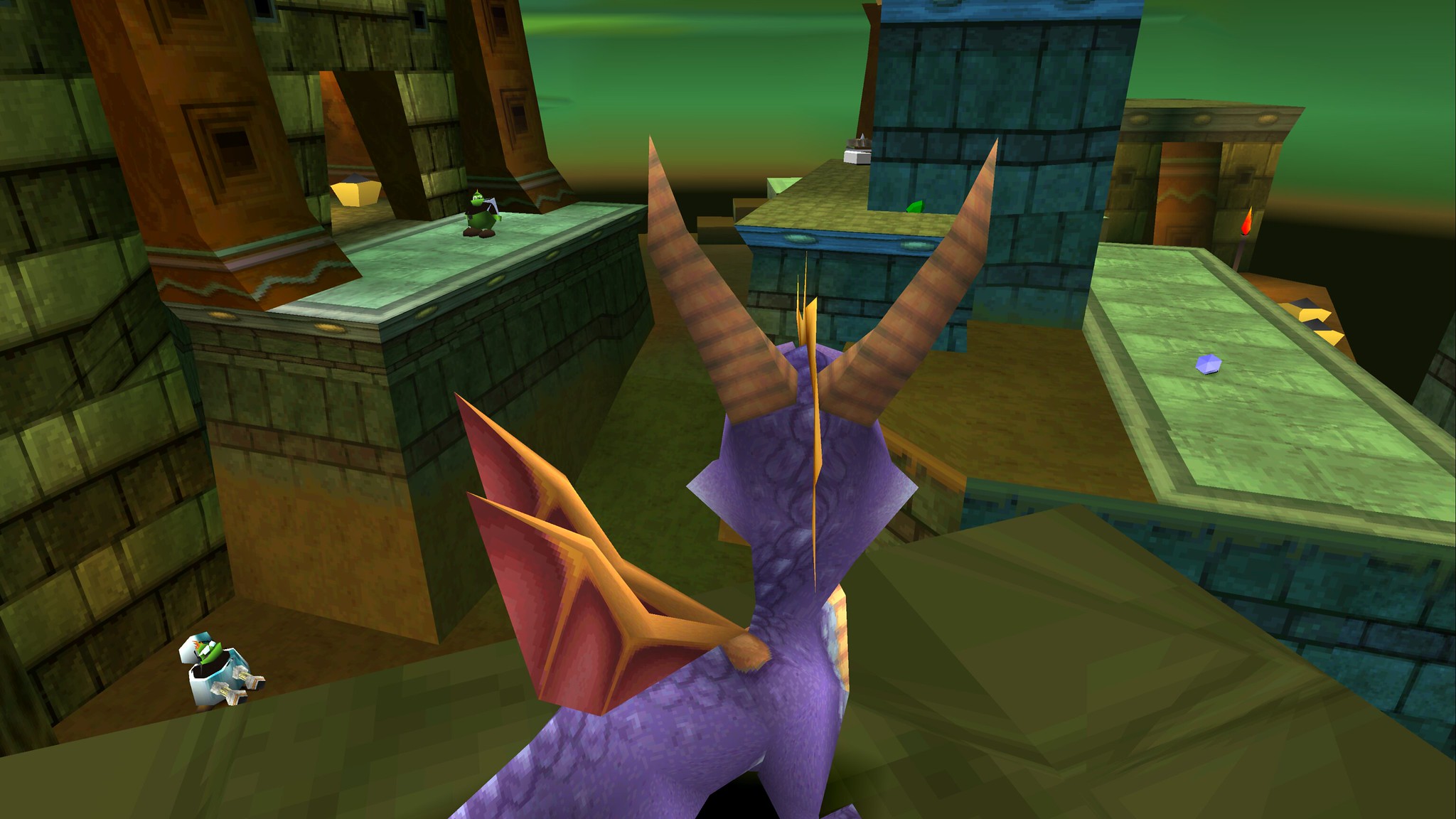
We take huge draw distance for granted these days, but this was pretty impressive back then.
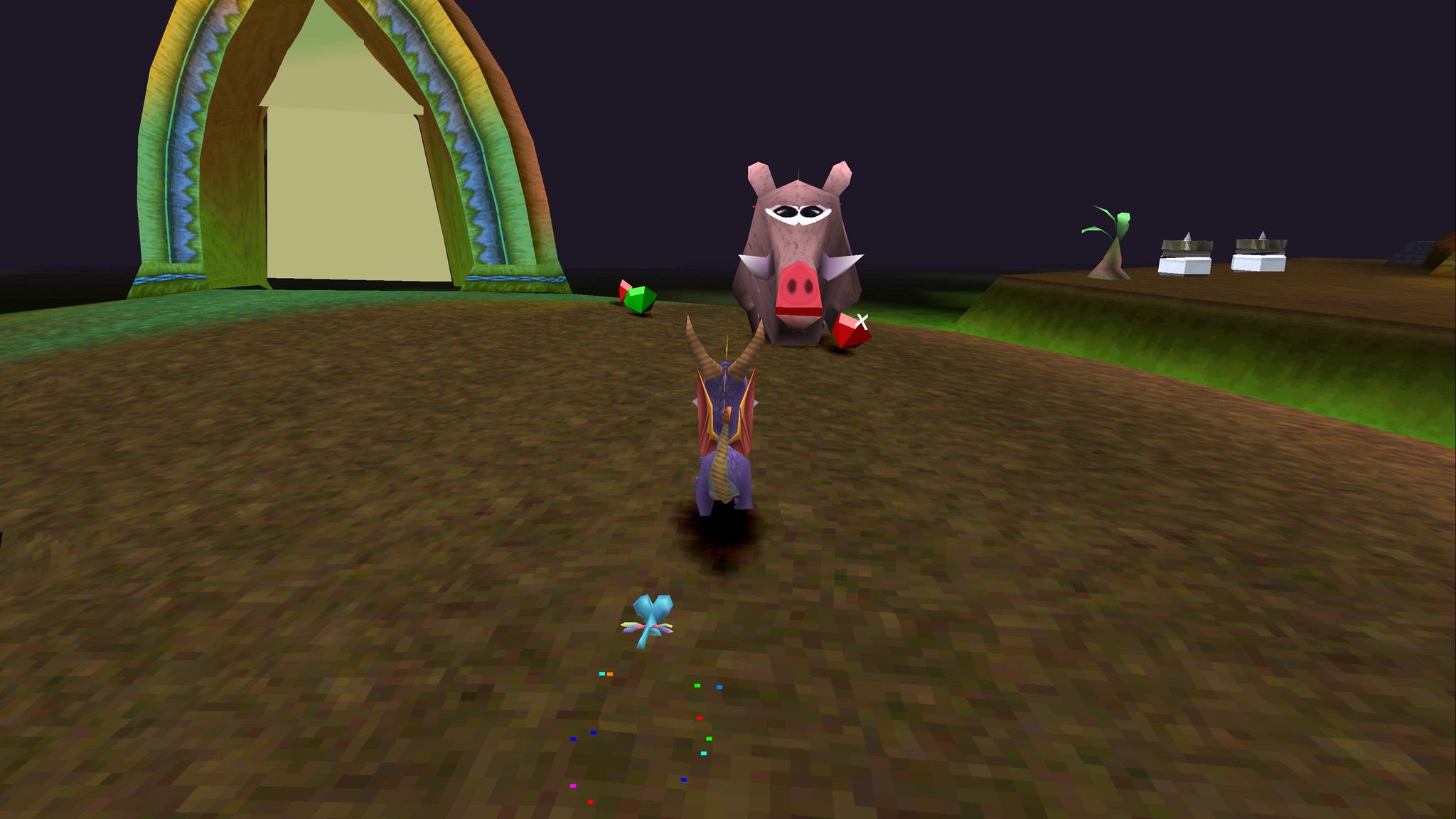
Character designs in this game are unique, at least. Despite enjoying the overall visual style, I find the characters to be mostly off-putting.
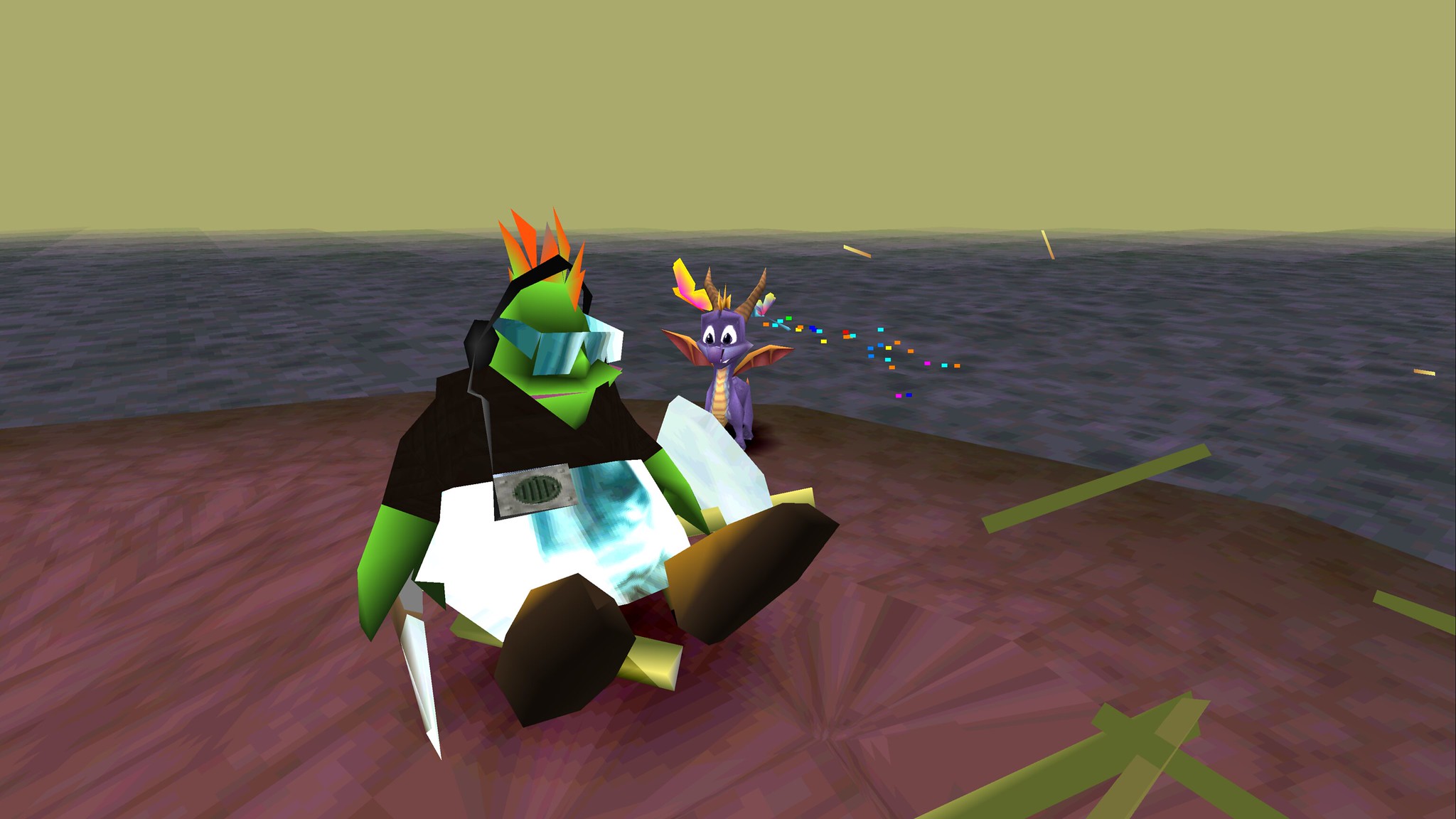
Nothing to see here, just a dude with a mohawk napping with a knife while wearing sunglasses and listening on headphones.
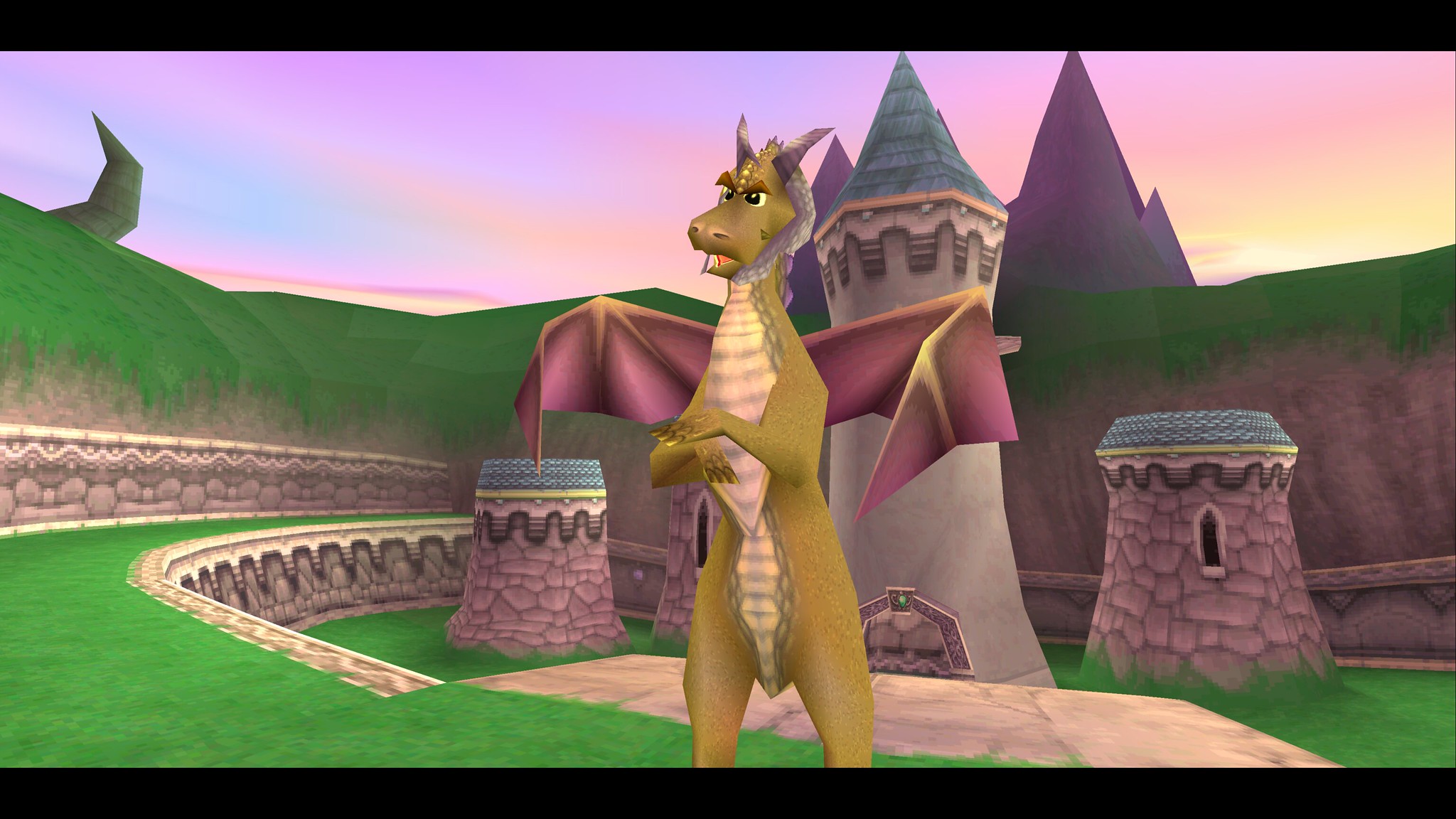
Most of the dragons will give you a quick monologue when you free them. The voice acting in this game is actually pretty good, with lots of animation veterans on the voice acting roster. It feels like watching any Saturday morning cartoon of the era.
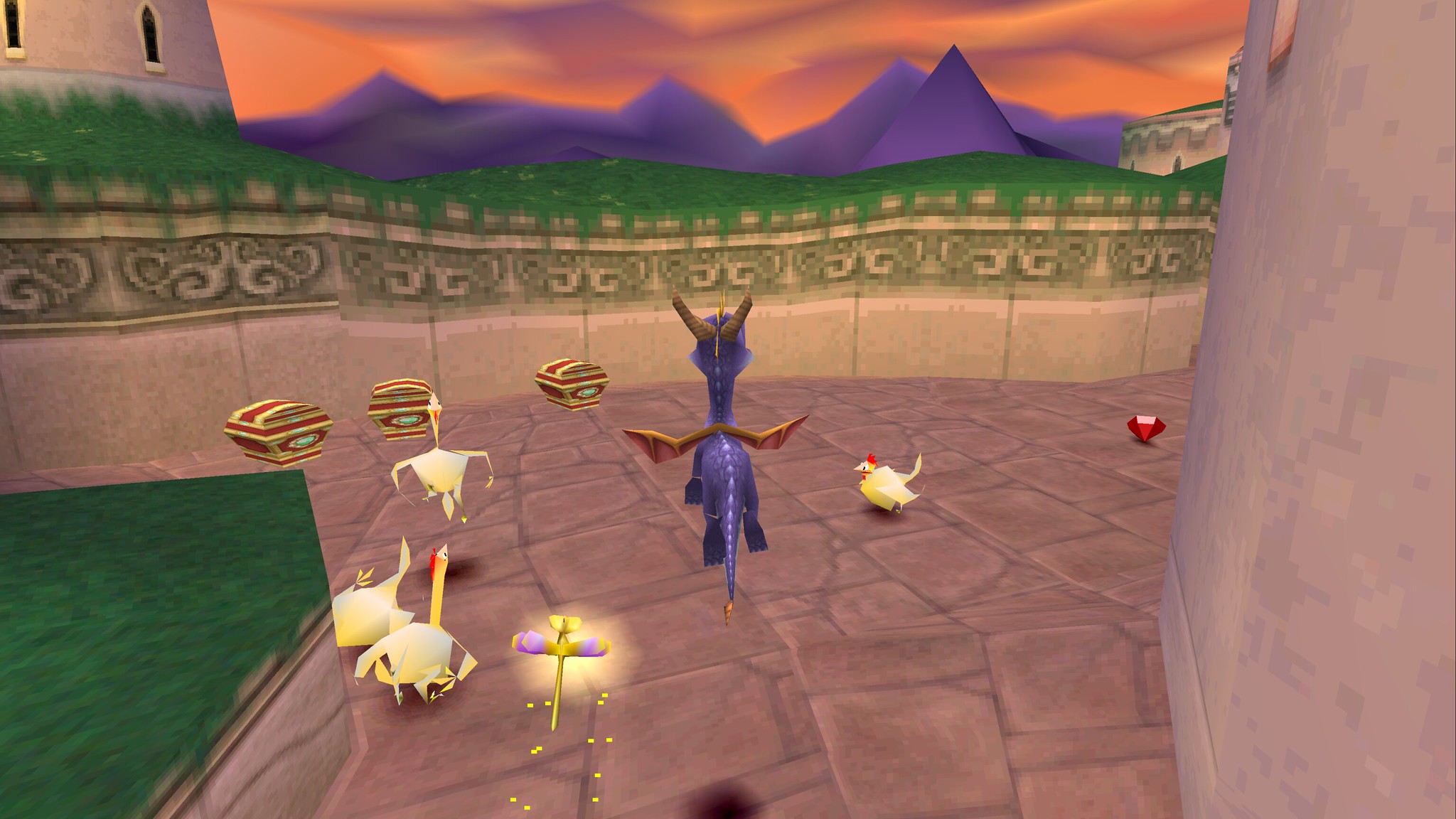
Spyro talks too, and he’s voiced by Carlos Alazraqui, who’s done lots of fun roles like Rocko of Rocko’s Modern Life, the Taco Bell Chihuahua, and Deputy James Garcia on Reno 911.
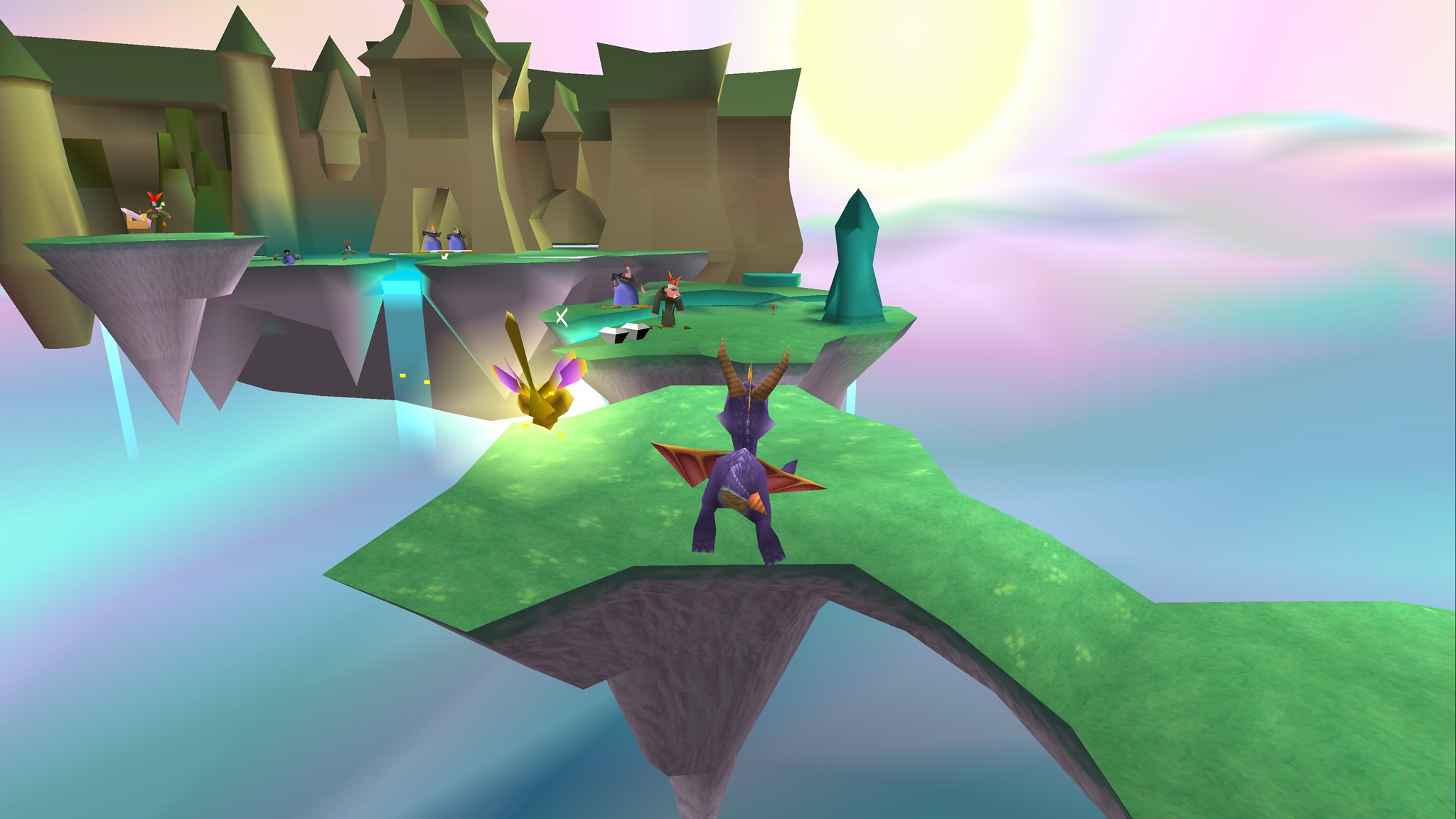
They were definitely inspired by Super Mario 64 when they made this game, as most people who made 3D platformers in the late 90’s were.
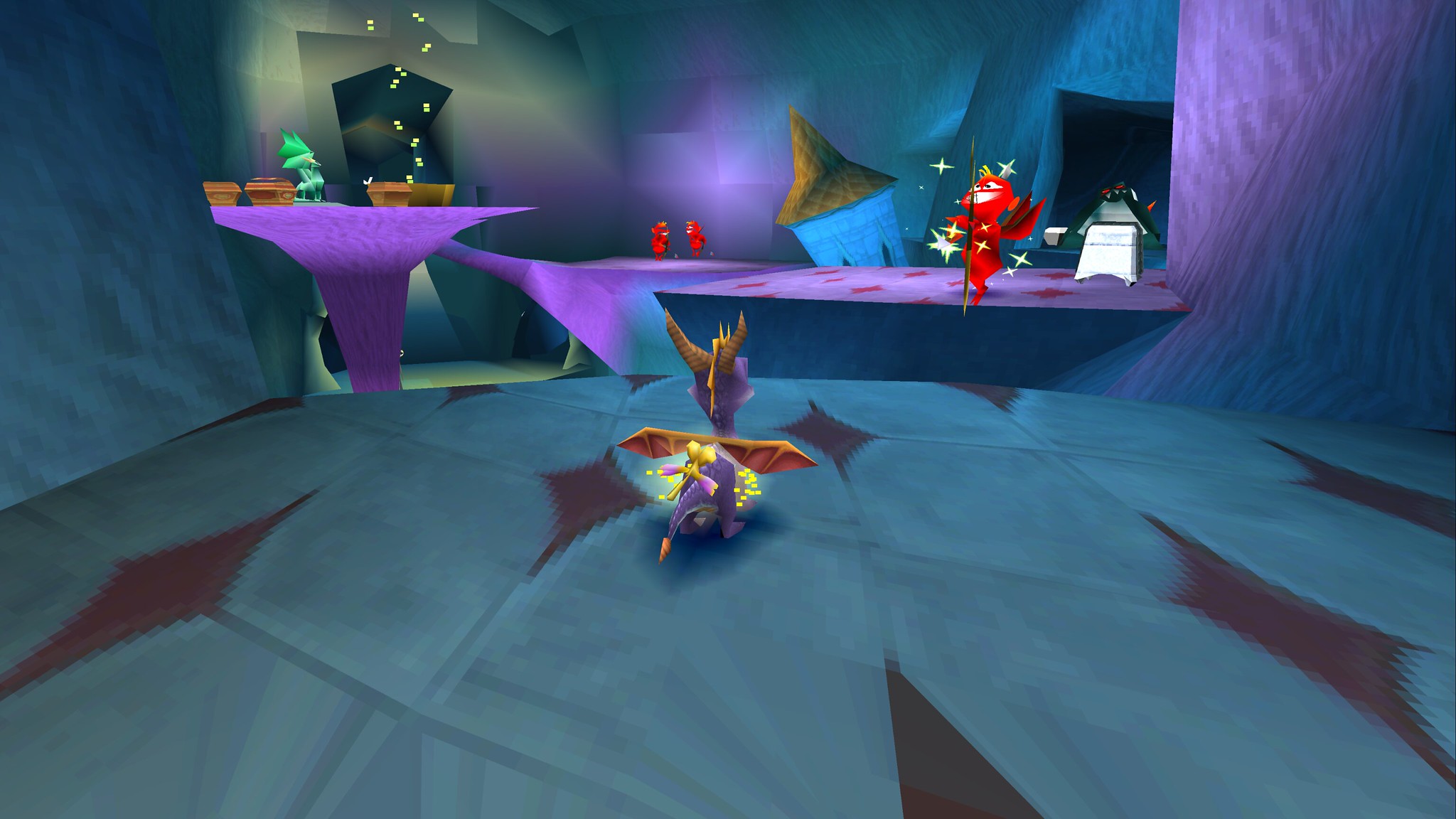
Even though the game is pretty easy, you do have to know what you’re doing and have a little bit of strategy. This was an era when they were still figuring out what to do with 3D platforming, and a lot of the ideas still came from the 2D platformer school of design. Here, there’s one way to get to the next platform and there’s an enemy waiting in your way: a very 2D-era level design.
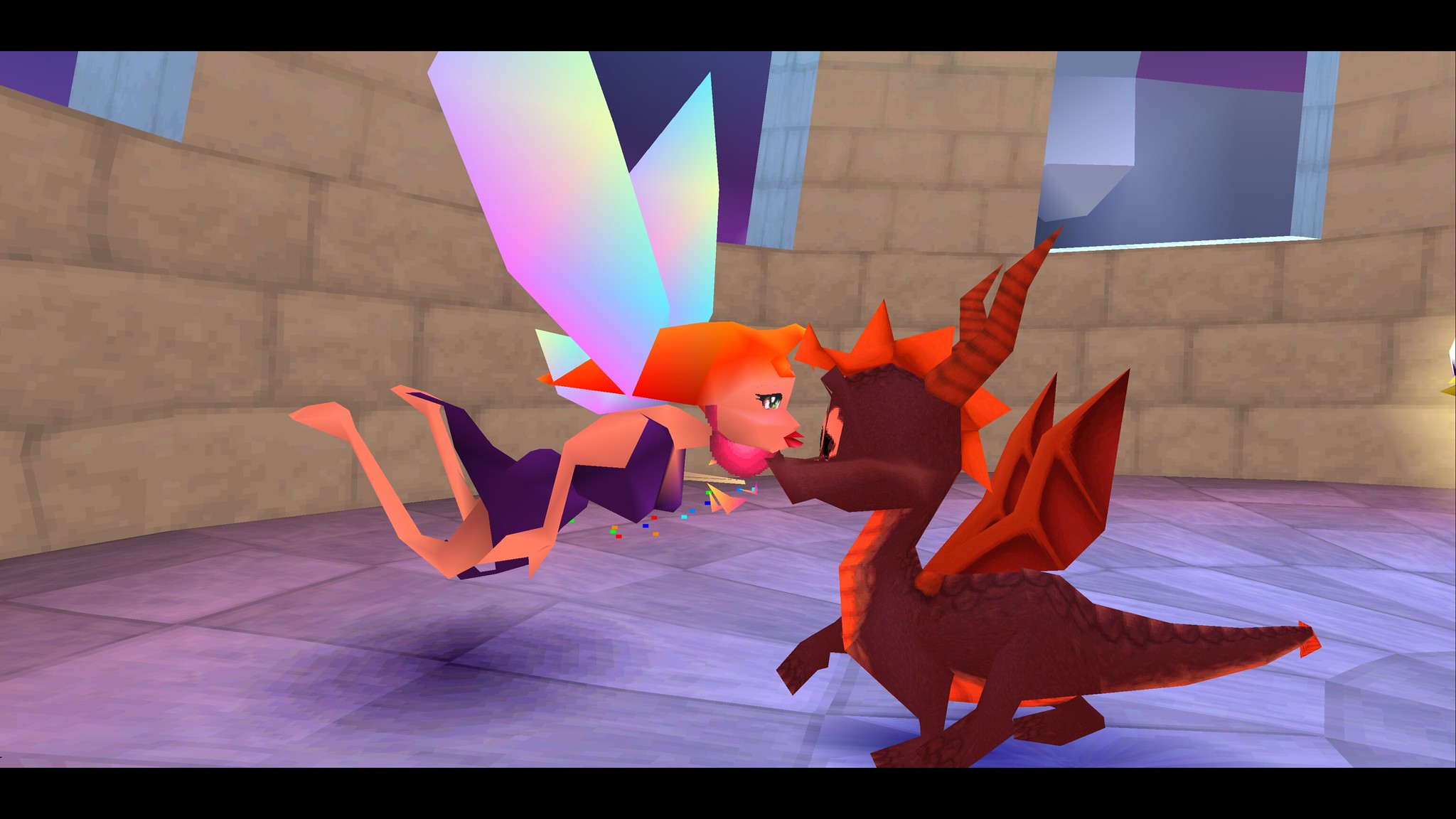
This fairy unlocks a Spyro super power.
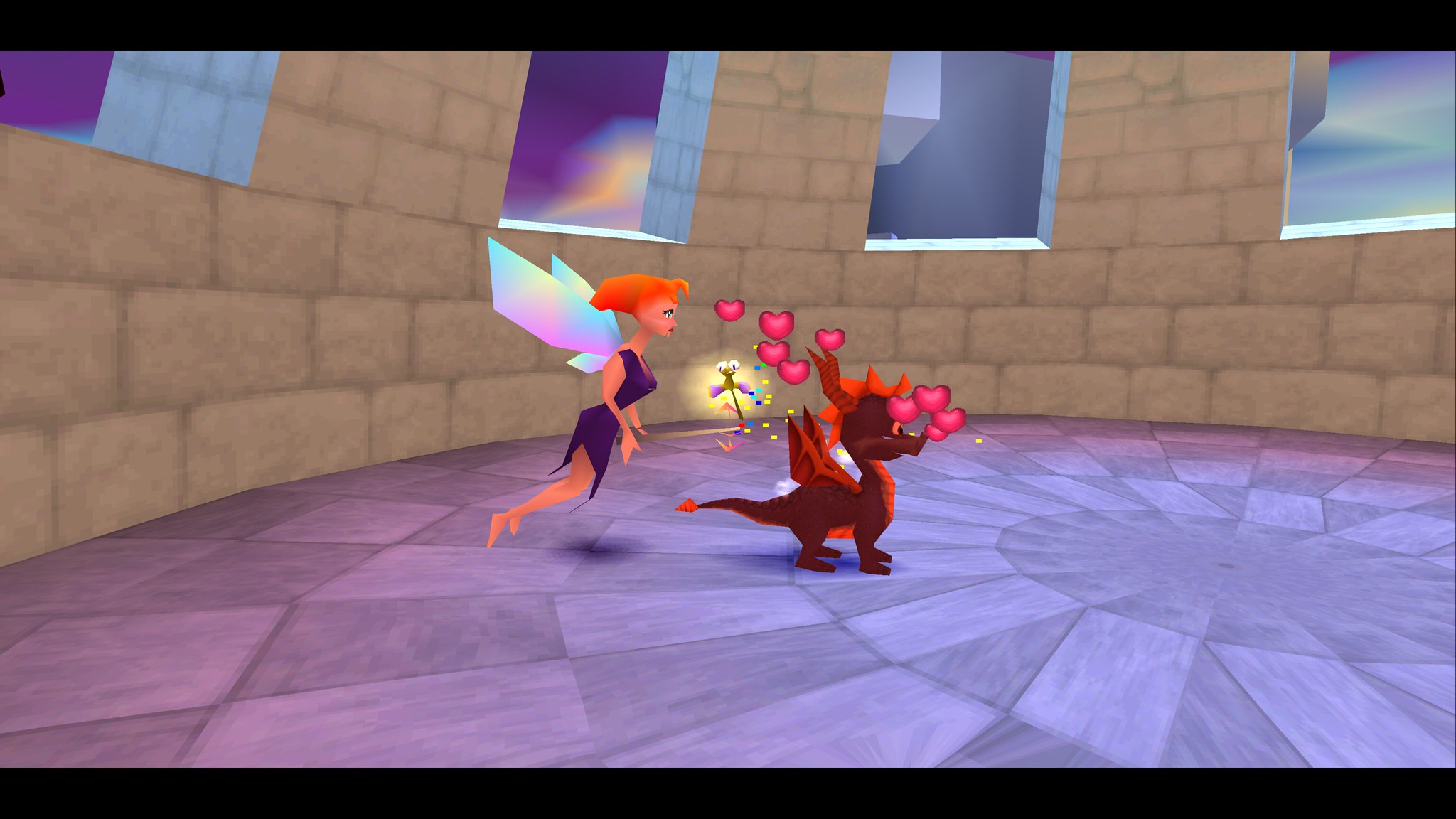
After things get a little Bee Movie, Spyro is psyched up.
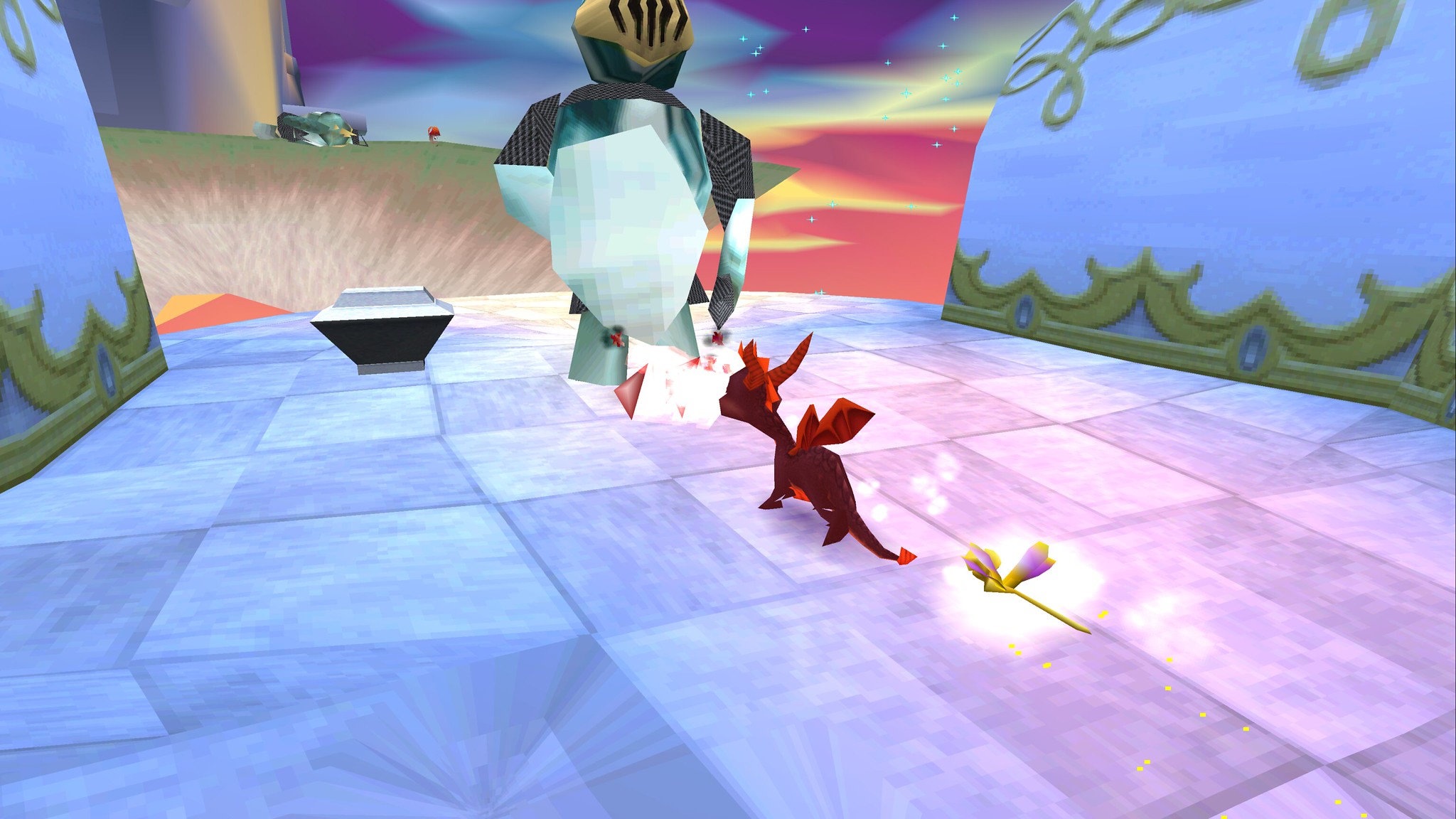
This gives him the super flame that destroys anything in his way for a short period of time.
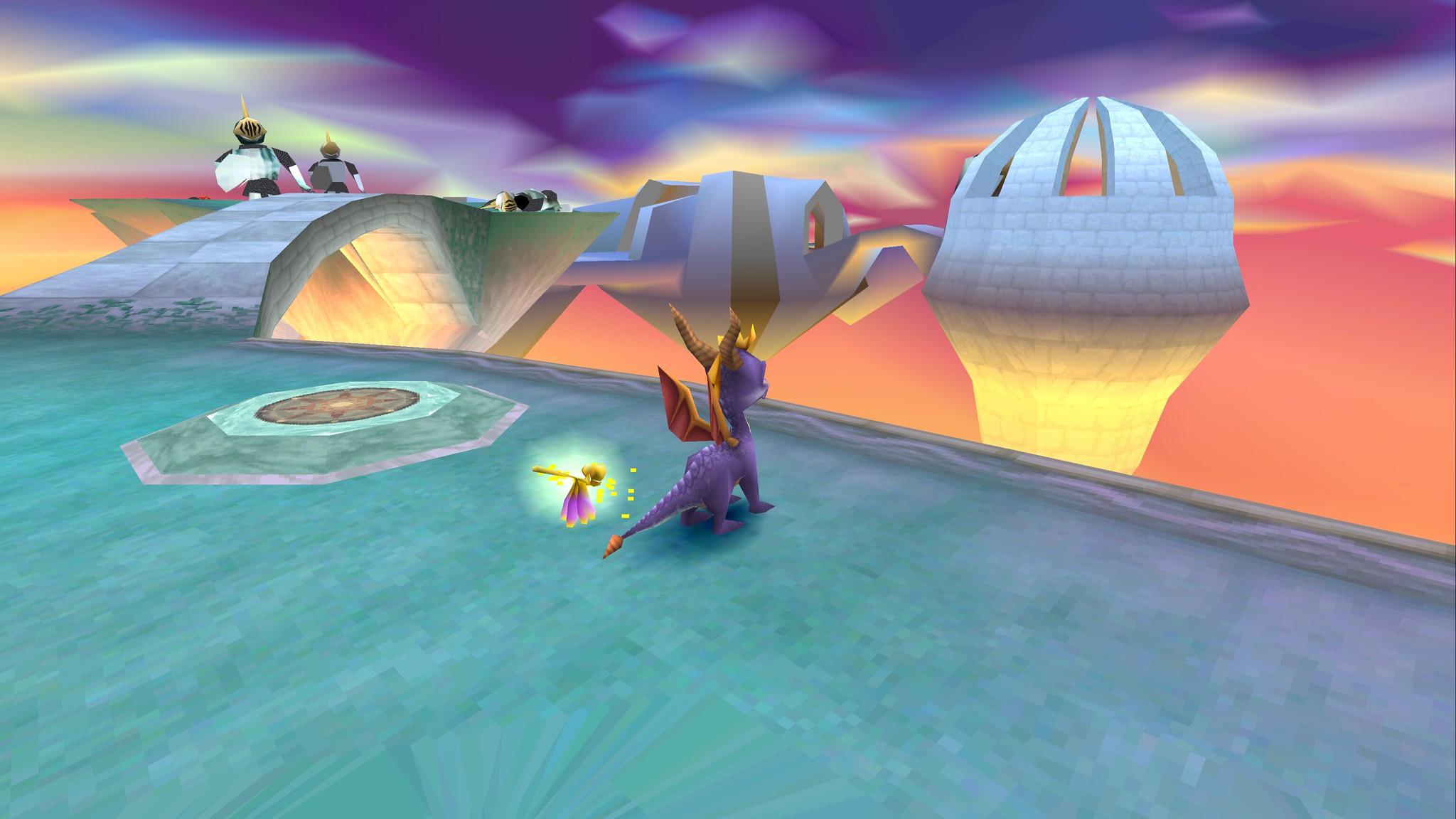
Even the colors of the sky and environment get more interesting as you progress into this game. They really turned the skybox up to 11, looking wilder than Bespin in 1997’s Star Wars Special Edition, but somehow it works perfectly.
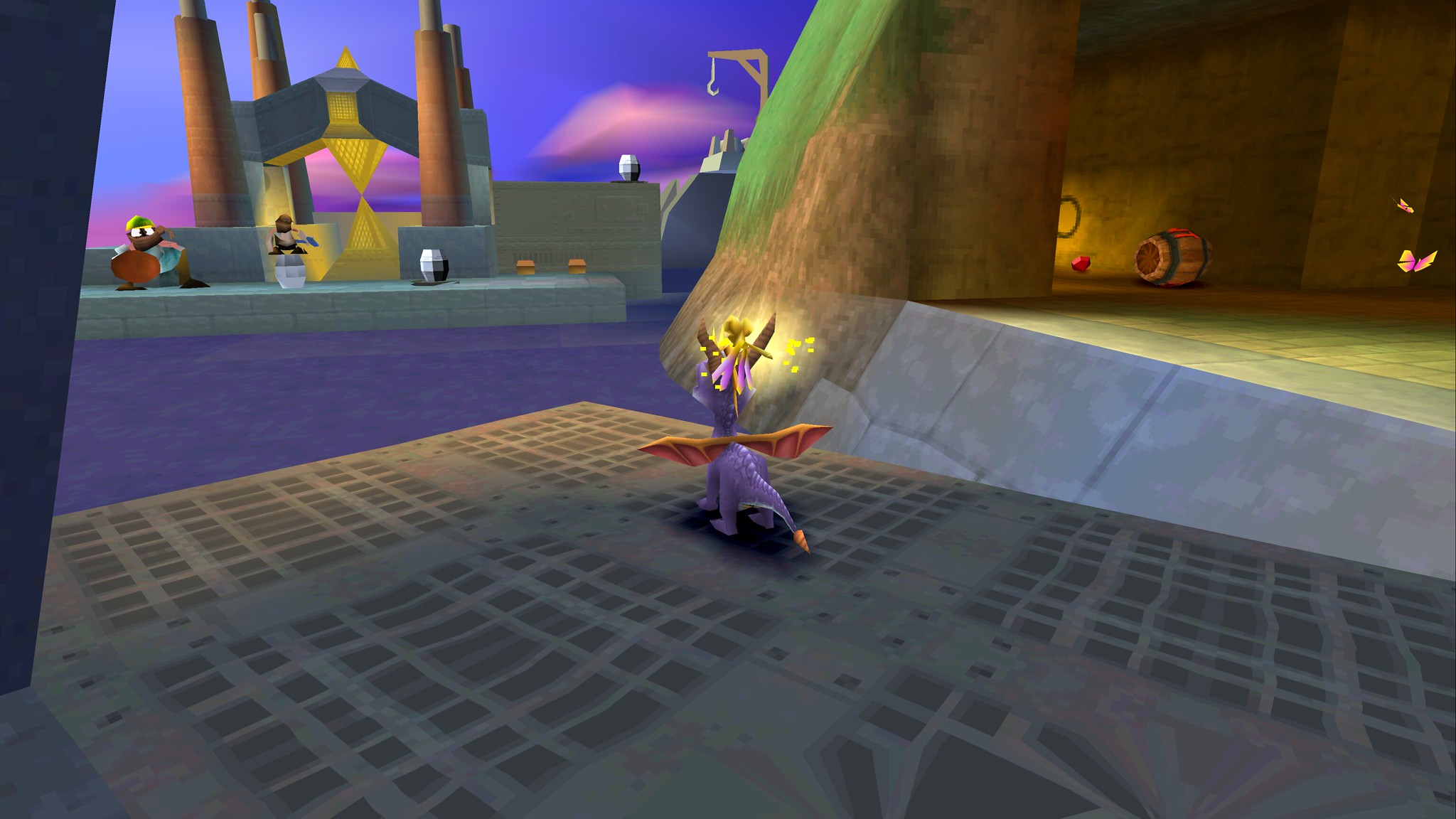
Generally, levels have some branching paths and a bit of a maze-like quality; they aren’t just straightforward A to B. These areas from later on have more cohesive designs though, encouraging you to loop around instead of double back.
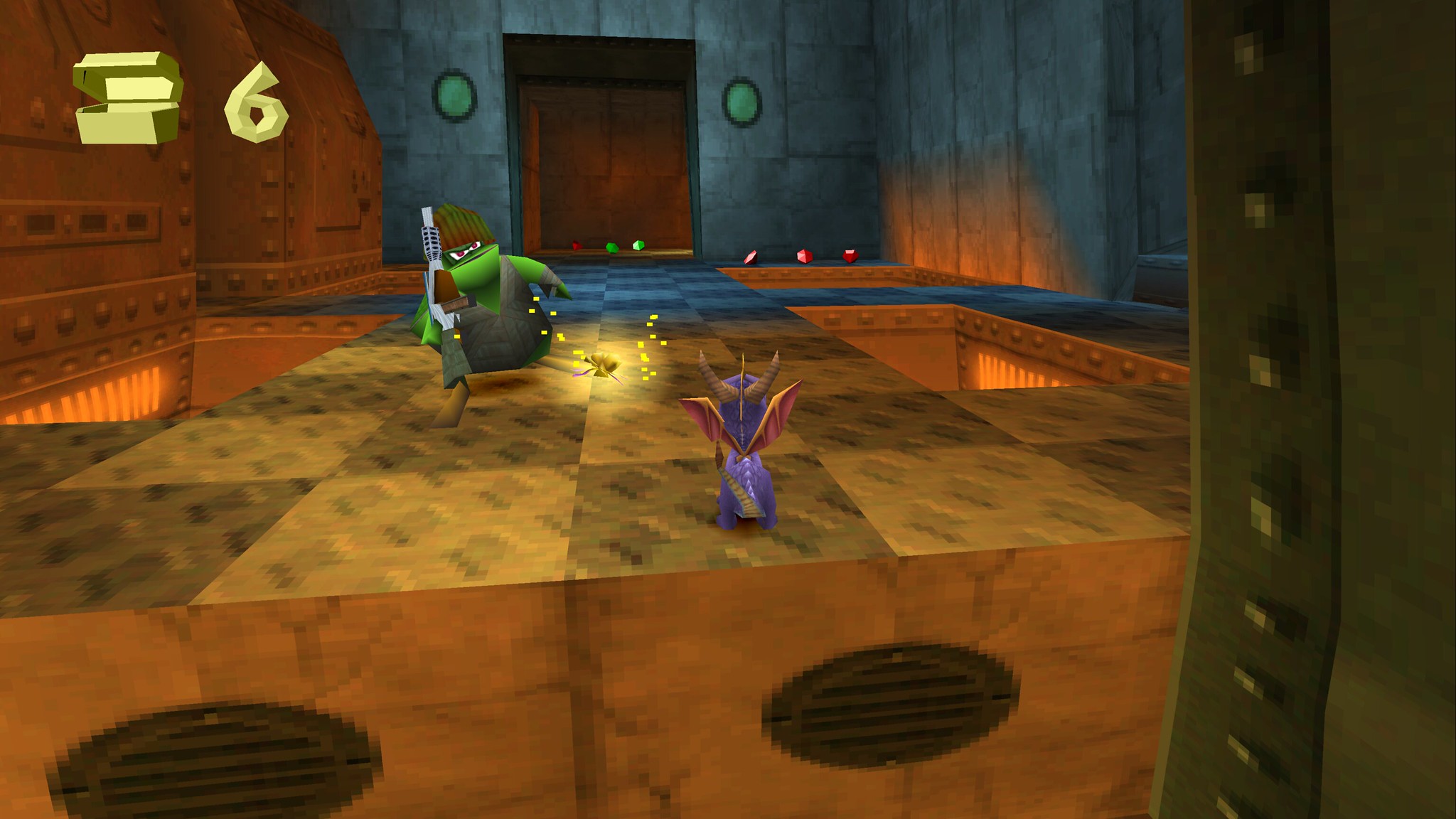
Some of the enemies had projectiles, but now they have guns??
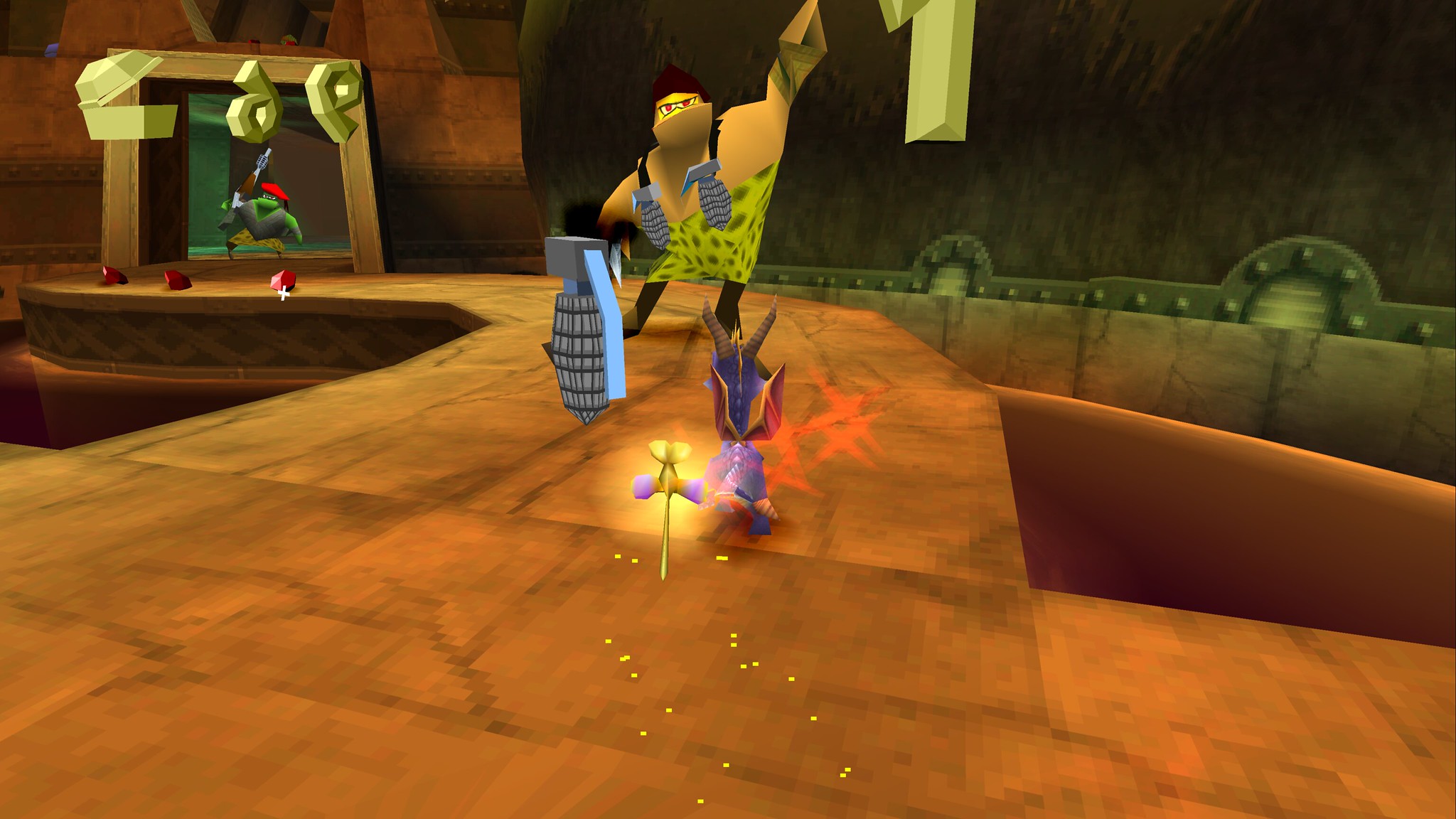
Grenades too? You can tell we’re getting to the end of the game.
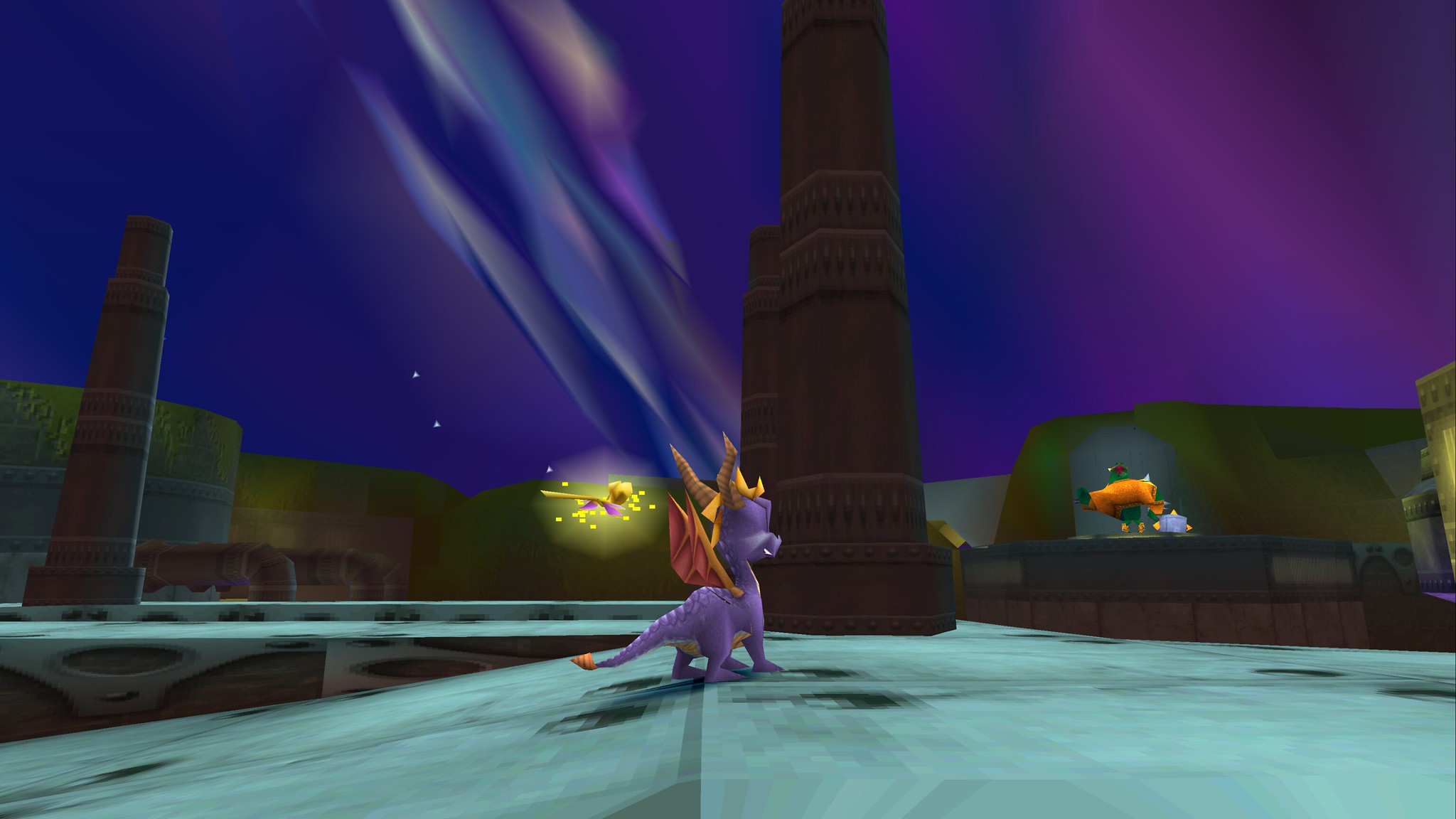
Speaking of rad skyboxes, they even had some Northern Lights looking business in this one.
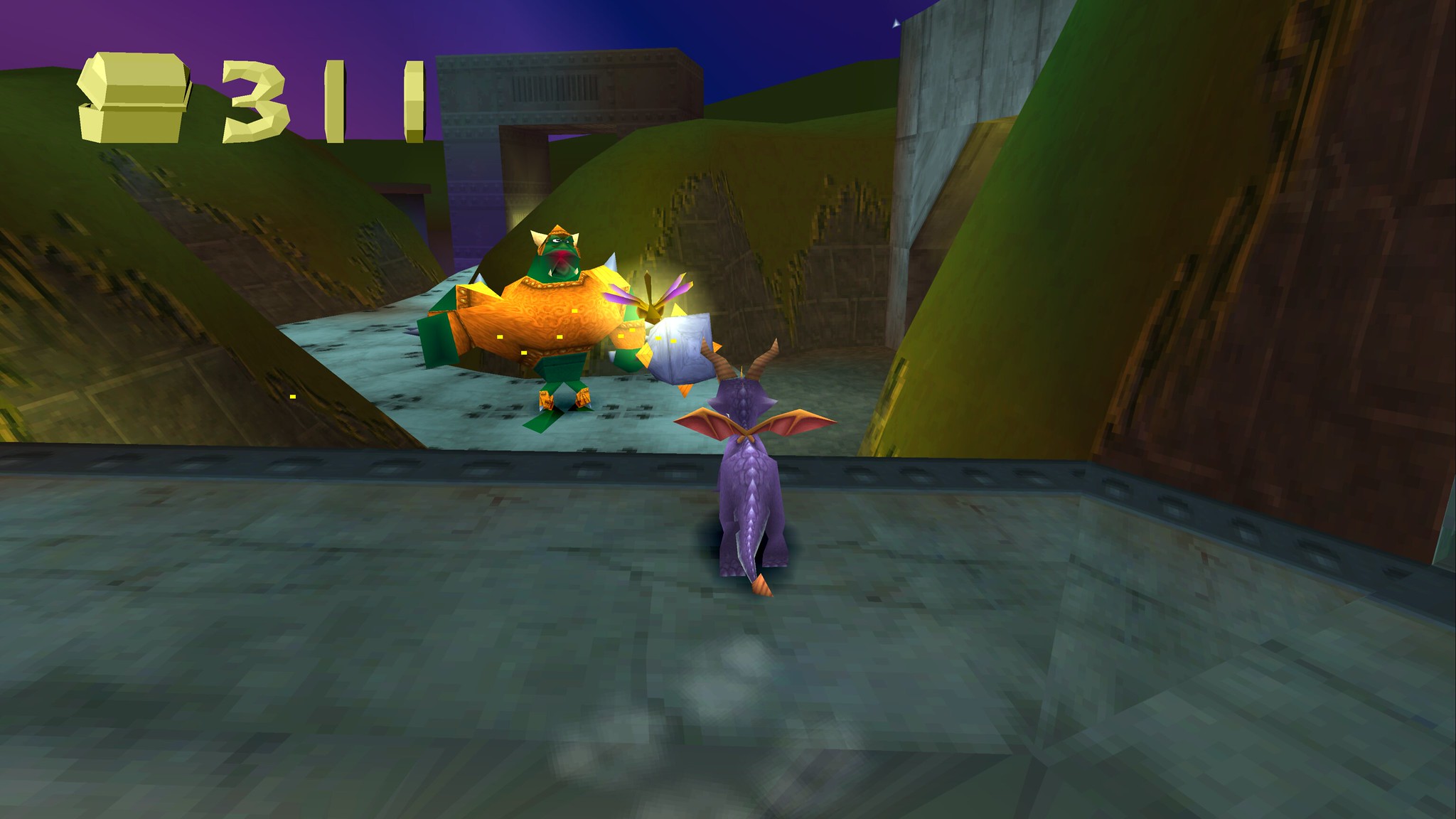
The final boss is an extended chase scene that serves as your last running and jumping test.
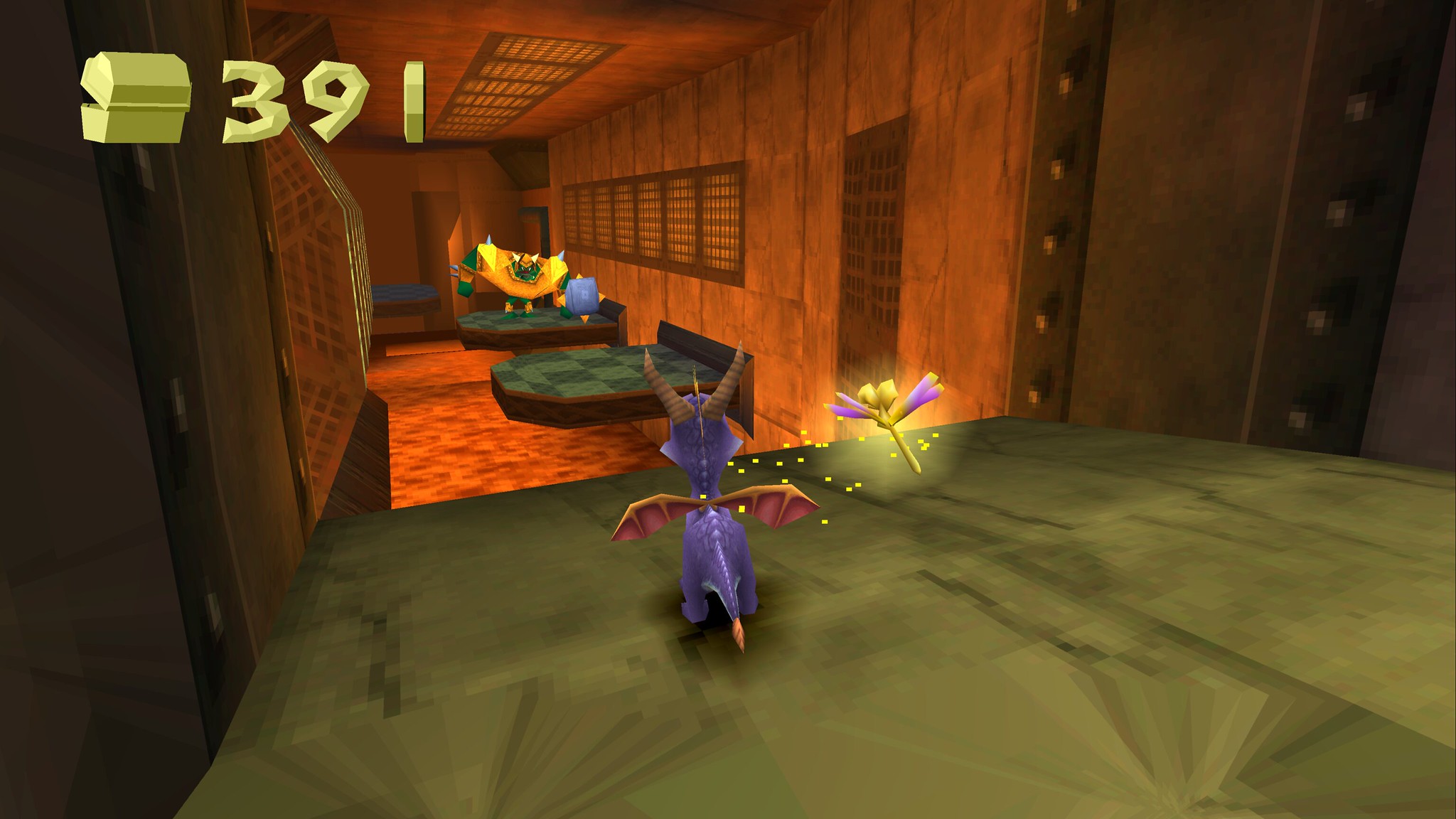
This was a pretty fun chase, and like the rest of the game, it wasn’t too hard. No huge difficulty ramp up here.
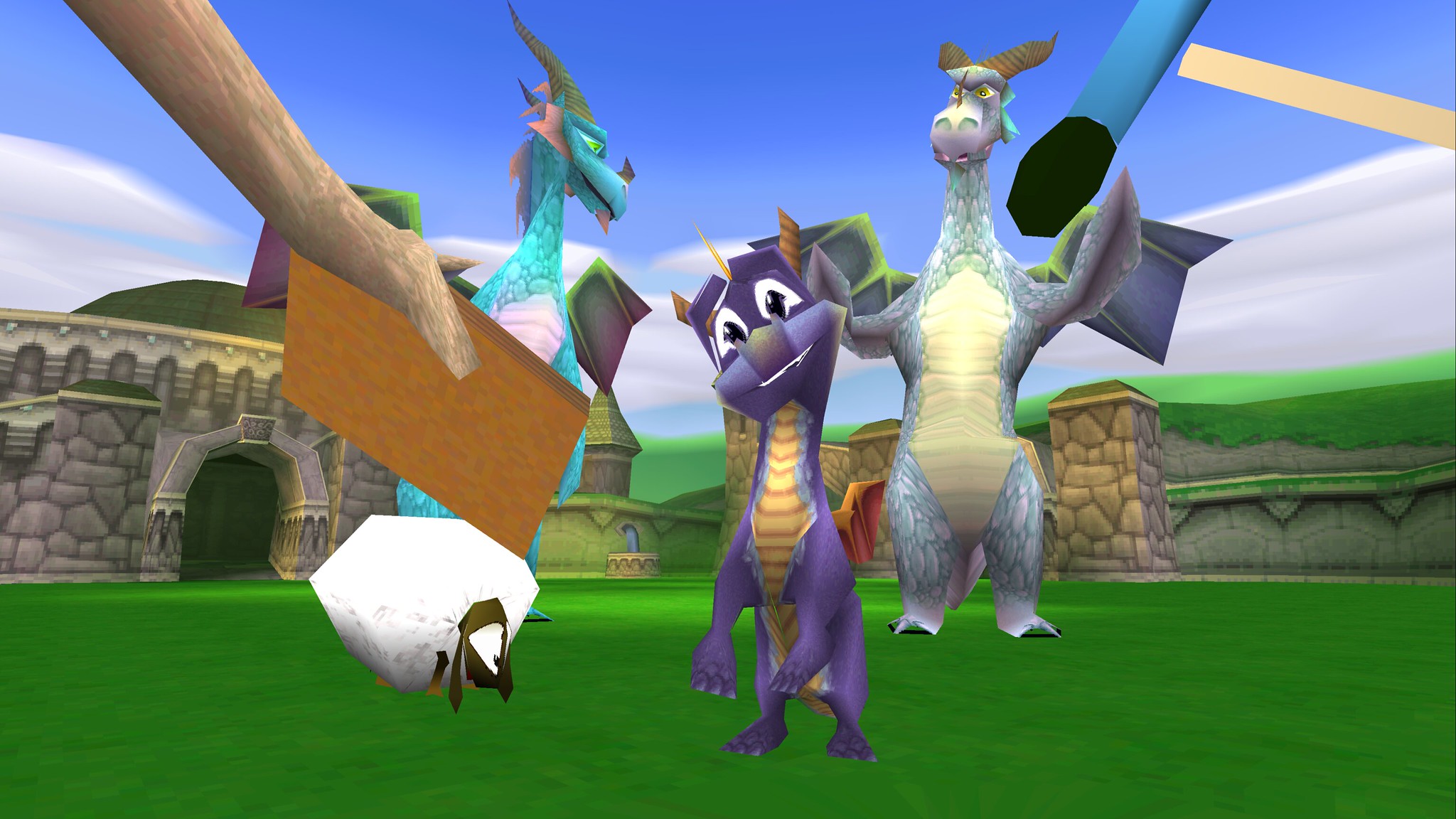
After this, you get interviewed again, and the credits roll.
Little bit of humor thrown in there at the credits.
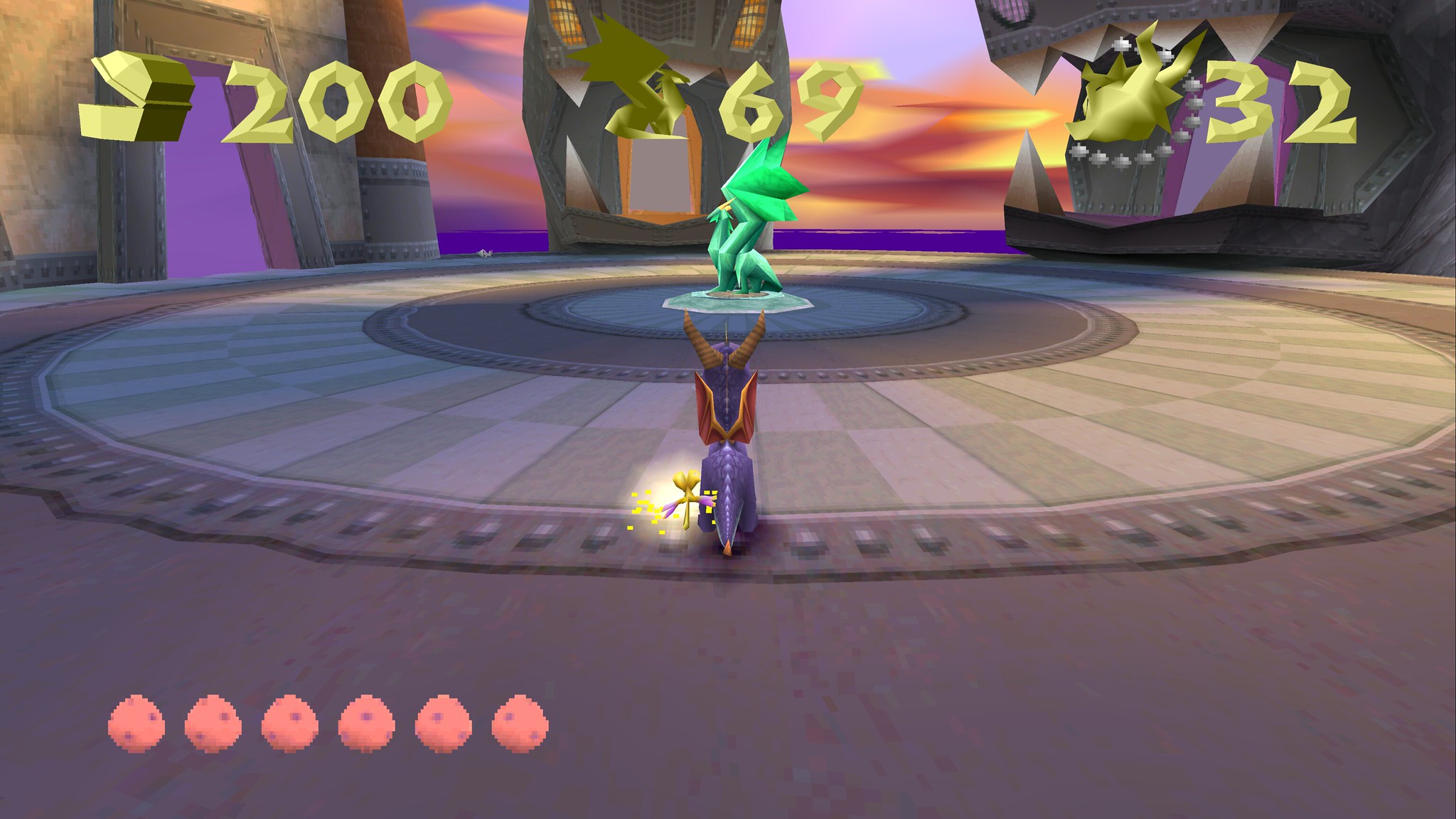
And then you’re back in the game world to grab one more dragon, who gives you the classic story: hey, if you get all the items in every level, come back here for the real ending.
Well, I don’t know about doing that, but I did enjoy playing this game. And so did many other people: this game sold 4.8 million copies, putting it 18th on the all-time PS1 sales list (between Resident Evil and Tomb Raider 4). It does feel floaty, but then again Spyro is a floaty dude. It also feels like it was made with love, which is always my favorite thing to discover. The story was completely stupid and utterly forgettable, but that’s okay because that’s not what we’re here for: Super Mario has an irrelevant story too but it’s still the benchmark series for this genre. I want to play a fun game, and Spyro the Dragon is fun.
After accelerating all the way to the finish line, I still wanted more. Knowing that they kept improving this game as it went, and that the sequel was released just over a year later, I knew I had to dive in. Bring on Spyro 2!


 Star Road

