
Every PS1 Game – ペルソナ2 罪 aka Persona 2: Innocent Sin
As I laid out in my post about the first Persona game, the main reason I started exploring this series was because I heard about Persona 5 and decided to explore the entire series before jumping into the latest installment. I enjoyed Persona 1 much more than I expected, and even before the credits rolled for that game I was looking forward to seeing what the Persona 2 duology would bring.
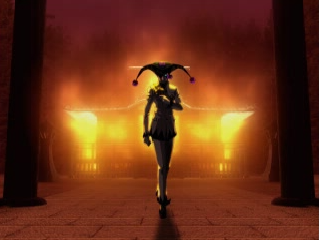
Duology? Yep, there are actually two games that make up “Persona 2”, released in 1999 and 2000. For various reasons, the US market wouldn’t receive part 1 until a PSP version was released in 2011. But this website is focused on the PS1 of course, so I’ll be looking at the fan-translated PS1 version in this post.

In Japan this game has two names: ペルソナ2 罪, or Persona 2 Tsumi, where “tsumi” translates to crime or sin. The game artwork and game itself also list its name as Persona 2: Innocent Sin, so there is little debate over the actual name of this game, unlike the first game which was called Megami Ibunroku Persona in Japan and Revelations: Persona in the USA.
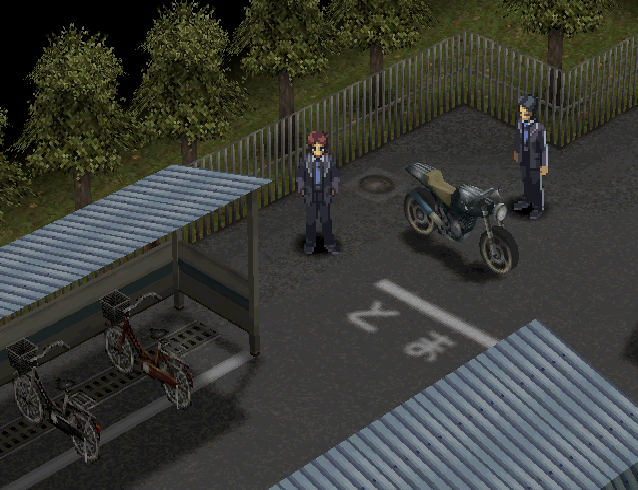
It was almost three years between the releases of Persona 1 and 2, and as soon as the game starts you can see the progress made between 1996 and 1999. This is a great illustration of how the quality of Playstation’s software library grew constantly through its life as developers figured out how to get the most of it.
Also, to reiterate another point I made in the first Persona post, while playing through this game on the Duckstation emulator I experimented with a variety of graphics settings and went back and forth between “Internal” and “Screen” resolution shots. There are quite a few shots I took at 1x resolution and internal resolution, hence the proliferation of tiny 320px width images in this post.
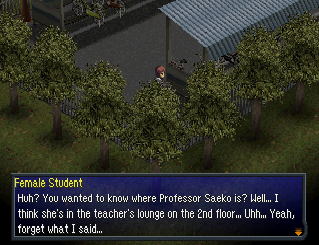
The opening of this game is brilliant. You need to find Professor Saeko, so you start asking around. A nearby student gives you the first clue.
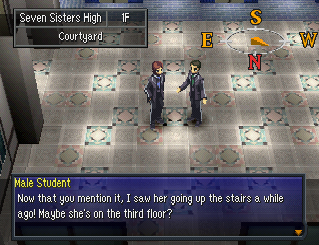
However, you soon realize that you’re on a wild goose chase, because as you talk to more people you keep getting more places to go. It’s an elegant way to introduce you to the world of Seven Sisters High, its characters, and this game in general.
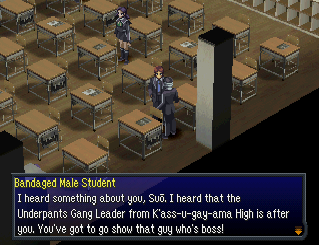
Time for a translation note. As I did with my critique of the Policenauts translation, I would like to first give the disclaimer that overall I found the translation to be pretty good, and any gripes I have are really more like nitpicks on things that don’t really affect your enjoyment of the game. Like the “Elles/LS” bag from Policenauts, the translation of this school name becomes a big deal in P2:IS because it’s a major presence in the game.
Kasugayama High School (春日山高校, Kasugamaya Koukou) is the rival school to the protagonist’s school, Seven Sisters High School. The characters of Kasugayama, 春日山, literally mean “spring day mountain”, and 高校 just means “high school”. In the Japanese version, the derogatory nickname for this school is a simple shortening to カス高 or “Kasu Kou”, with this “kasu” meaning something like dregs, leftovers, or junk.
Amazingly, the Gemini fan-translation was released way back in 2008, three years before the official PSP English localization. In the official version, Atlus translated it as “Cuss High”; my guess is that they were trying to keep the “kasu” pun intact and “cuss” was close enough. “Cuss” is an odd sounding word in the 20’s, but I recall it being used commonly when I was a kid in the 90’s.
As you can see in the above screenshot, Gemini decided to call it “K’ass-u-gay-ama High”. It’s certainly juvenile enough to be from the mind of a teenager. But this ignores the entire point of a nickname, which is that it’s a short version of a name: just look at how “Kasu Kou” sounds and looks versus “Kasugayama Koukou”.
Some localization companies like Working Designs would have renamed the school to something like “Shitamachi High School” and then shortened it to “Shit High”, but that localization style of completely changing names has completely fallen out of favor, and it actually started around the time of this game’s release in the late 90’s. Remember how 1996’s Revelations: Persona had significant changes to not just names, but the appearances of characters? When Atlus sent the next Persona to the US in 1999, it didn’t have any of that type of changes.
I suppose another option would be to translate Kasugayama and go from there. The protagonist goes to 七姉妹学園, Nana Shimai Gakuen, which translates directly to “Seven Sisters Academy”, but is referred to as “Seven Sisters High School” here and in the PSP localization. Perhaps they could have translated Kasugayama into something like Spring Mountain High School and made the nickname related to that. Any ideas? I can’t think of anything off the top of my head. This is just another example of how hard it is to translate insults and slang between Japanese and English.
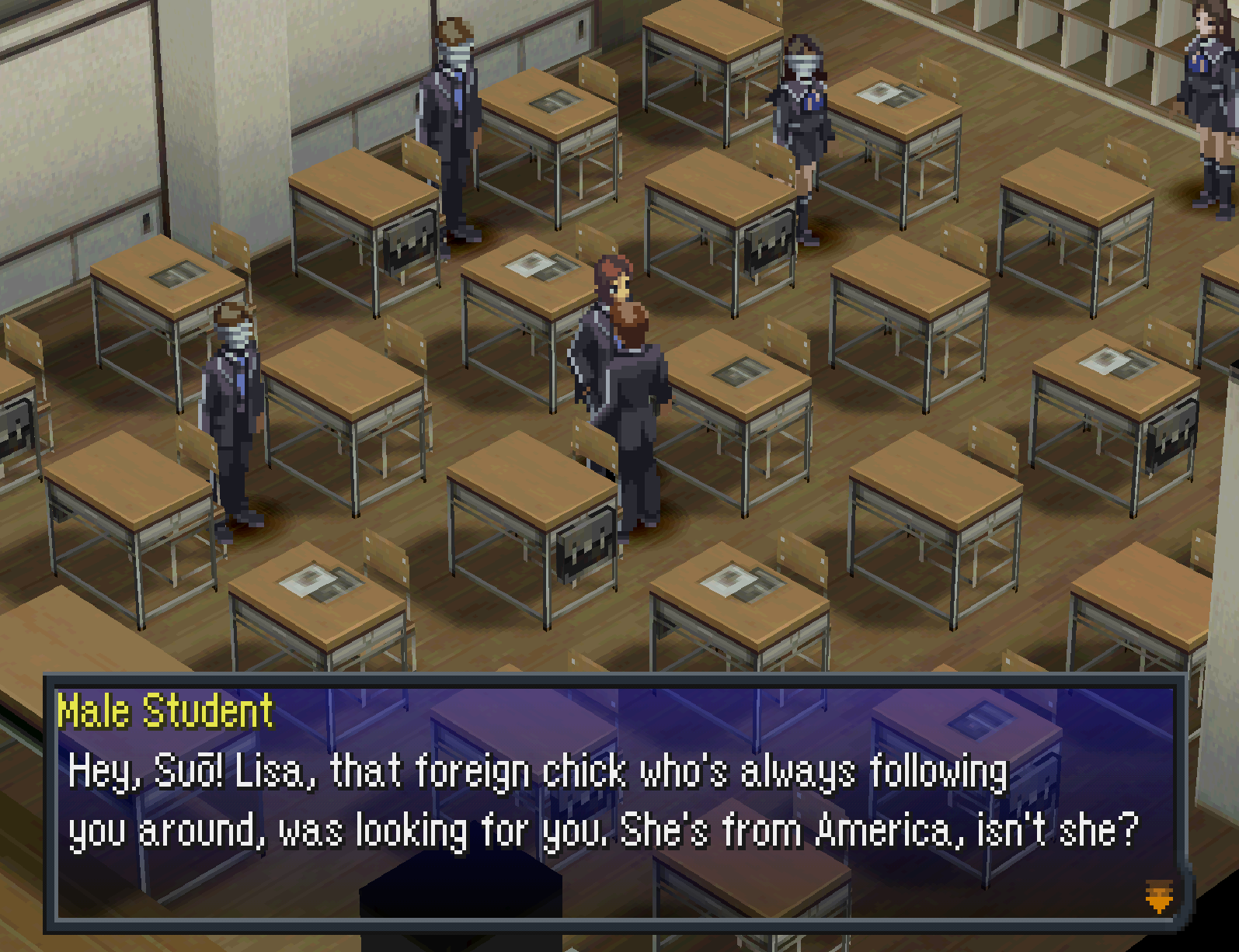
Here’s another translation preference: the use of a macron, which is a horizontal bar above a vowel. It originated in the Greek language to indicate a long vowel sound. It’s perfectly appropriate here: the protagonist’s name is Tatsuya Suou, and the macron helps readers understand that his last name has an elongated second syllable. Personally I’m not a huge fan of this mark, but I am certainly biased because I know how to read Japanese, so I would prefer to see the “raw” characters. In general, however, I think the macron is very helpful to help people pronounce Japanese words so I am in favor of its usage.

After running around the whole school, you end up right back where you started, and meet both Professor Saeko and your classmate Lisa. The sexiest girl in Sevens.
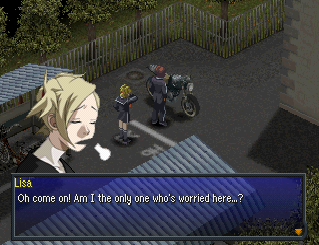
The character portraits took a huge leap in this game. Now each character has a wide range of expressive portraits that really add a lot of flavor to the dialog.
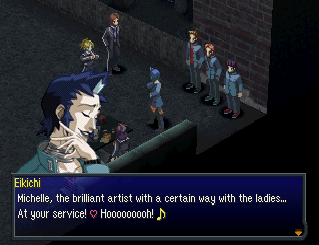
The school’s nickname just annoys me because it’s stupid, but I can give it a pass because I recognize the difficulty of translating insults and slang. But this actually bothers me because it’s a straight up mistake, an improper translation. They translated Eikichi’s nickname ミシェル (misheru) as Michelle, a female name, even though he is clearly a man. At first I thought there might be a plot twist involved or some specific reason for him to be nicknamed Michelle, but nope: as confirmed by the official English PSP version, his nickname is Michel, a male French name.
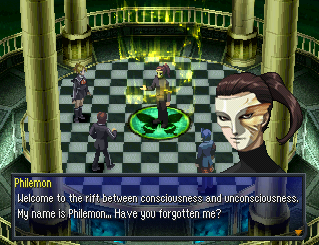
Whoa! Philemon’s back! I knew it was a good idea to start this series from the beginning.
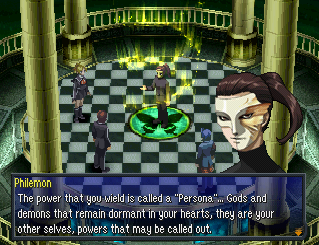
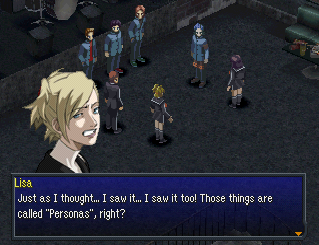
As I mentioned in the Persona post, this series is not shy about throwing the “Persona” word around. While some games and movies pick an abstract title that represents a concept or idea, the Persona series is called Persona because that’s what it’s all about.

In Persona, you play the game “Persona” by taking turns calling out to “Persona”. In Persona 2, it has a take on a Japanese urban myth where you have to call your own phone number to summon your Persona.
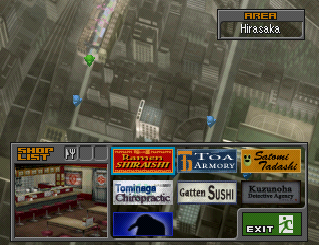
This is the first game in the Persona series where the UI started to shine; the first one was pretty standard, but everything in P2 just looks cool.
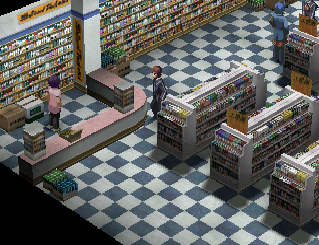
Of course, I wasn’t thinking about posting on this website when I played the game, but I’m not sure why I kept all the screenshots at “Internal Resolution” when I played so much of the game at 1x resolution.
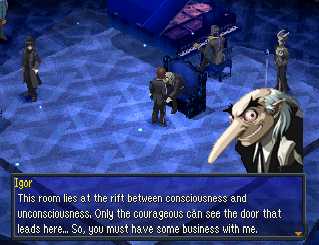
Another Persona mainstay is of course Igor and the Velvet Room.

Is it just me or does Steven Silverman, Lisa’s dad, look like Steven Seagall from the late 90’s?
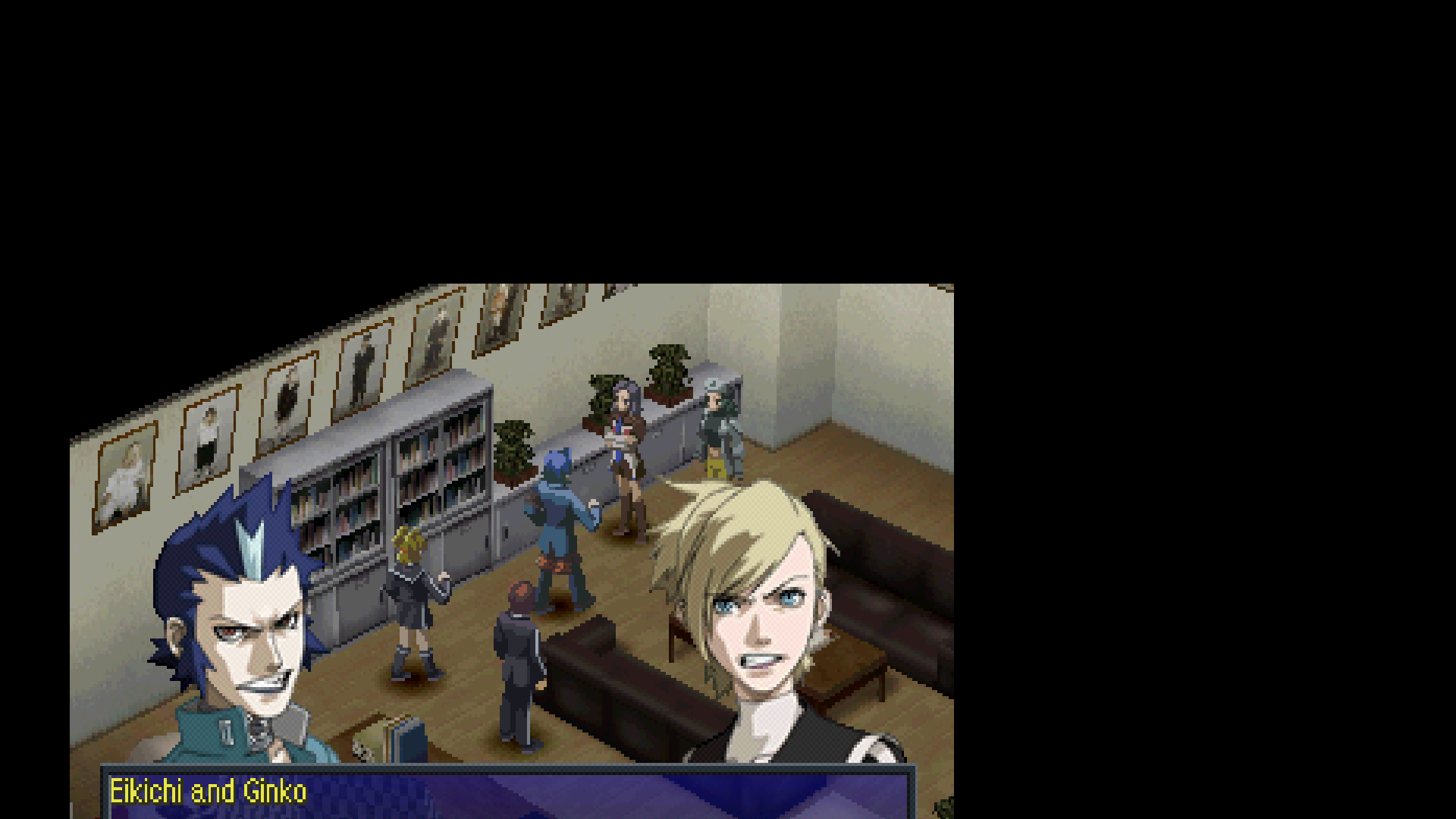
This is what I get for not paying attention to the screenshots I’m taking. I don’t even know how I triggered this bug, but I played for hours before realizing that all my screenshots were completely fucked. Ouch!

I messed with Integer Scaling a bit, which gives you a very sharp image at the expense of not being able to fill the screen.
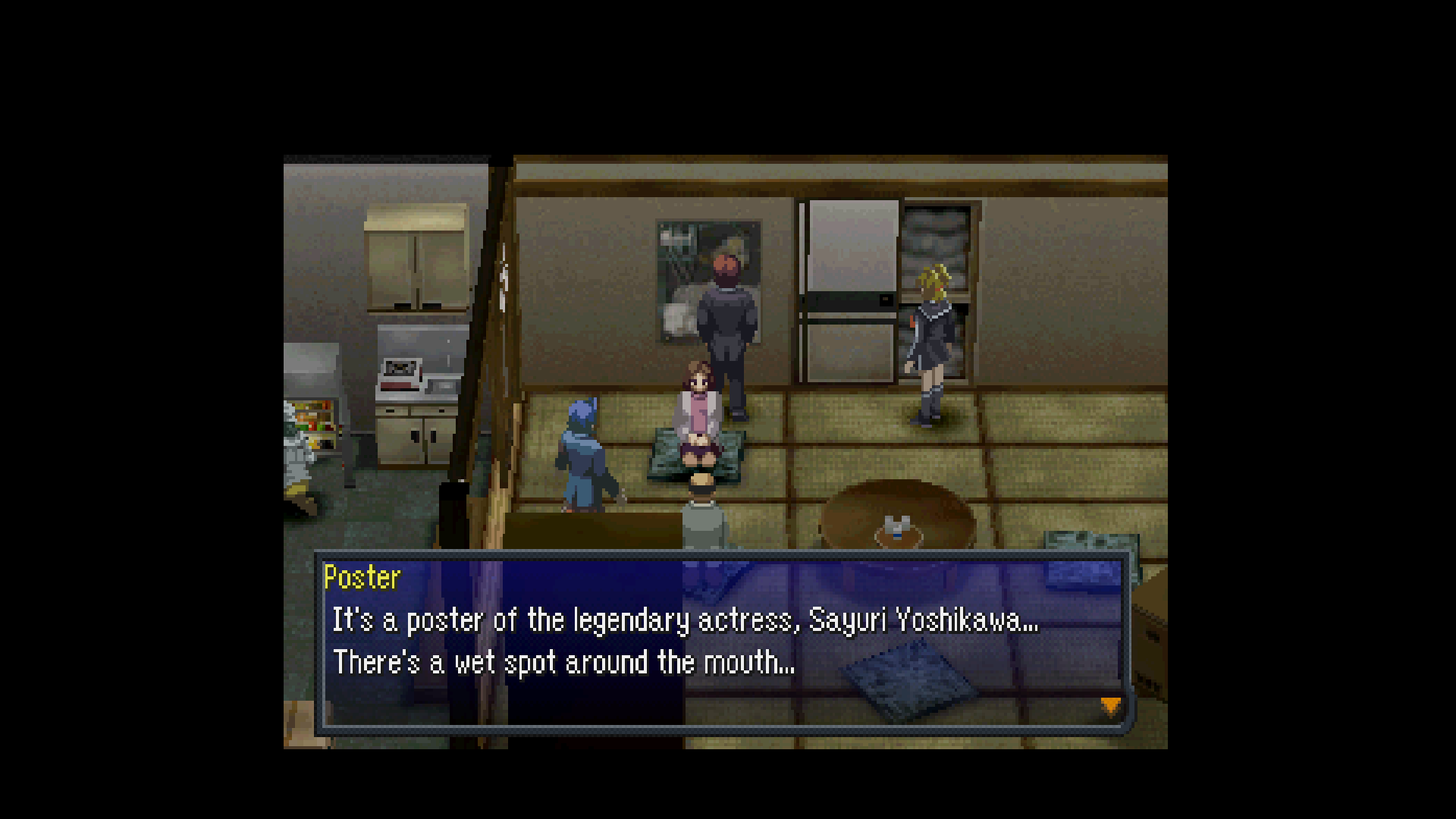
Yikes…


Cool moment, and the solarized portraits add to the trippiness.
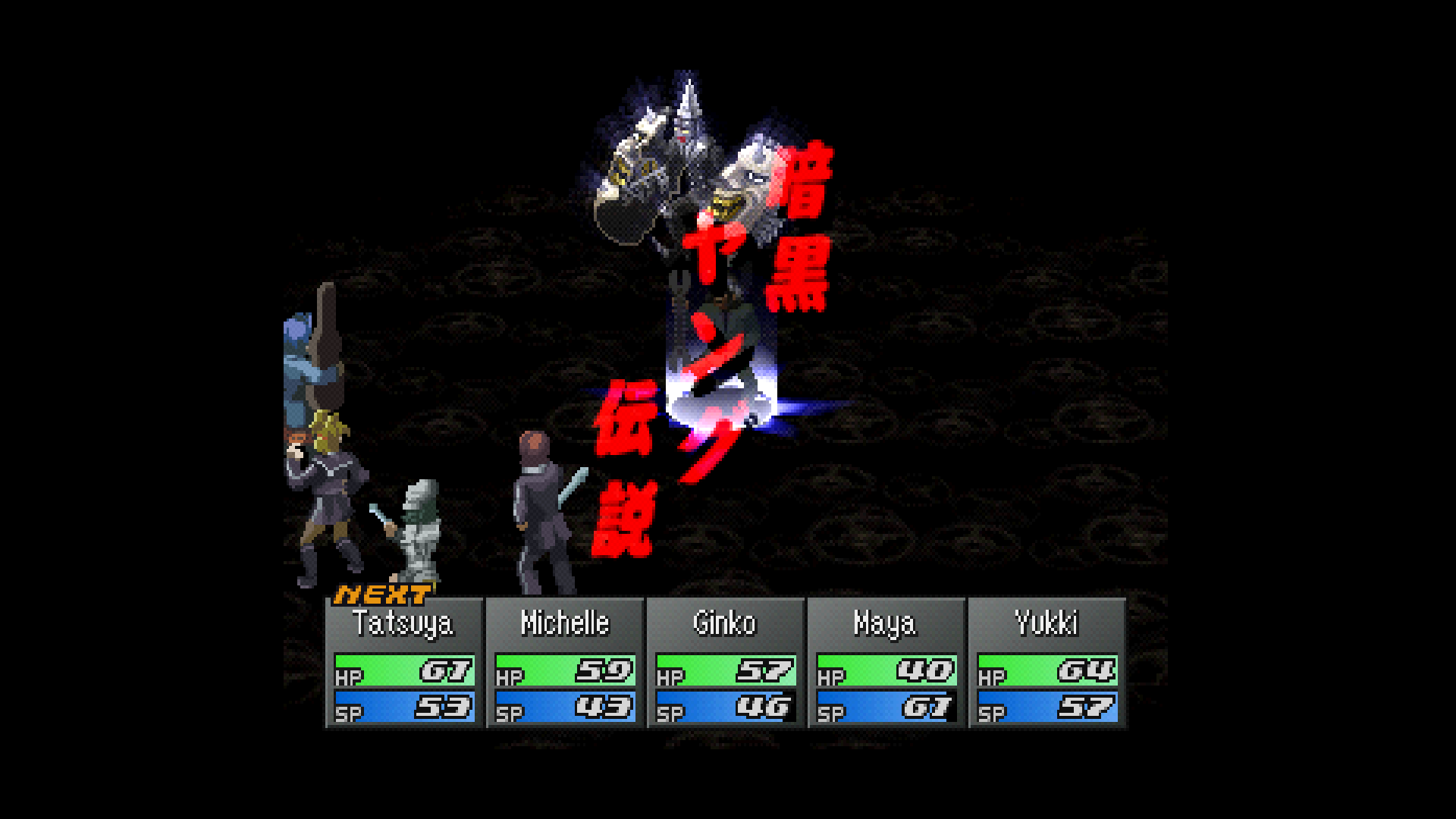
The battle scenes aren’t anything special, but they are a little nicer than the first game. One thing to note is that this game is pretty easy, even for someone as dense as me. Persona seems easy when you talk to hardcore fans, but I couldn’t figure it out on my first playthrough. P2:IS, on the other hand, is both simple and easy to understand: perfect for me. Notice how much of my RPG game articles are related to the atmosphere, characters, and story of a game, and how little I tend to touch on battles: despite the battles being a huge aspect of these games as far as time, they hold relatively little interest to me. The main thing keeping me away from so many old school RPG’s is their over-reliance on battles.

One of the main gameplay premises of the game is the rumor system; the in-game lore is that any rumor that spreads enough becomes true. You can affect this by hearing rumors from various sources, then spreading them.

In some cases, you can specifically pick which version of the rumor you want to spread. Another cool link to the SMT universe here is that rumors are spread via the Kuzunoha detective agency. The main character of the first Devil Summoner game, another spinoff of the Shin Megami Tensei series (just like Persona), is named Kyouji Kuzunoha.

Even at 1x resolution, the environments are lush and detailed.
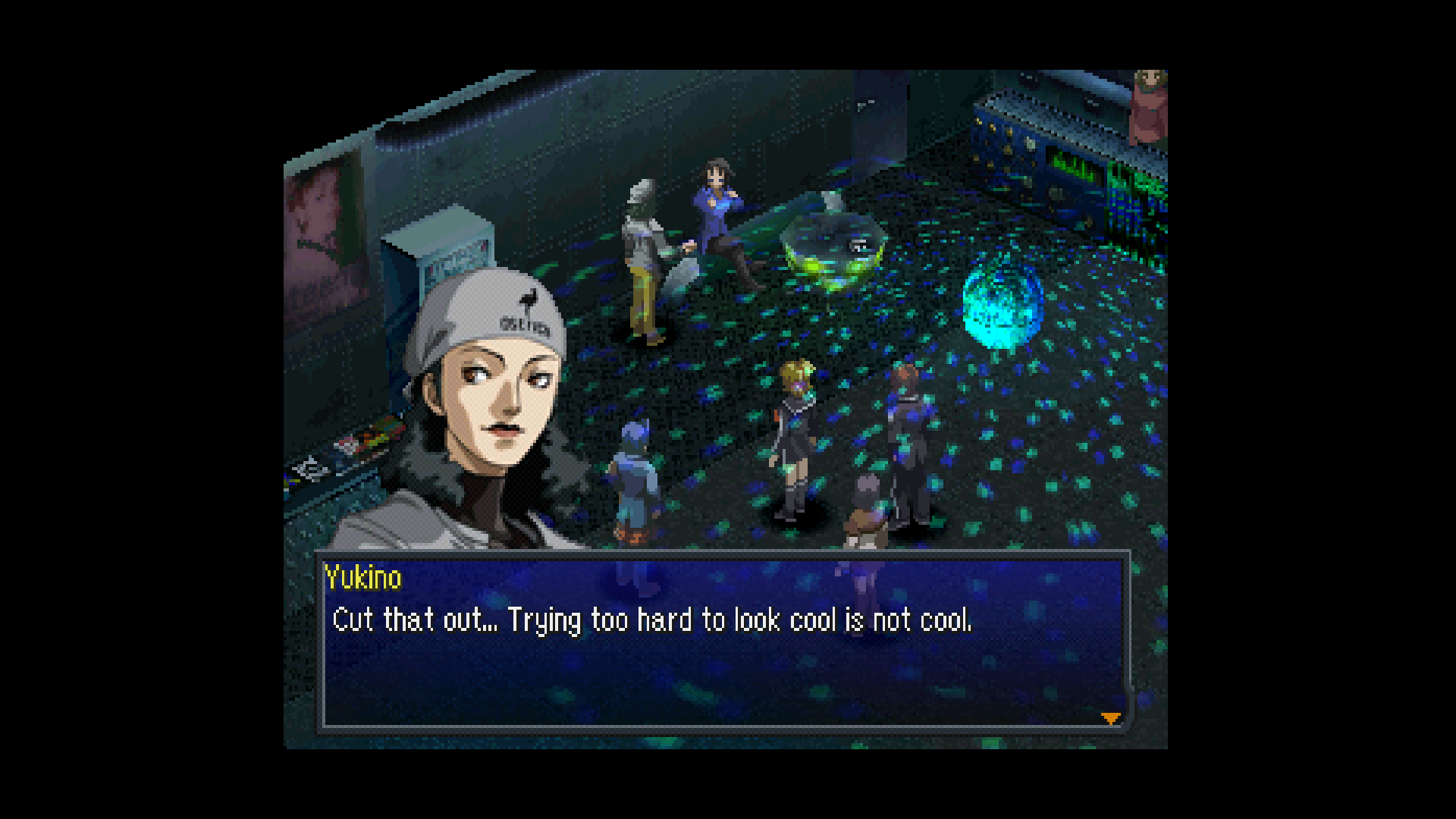
True.
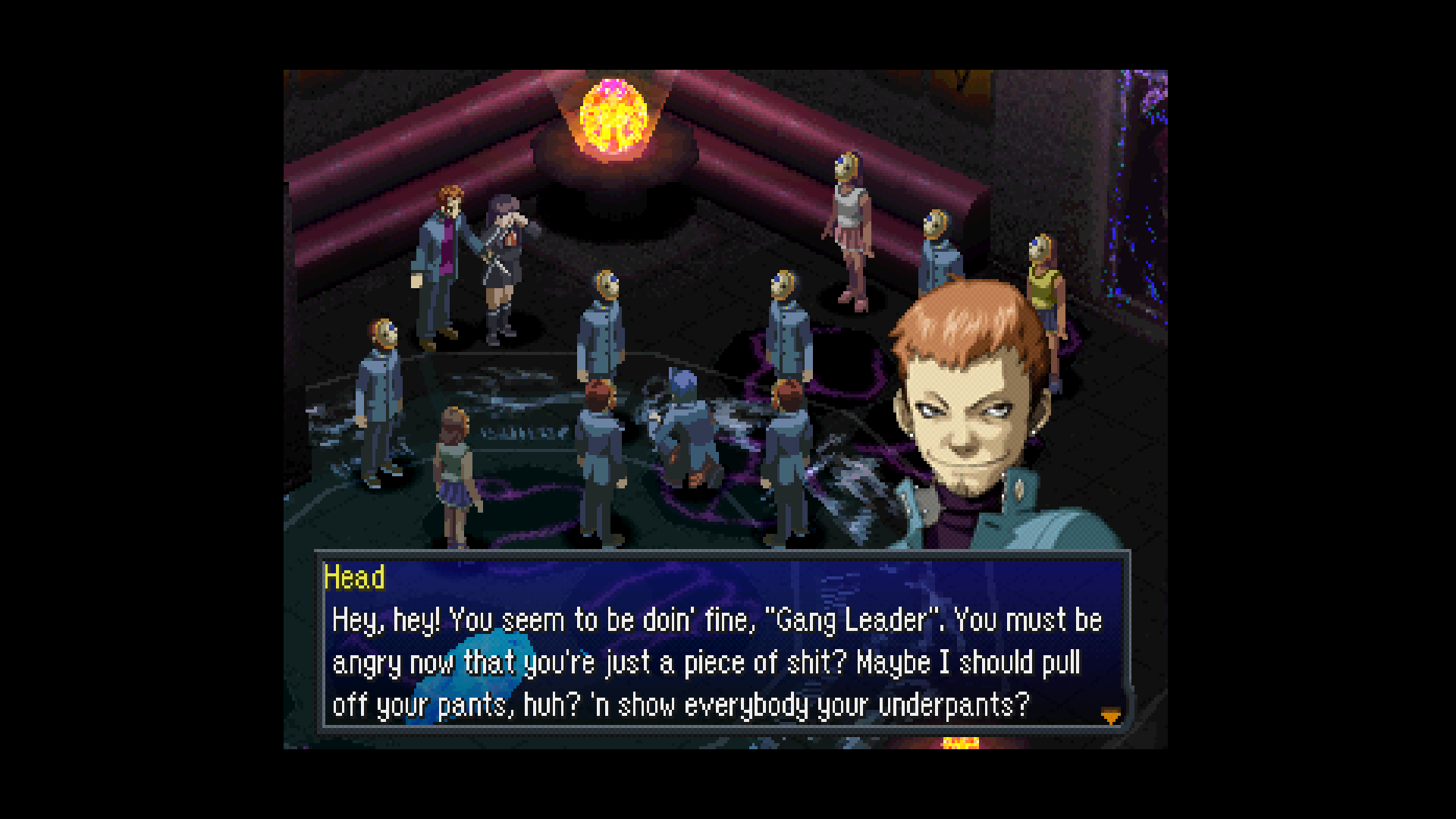
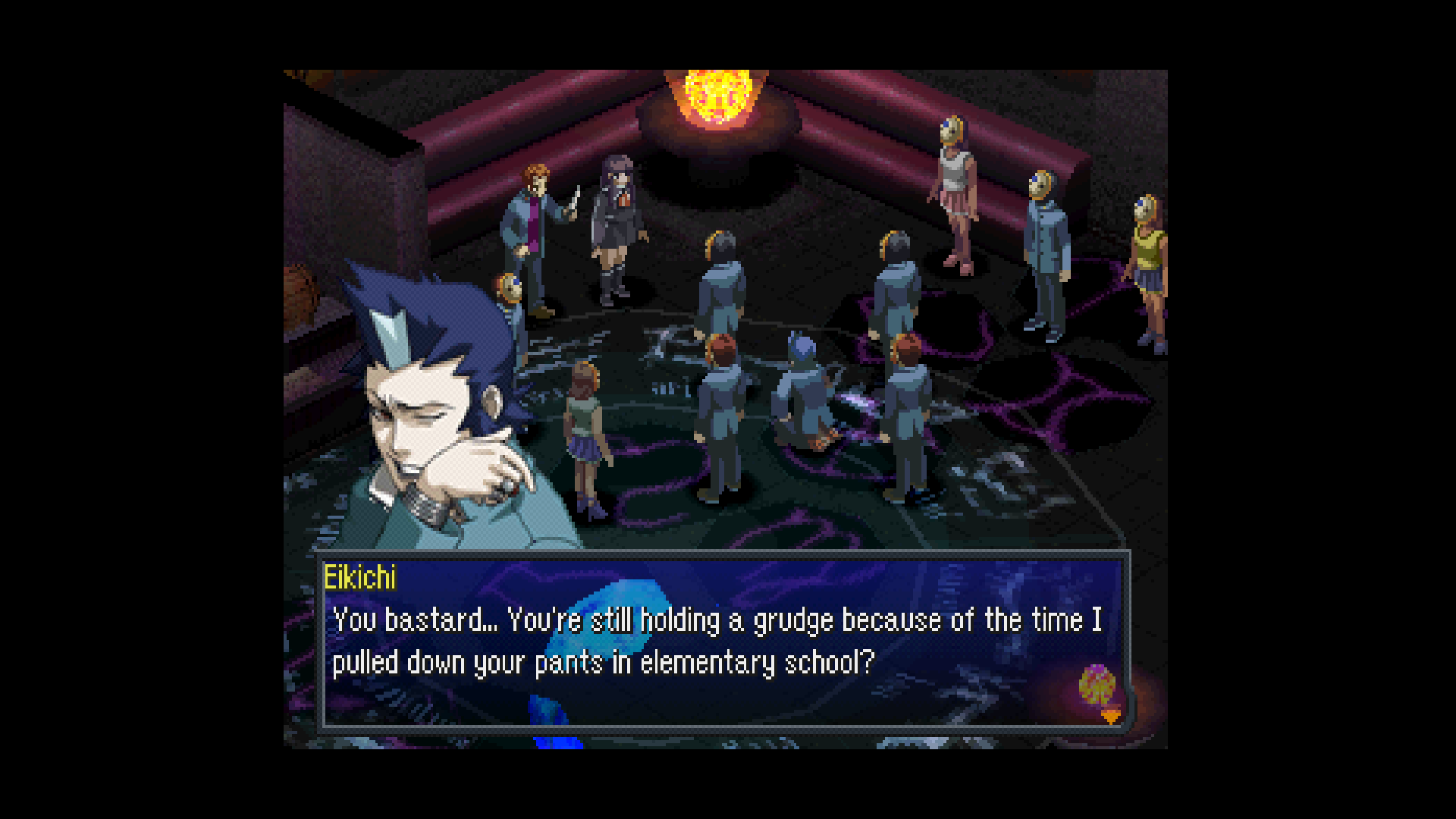
These games were definitely intended to be played by older teens and adults; it’s a common trope in Japanese media to fantasize about the high school years specifically. The nature of the story and the way it’s written point to a mature target audience, but don’t forget: the game is still about high schoolers, and the dialog and some story points do reflect that.
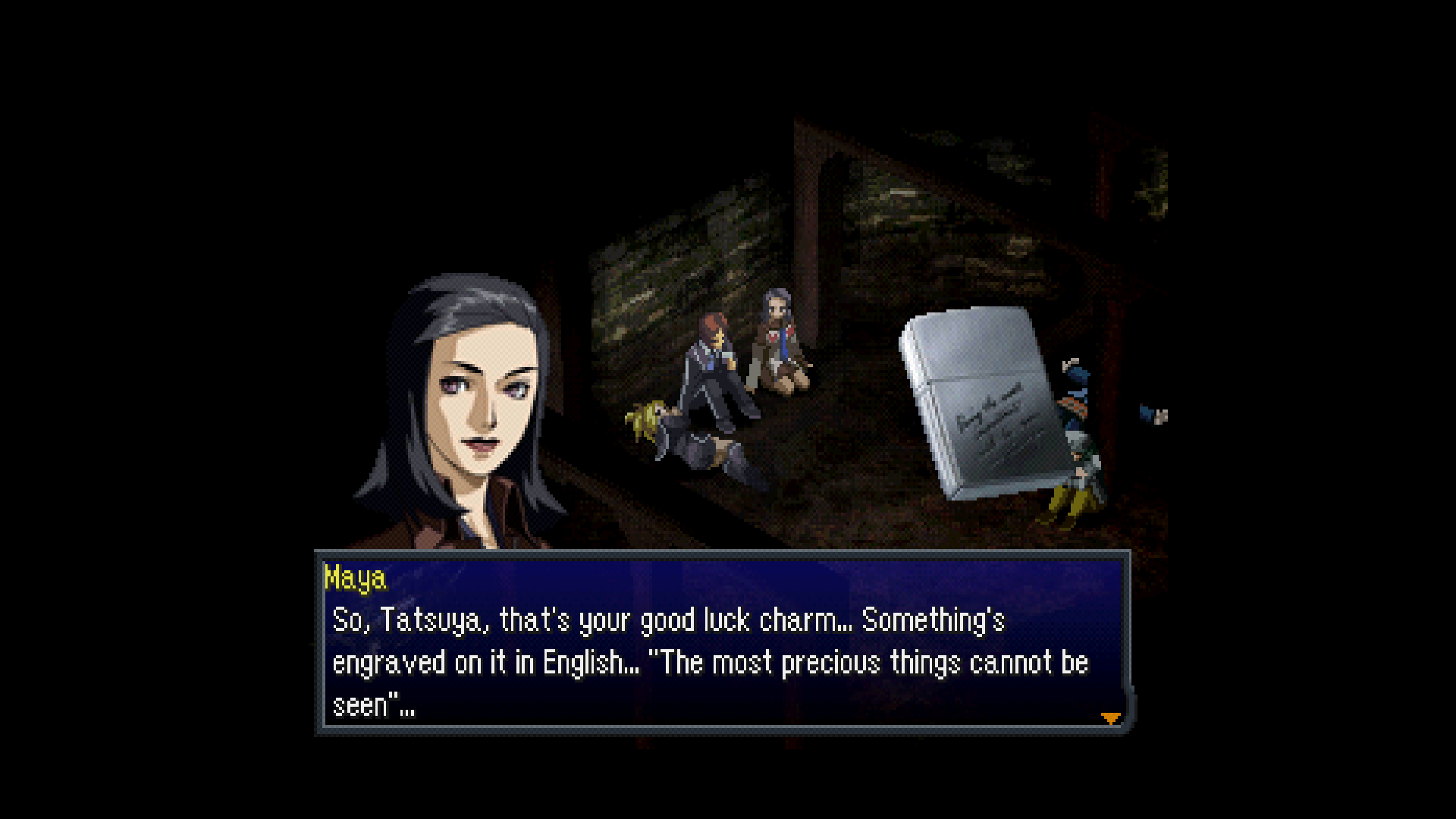
There’s a trippy scene straight out of Japanese horror where you get stuck in this shelter with no way out. There really isn’t an actual way out, but when you struggle long enough, the game reveals it to you.
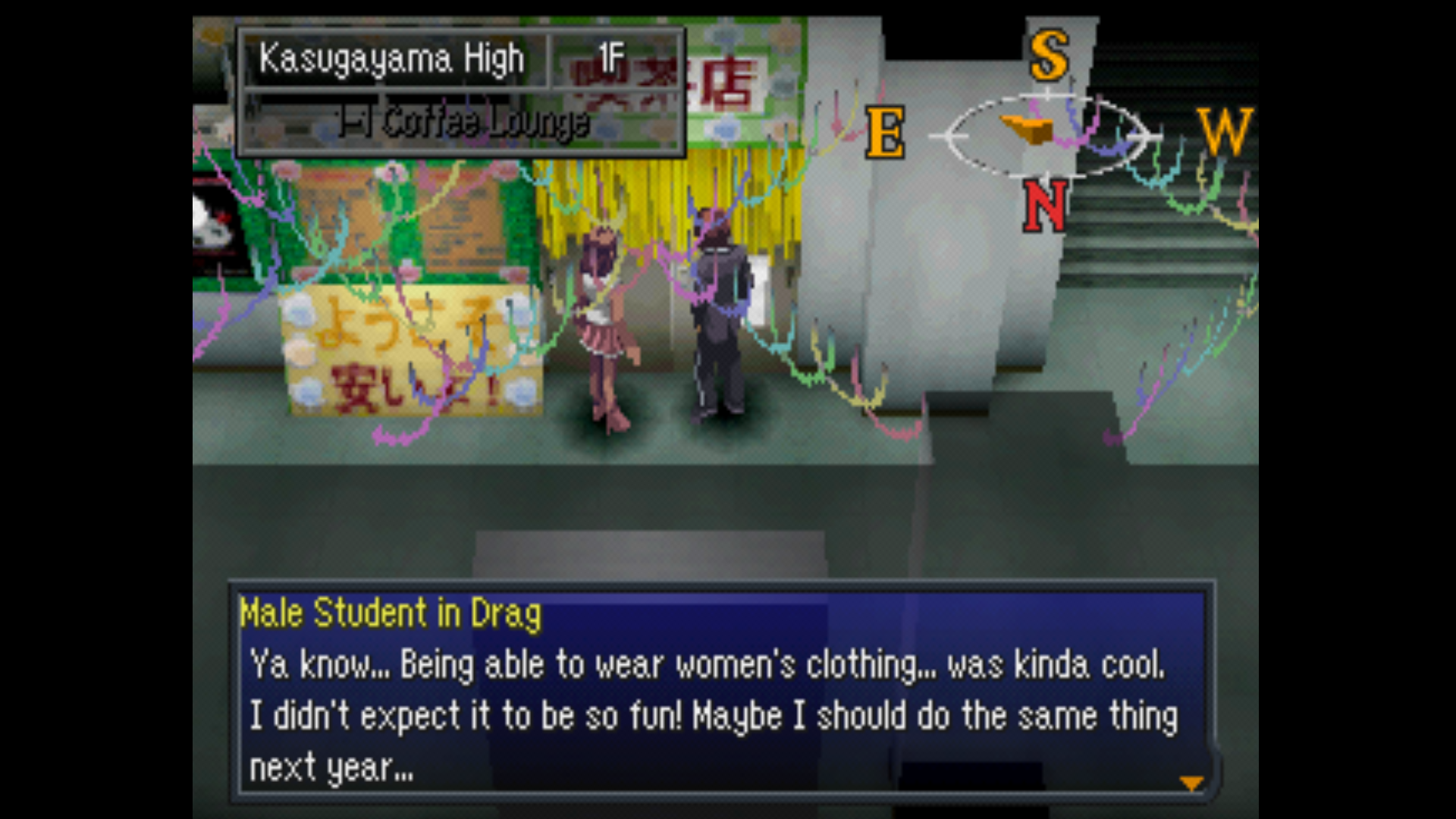
The Persona series has an interesting relationship with gender, sexuality, and self-expression. I’ve seen some minor ranting towards the series as people try to use modern Western social standards to judge the Japanese social standards of the 1990’s or 2000’s. Context is important when looking at things from other cultures and times.
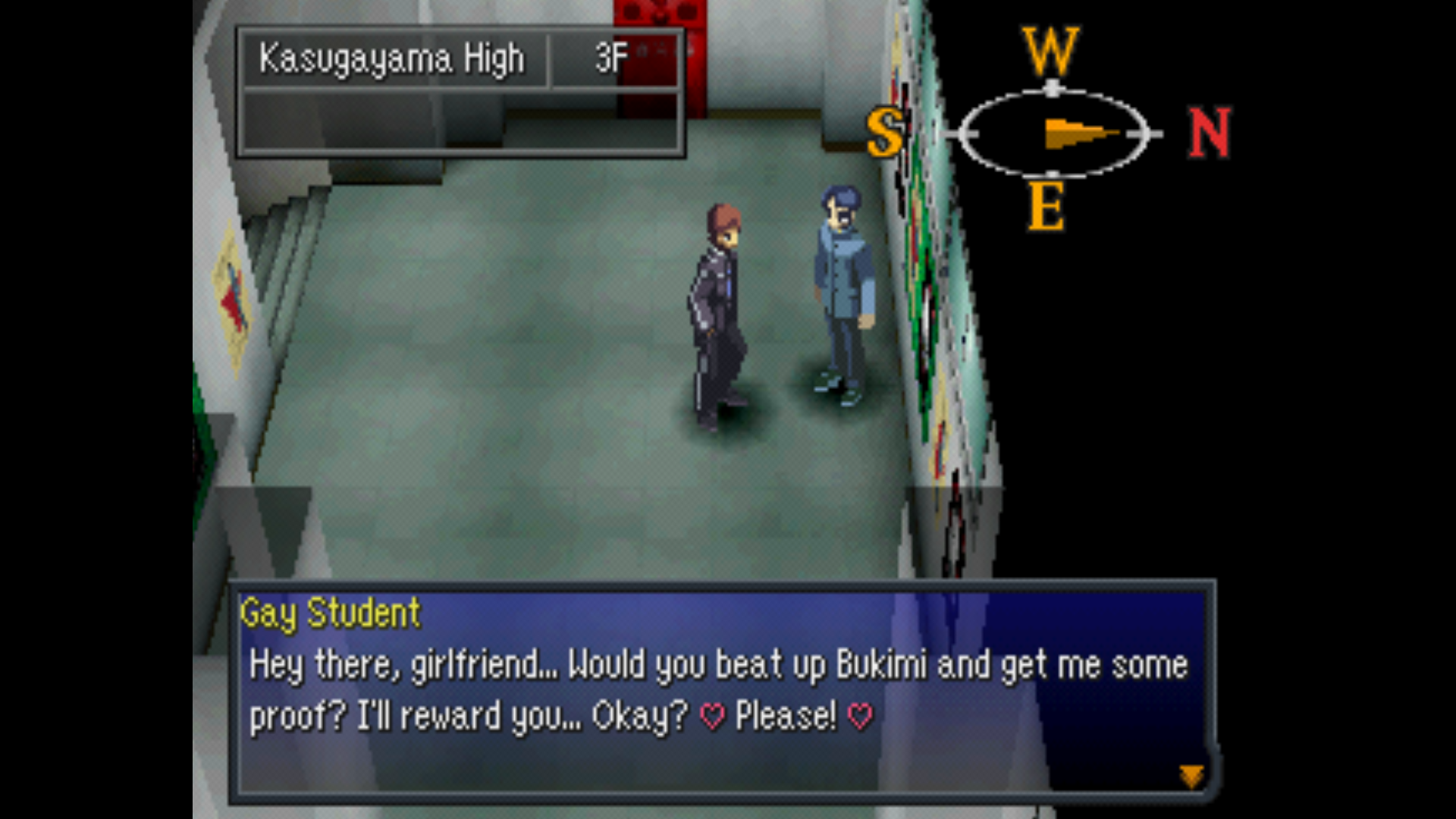
On a technical note, by this point I had abandoned the integer scaling and was now using the smooth bilinear scaling. The smoothing looks good at the small image size in this post, but I’m not so sure about playing the game like this. Even playing on my couch from ~10 feet away as I usually do, I just can’t shake the feeling that the game is too blurry, like my eyes aren’t able to focus.

いらっしゃいませ, or irasshaimase, is a very common Japanese phrase that you will hear pretty much every time you enter a store in Japan. It’s often shortened to “irasshai” for a more casual feel, and anyone who has studied basic Japanese or visited Japan would be familiar with it. But a translation shouldn’t rely on too much prior knowledge. There is a school of thought that even common honorifics such as -san and -sensei shouldn’t be used in localization. I wouldn’t go that far, as I think the -senpai or -chan added to a name is not only hard to translate, but those words are so common that they’ve acquired their own meaning in English. It’s like describing something perfectly-imperfect as “wabi sabi”: just use the Japanese word because it’s the most appropriate one for the situation. But “irasshai”? They should have just translated that to “welcome”.
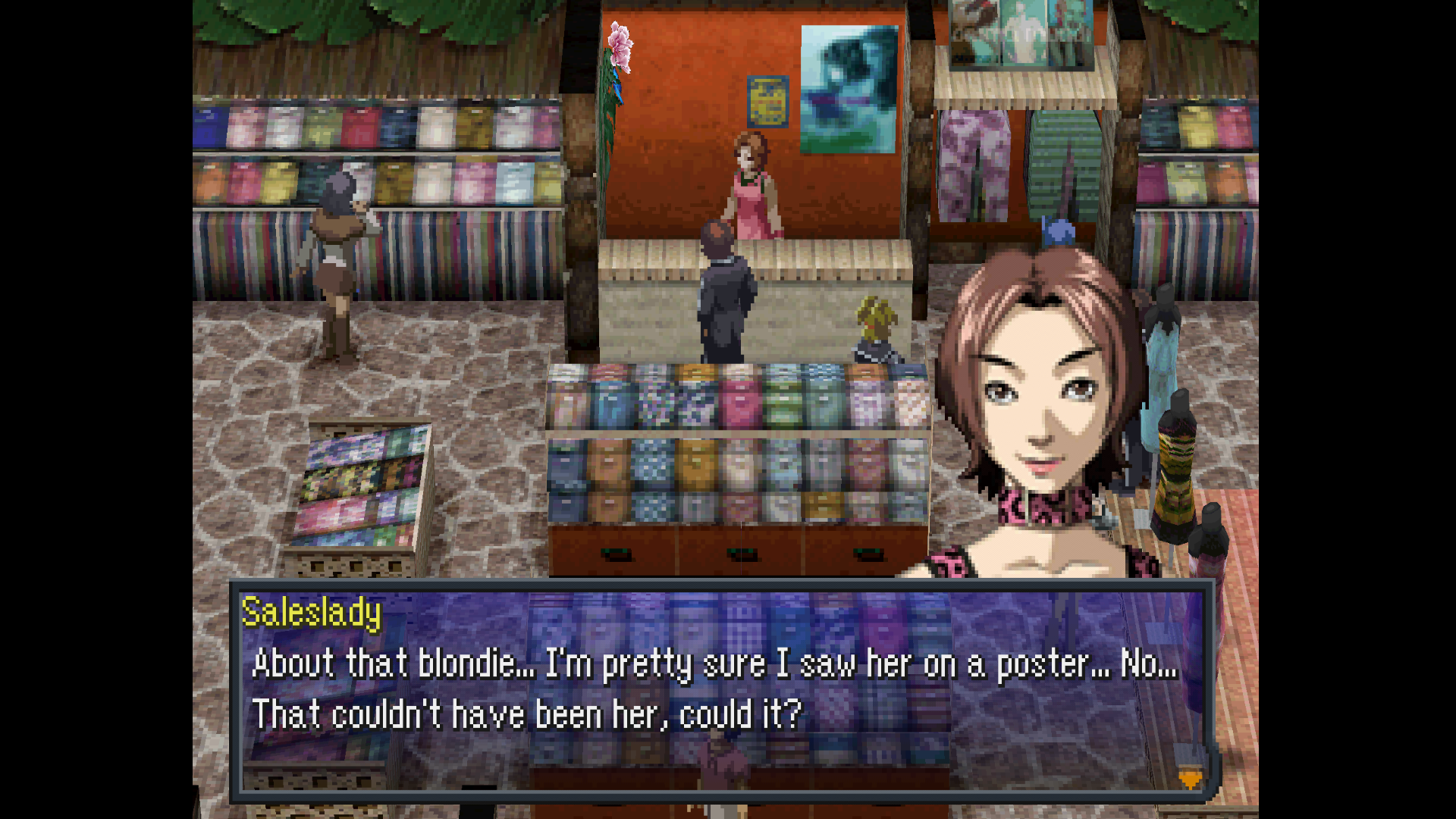
Coming back around to this game after finishing the entire series, I do see some parallels between the characters of Lisa in this game, Rise in Persona 4, and Ann in Persona 5.
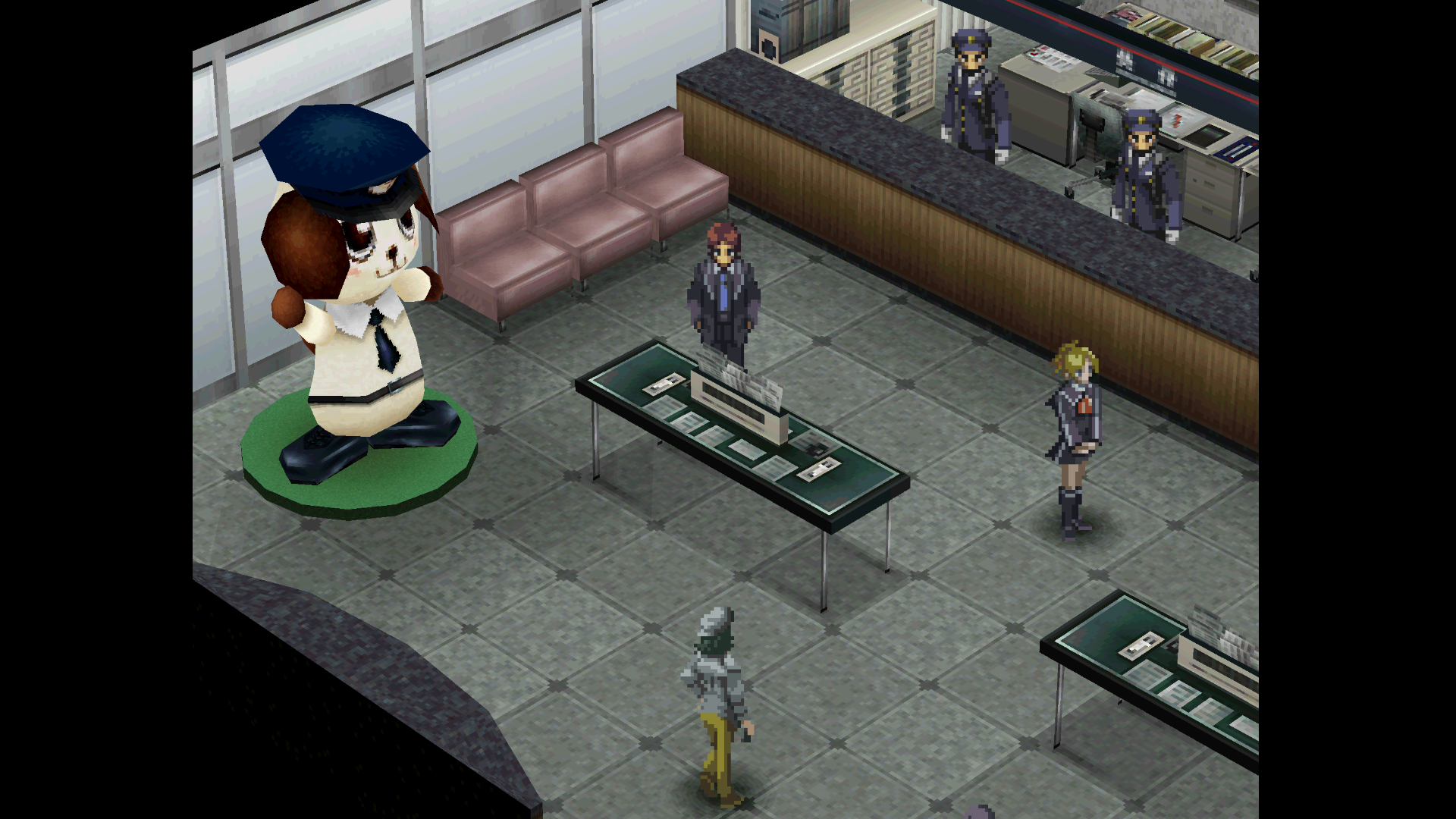
In a reverse twist of most PS1 games, it’s the characters that are pre-rendered and the backgrounds that are 3D rendered.
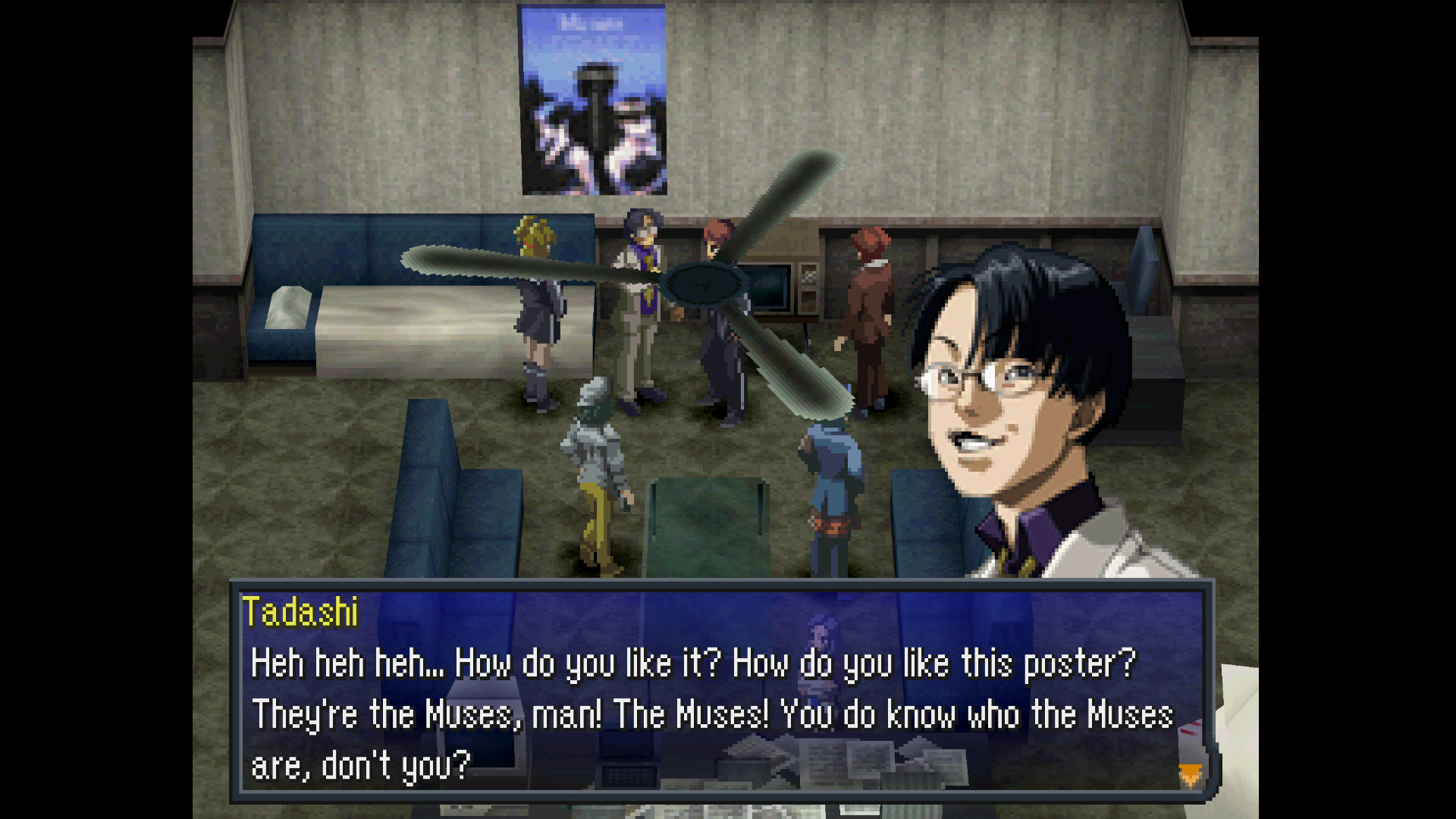
This room just has a ceiling fan hanging there, right between you and the characters. Not sure what this is supposed to add to the scene.
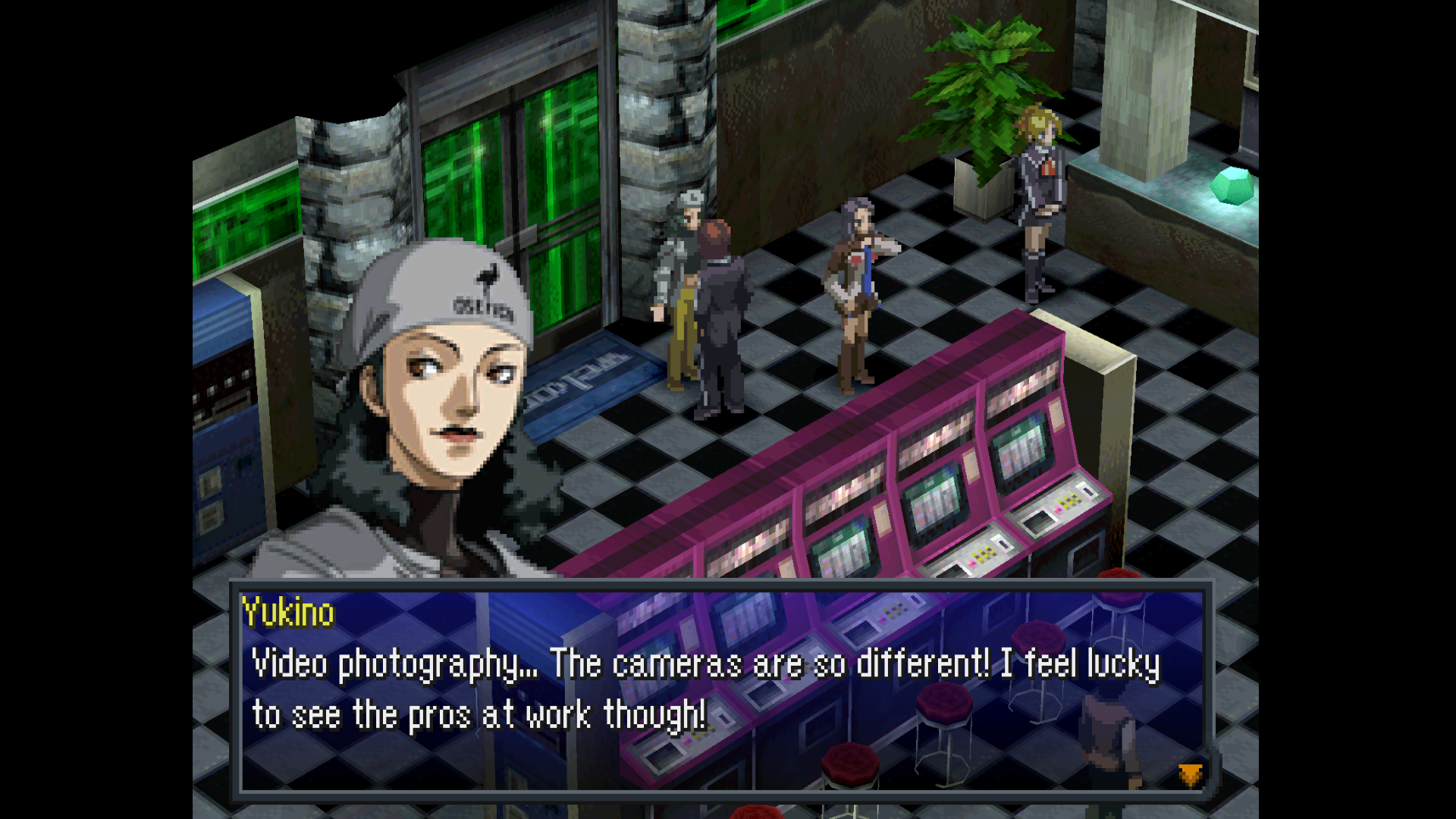
Relatable comment for me, a photographer who almost exclusively shoots still photos.
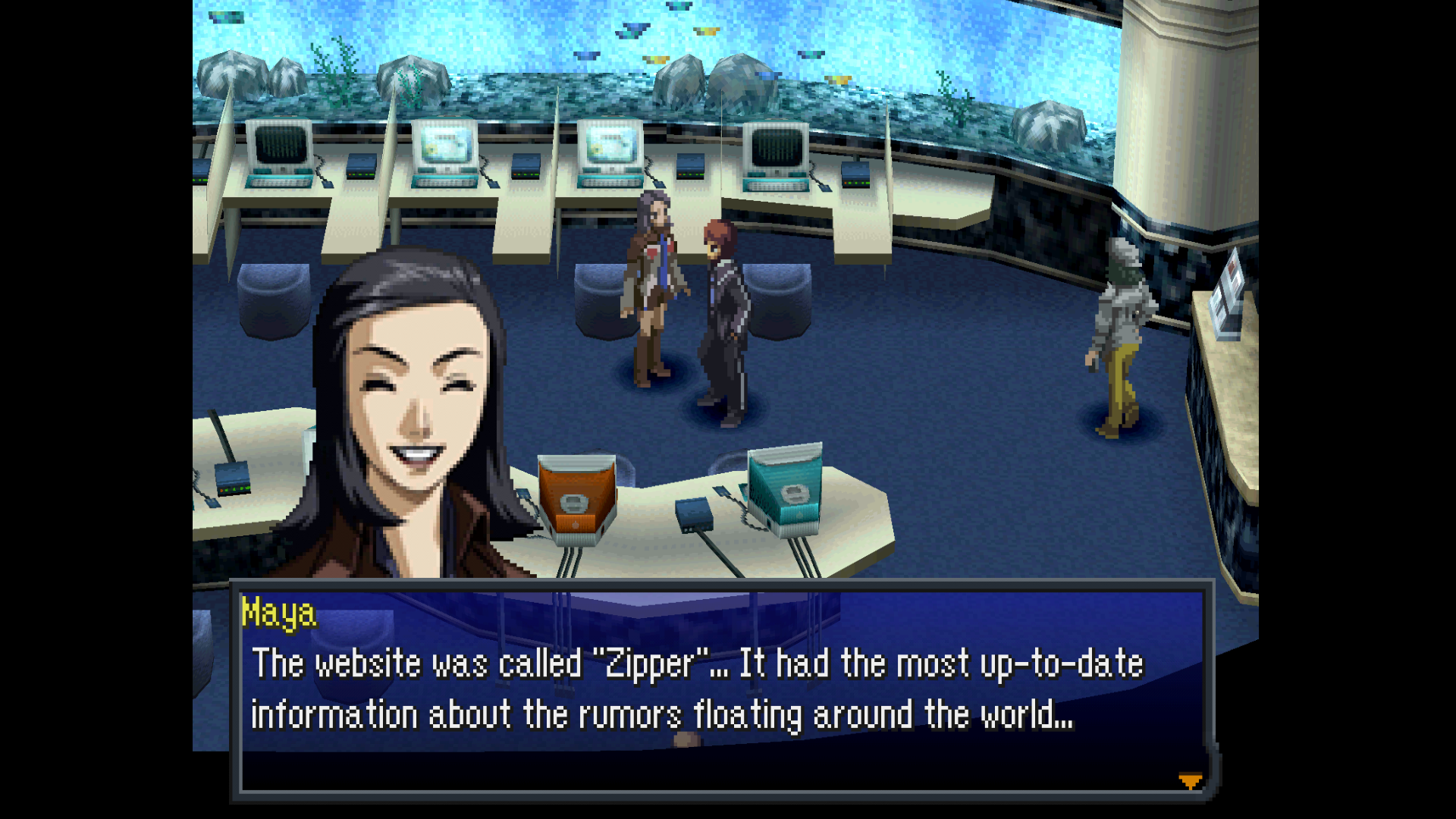
What a rad internet cafe; this place just screams “The Year 2000!”. The original iMac was released in 1998 in one color: Bondi Blue. In January 1999 there was a refresh that deleted that original color, replacing it with the famous five color lineup. So that’s pretty impressive that when this game was released in Japan in June 1999, it featured the brand new iMacs that had just been released a few months prior.
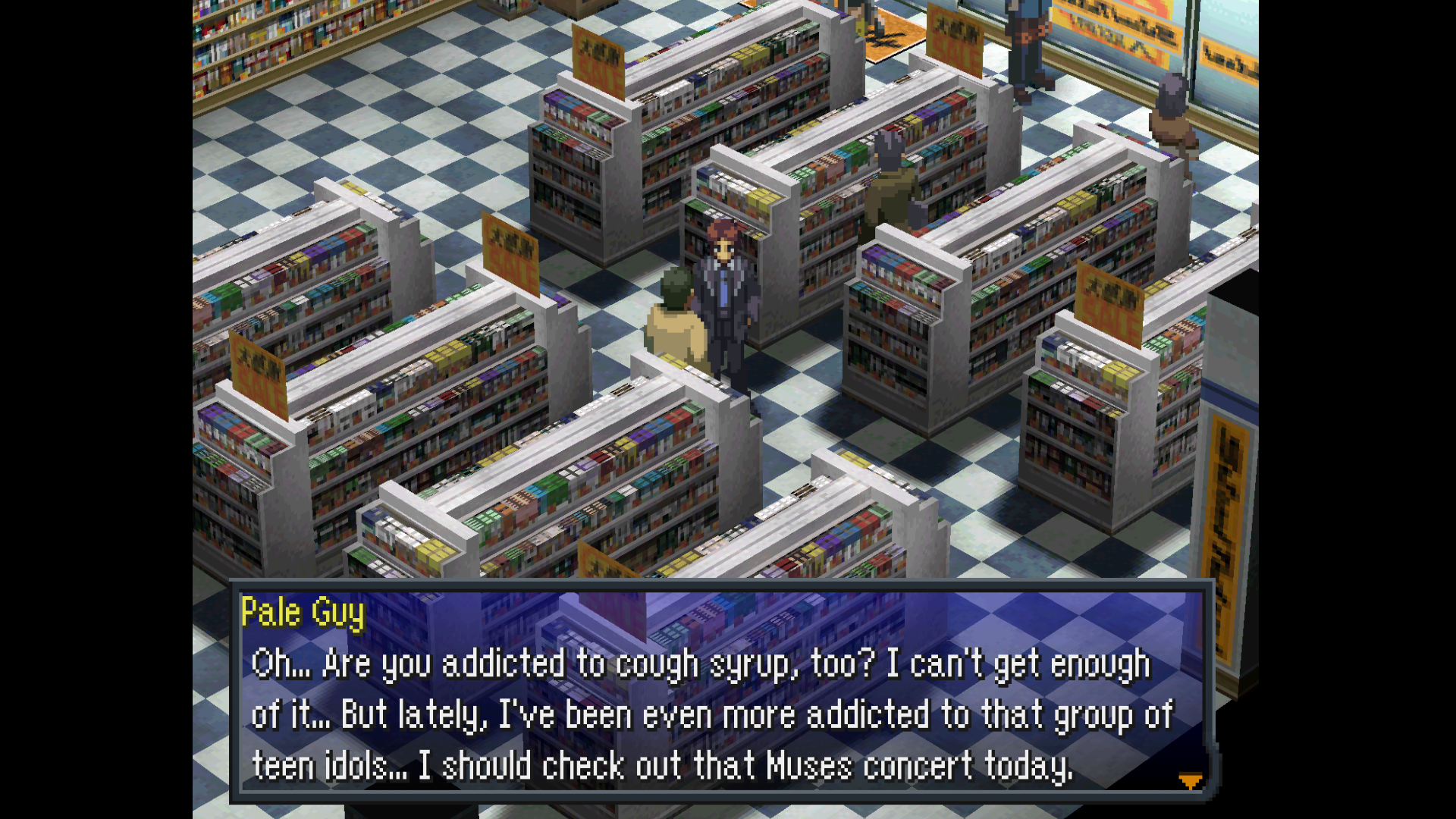
I wonder how this scene came across to Japanese audiences. All drug use is very taboo in Japan, so I imagine something like this comes across completely differently than it does in the USA, where rappers have been bragging about using “lean” or “purple drank” (i.e. strong cough syrup mixed with soft drinks) for decades.
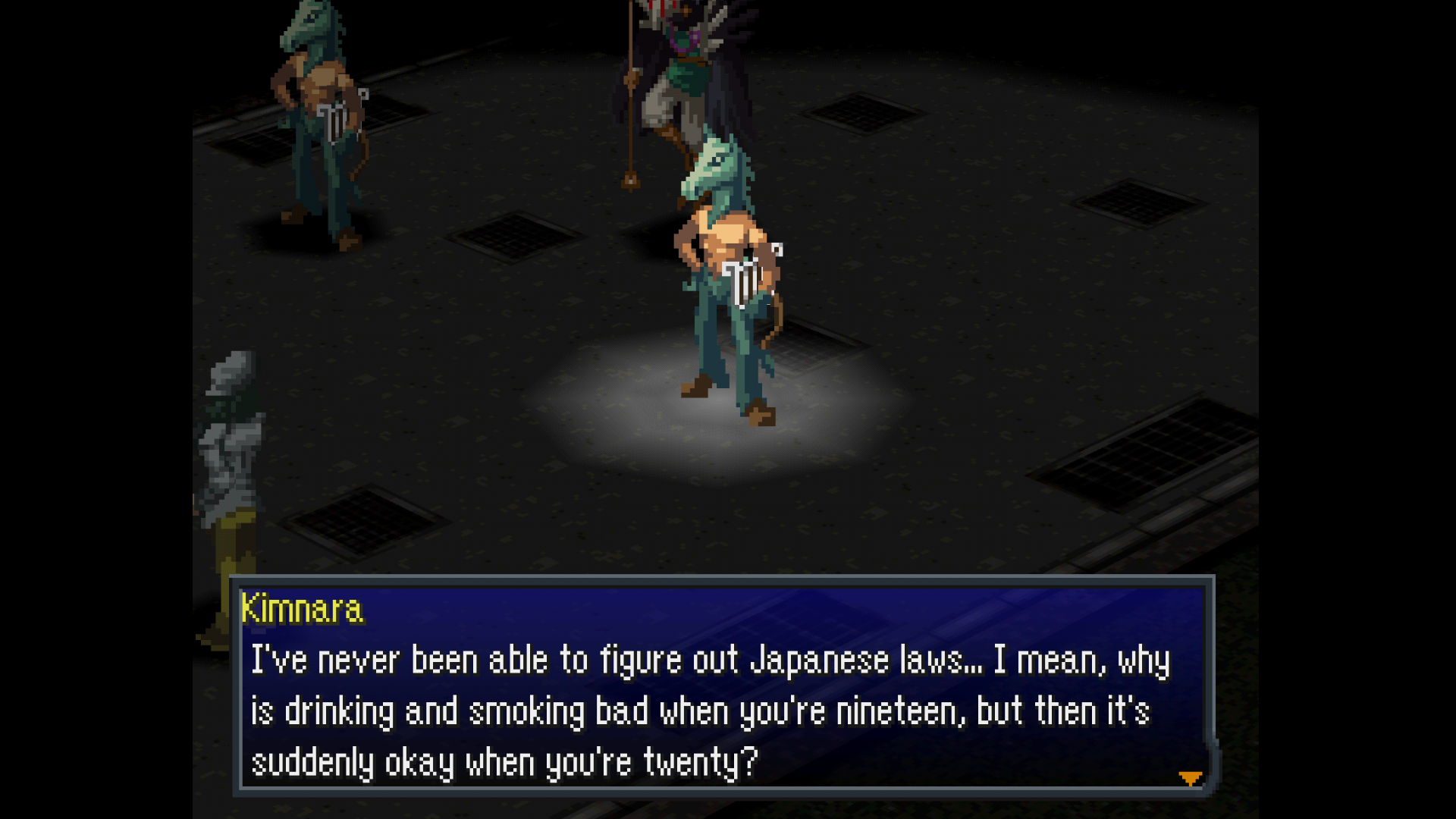
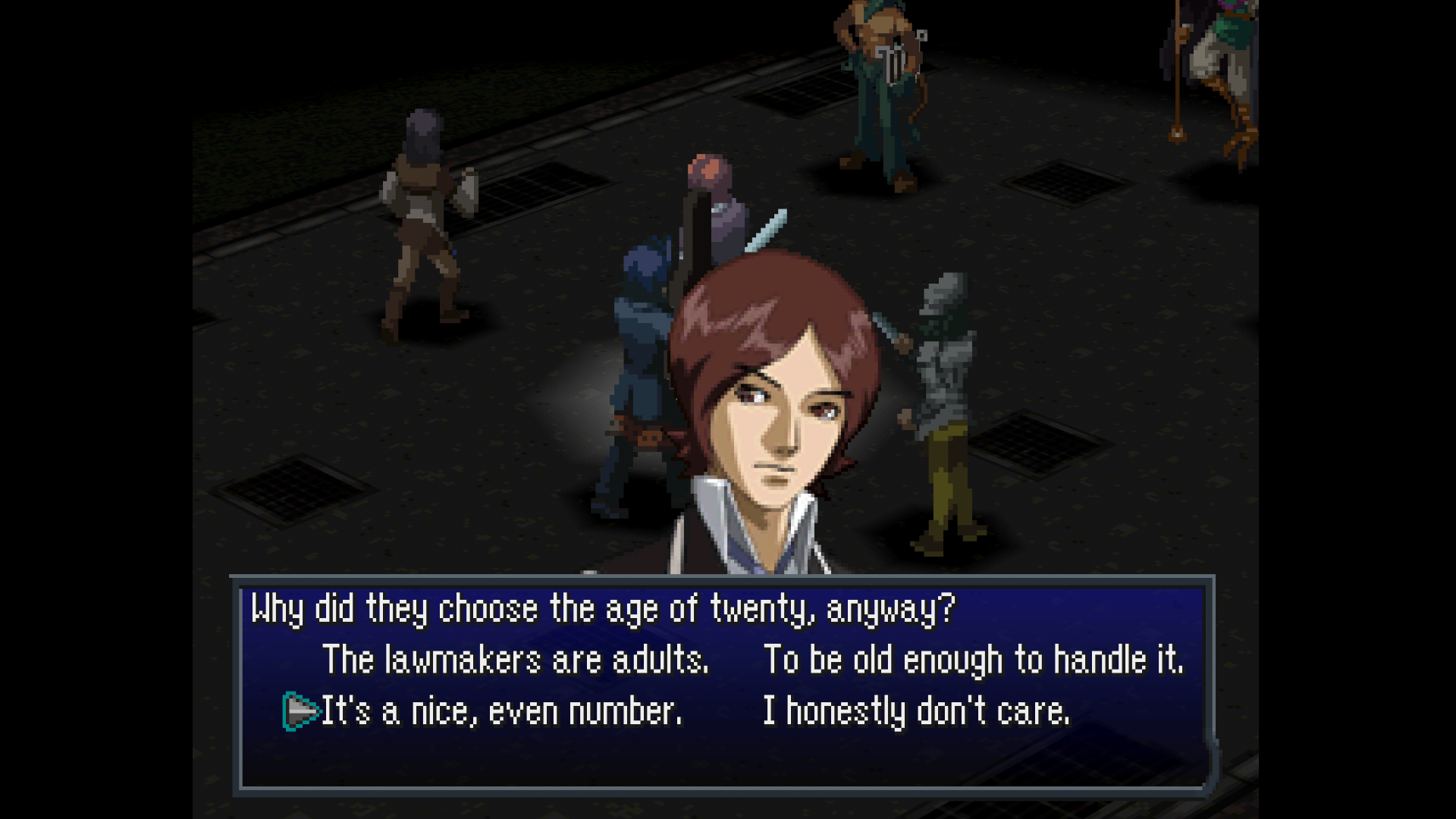
They greatly expanded the battle dialog with demons, and they have all kinds of interesting stuff to say in this game.
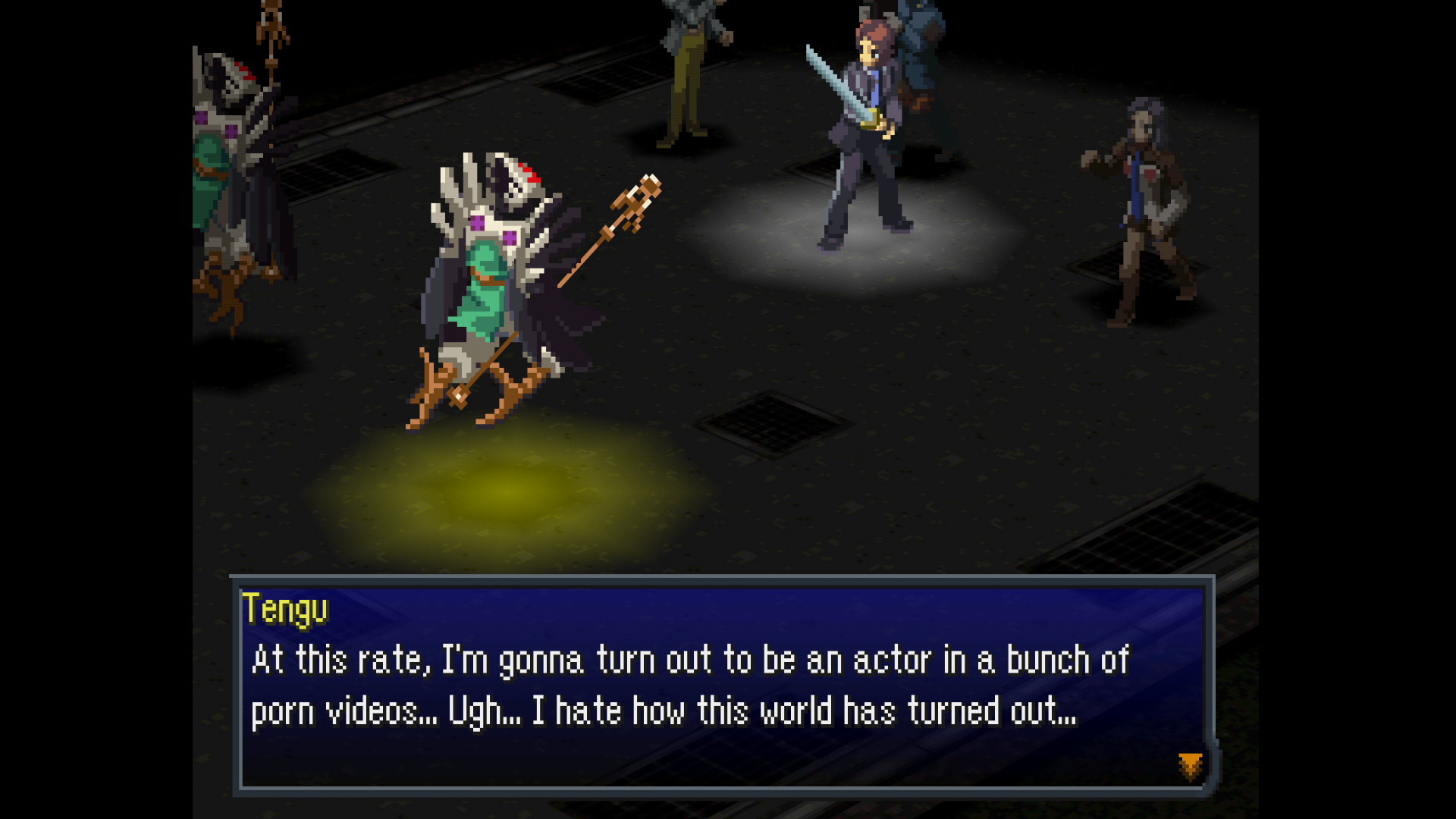
Case in point.
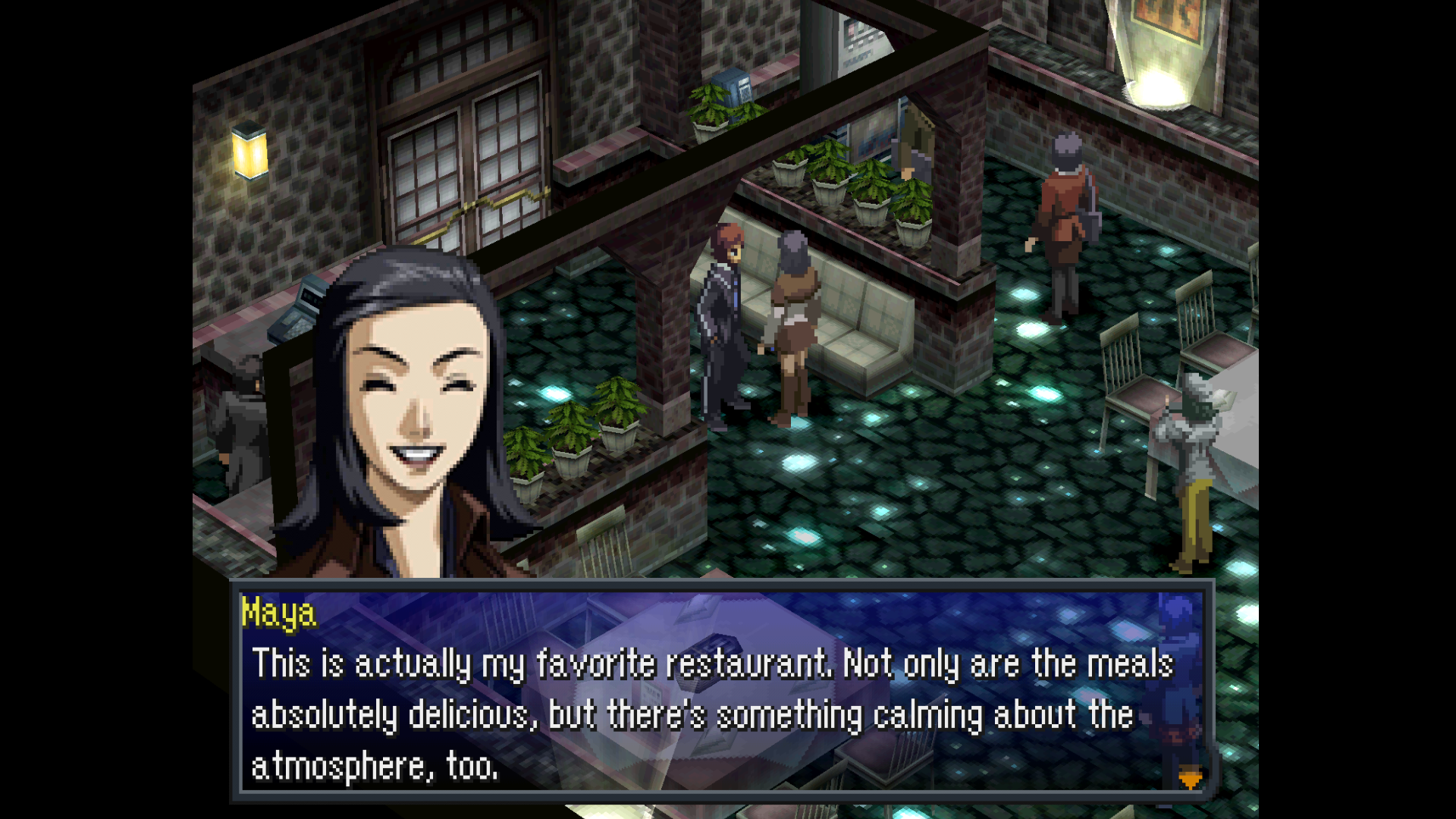
One of the hallmarks of the Persona series really starts to shine with this game: there is so much love put into the design of every interior scene.
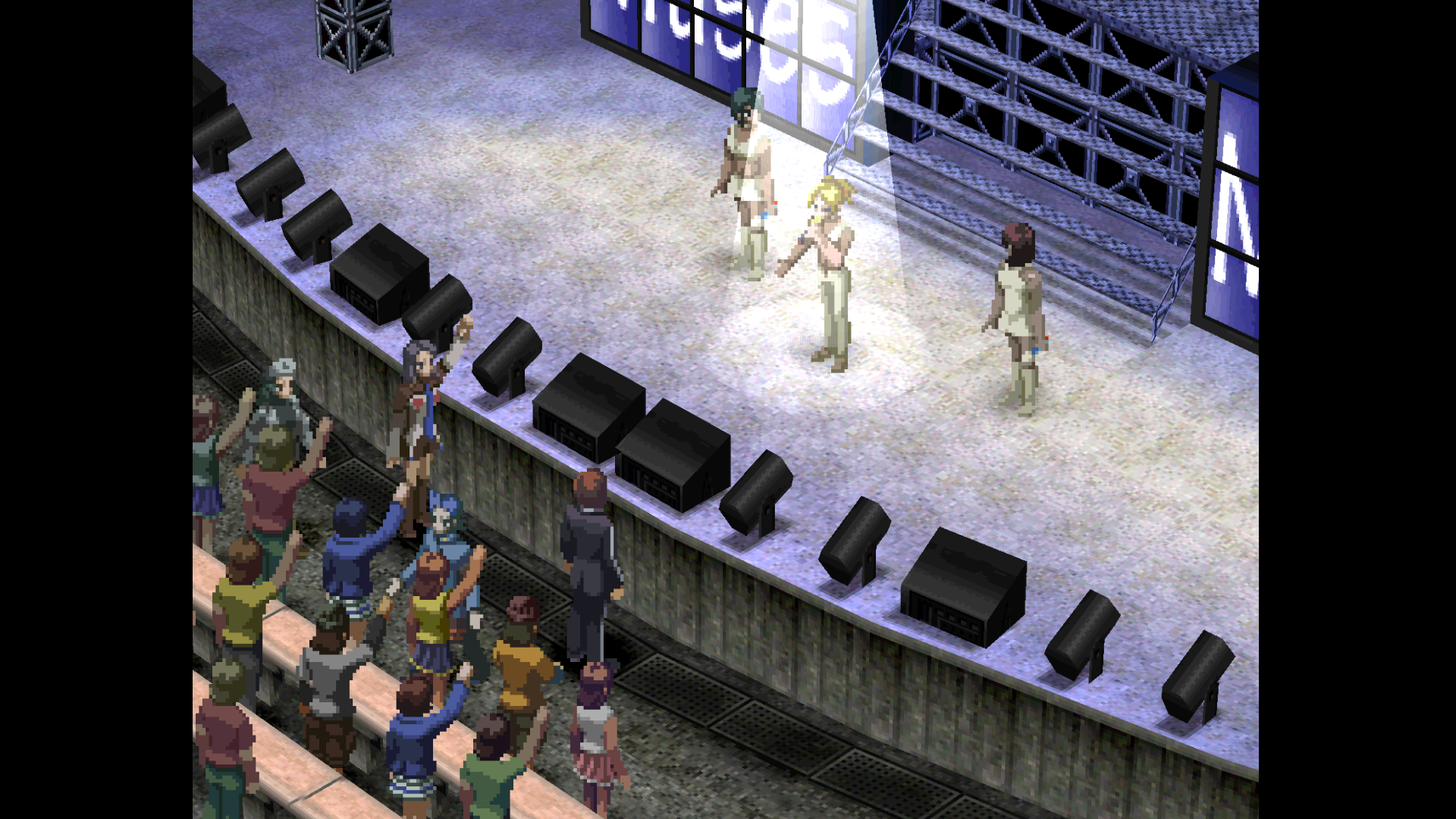
Due to rumors coming true, Lisa performs as the new leader of a pop group.
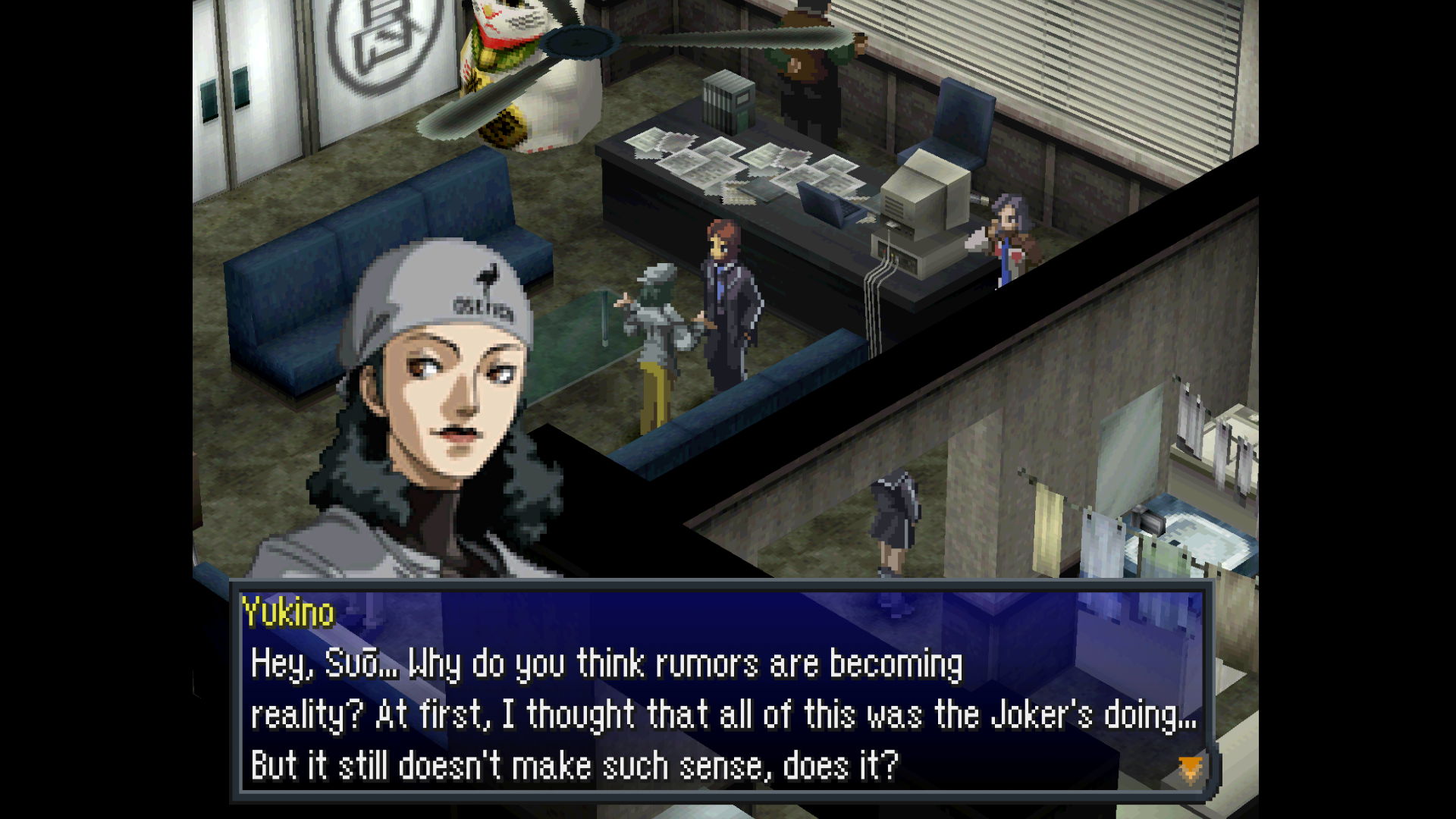
Some people get super involved in trying to figure out, decipher, or otherwise try to understand every aspect of a game, movie, or book. I recently saw a scathing critique of Shin Megami Tensei V where the author was severely offended about the fate of characters they viewed as “abandoned”. I’m much more laid back about that sort of thing: my main focus with consuming media is how it makes me feel, and that’s largely related to the flow of the gameplay. I also care a lot about the style of the graphics and music. But story? I don’t particularly care if it doesn’t make sense or I can’t figure it out, as long as it’s entertaining to me.
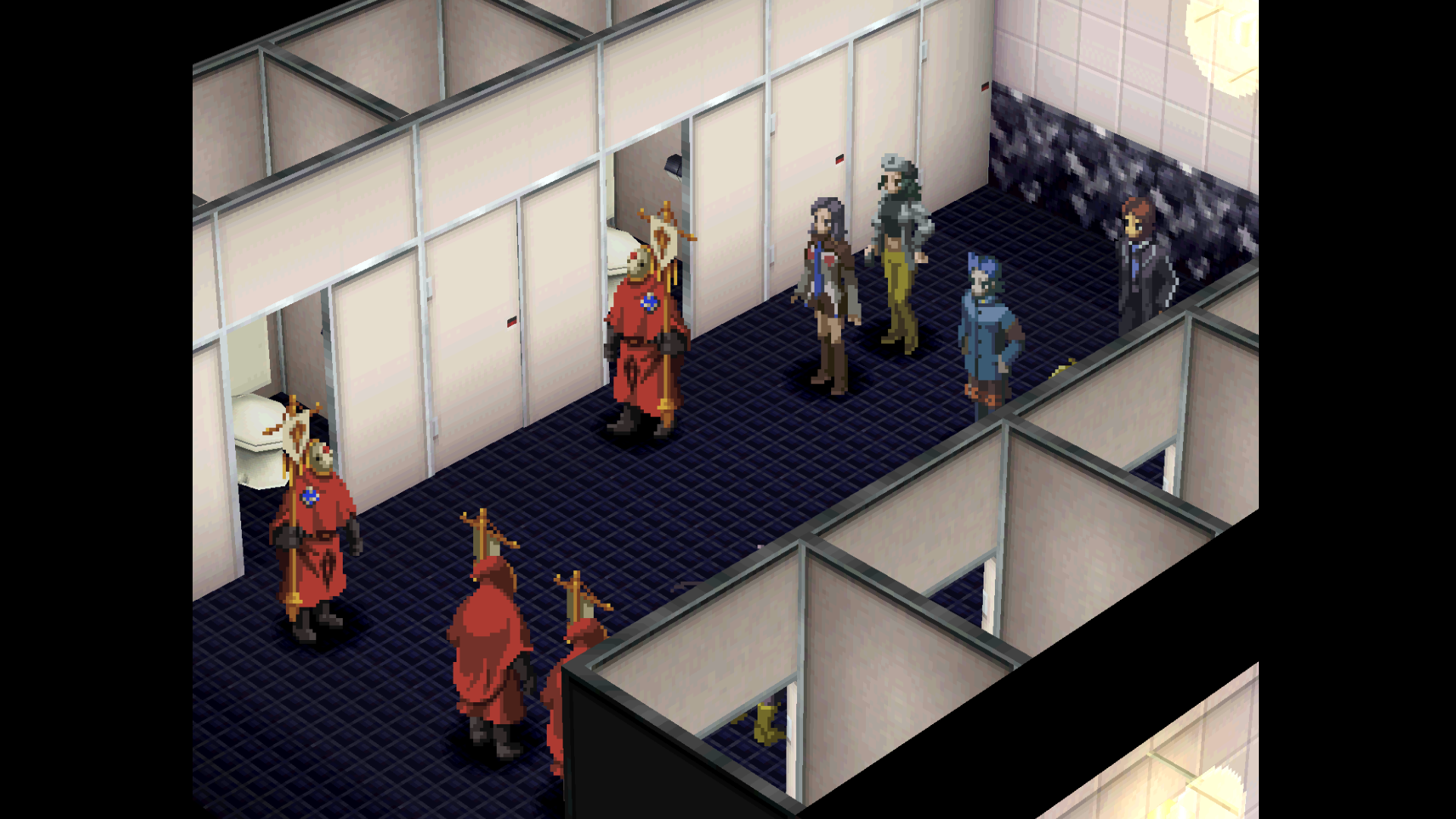

One huge aspect that is enabled by a full 3D environment is the ability to rotate the camera. Unusual for an RPG of this era, Persona 2 has camera controls.
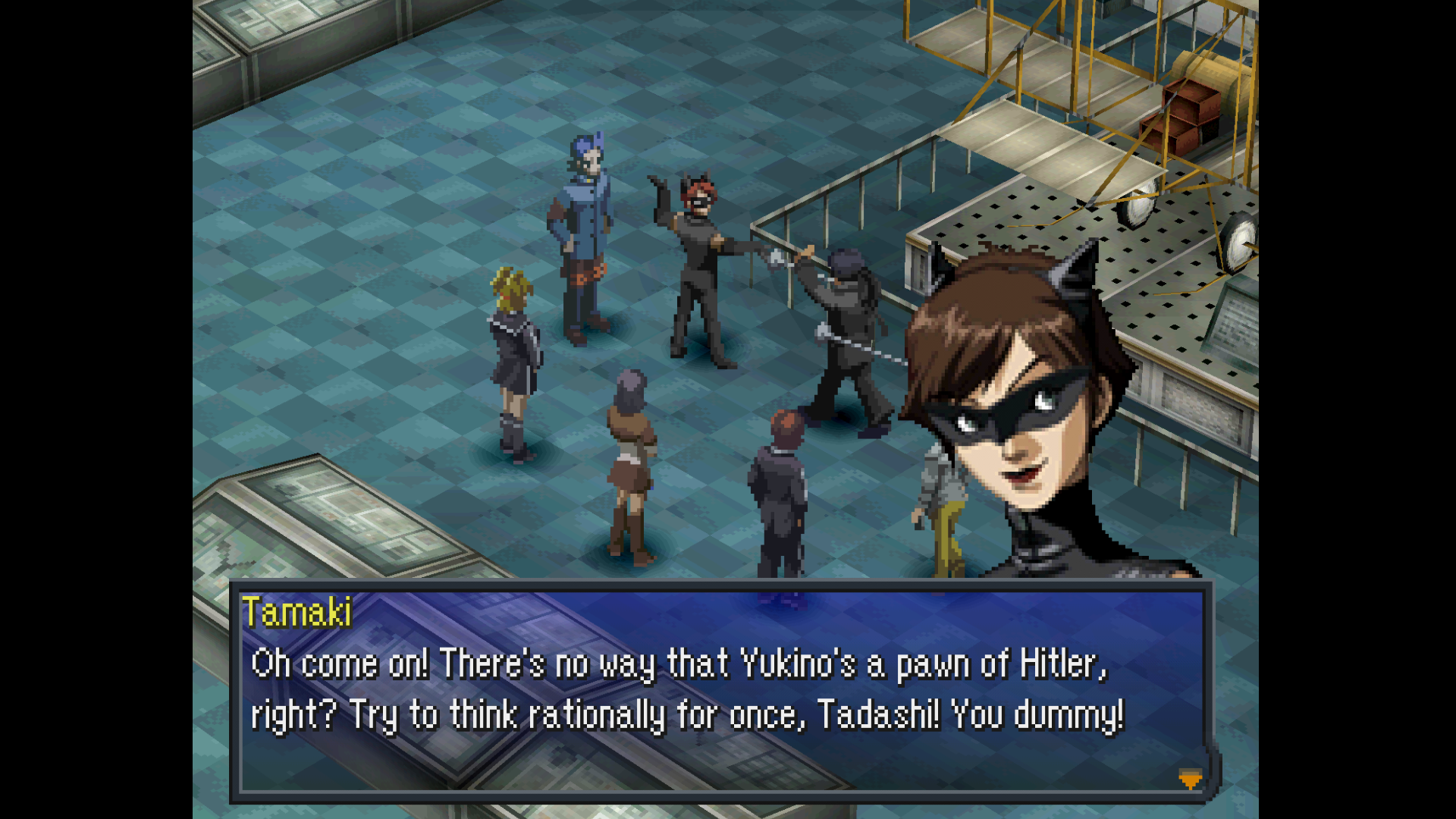
Among the reasons why this game was not originally localized outside of Japan, the existence of the actual Adolf Hitler as a character is likely one of the bigger ones. This is another example of something that seems so unfathomably offensive to Western society that it can be hard to understand, but consider the history lesson: World War II was fought between the Axis and Allied powers, and the Axis side consisted of Japan, Italy, and Germany.
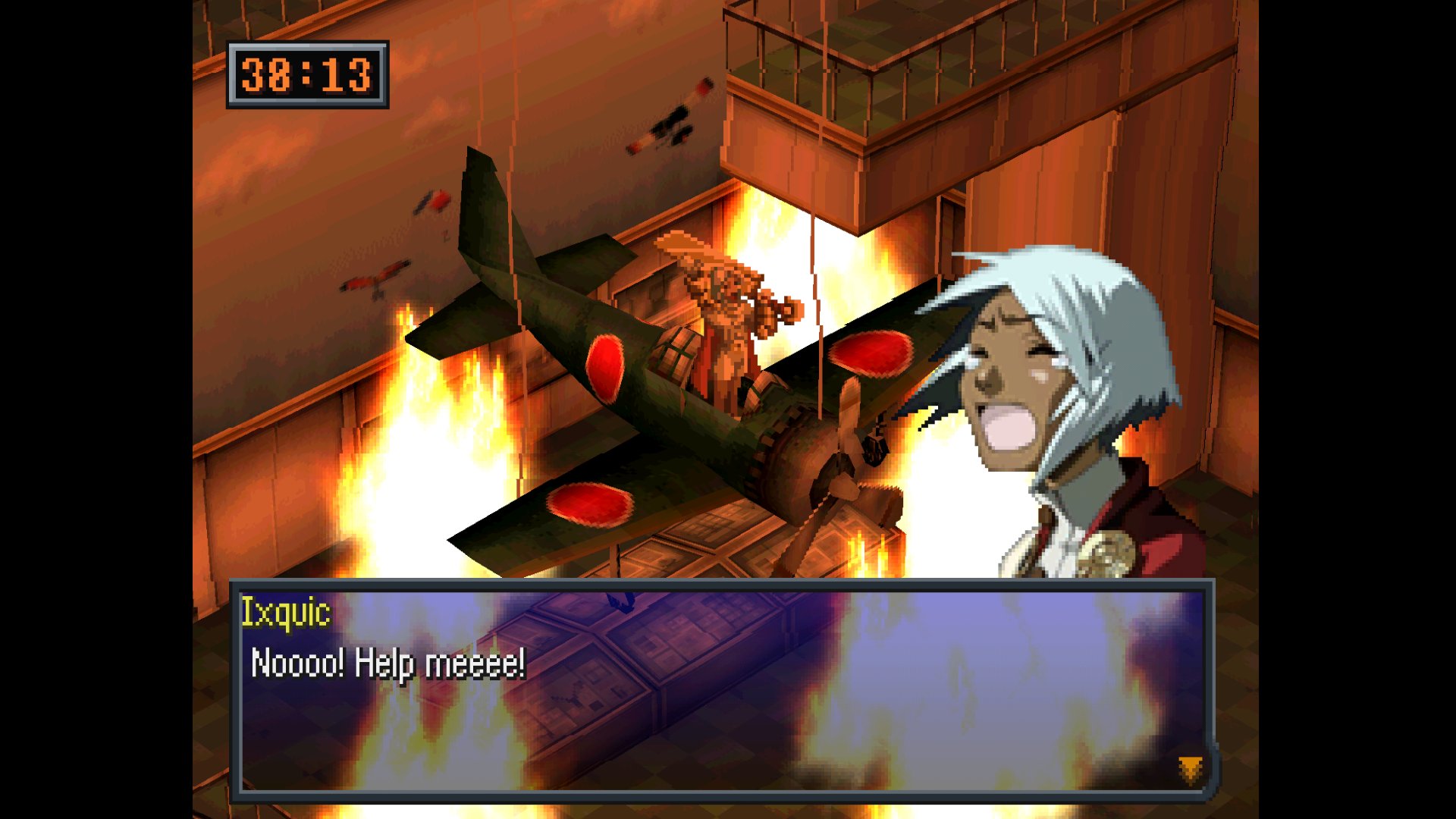
This is a Zero, which was the world’s dominant fighter plane at the beginning of WWII. This era of Imperial Japan and its symbols are considered offensive by some countries–especially Korea and China–but again, it’s not really a big deal in Japan. It’s like how in America we don’t mind venerating the Boeing B-29 Superfortress and the pilots who flew them, while in Japan they are not really big fans of the plane that dropped two nuclear bombs on them.

This is where the game starts getting really crazy with the rumor effect.

Another cultural reminder: Japan is not a Christian country. So this is like an American talking about some kind of Shinto or Buddhist legend, or perhaps like Lara Croft talking about ancient Mayan myths. While many people in Christian countries see the Christian Bible as a source of absolute truth, the rest of the world sees it as yet another collection of mystical fairy tales.
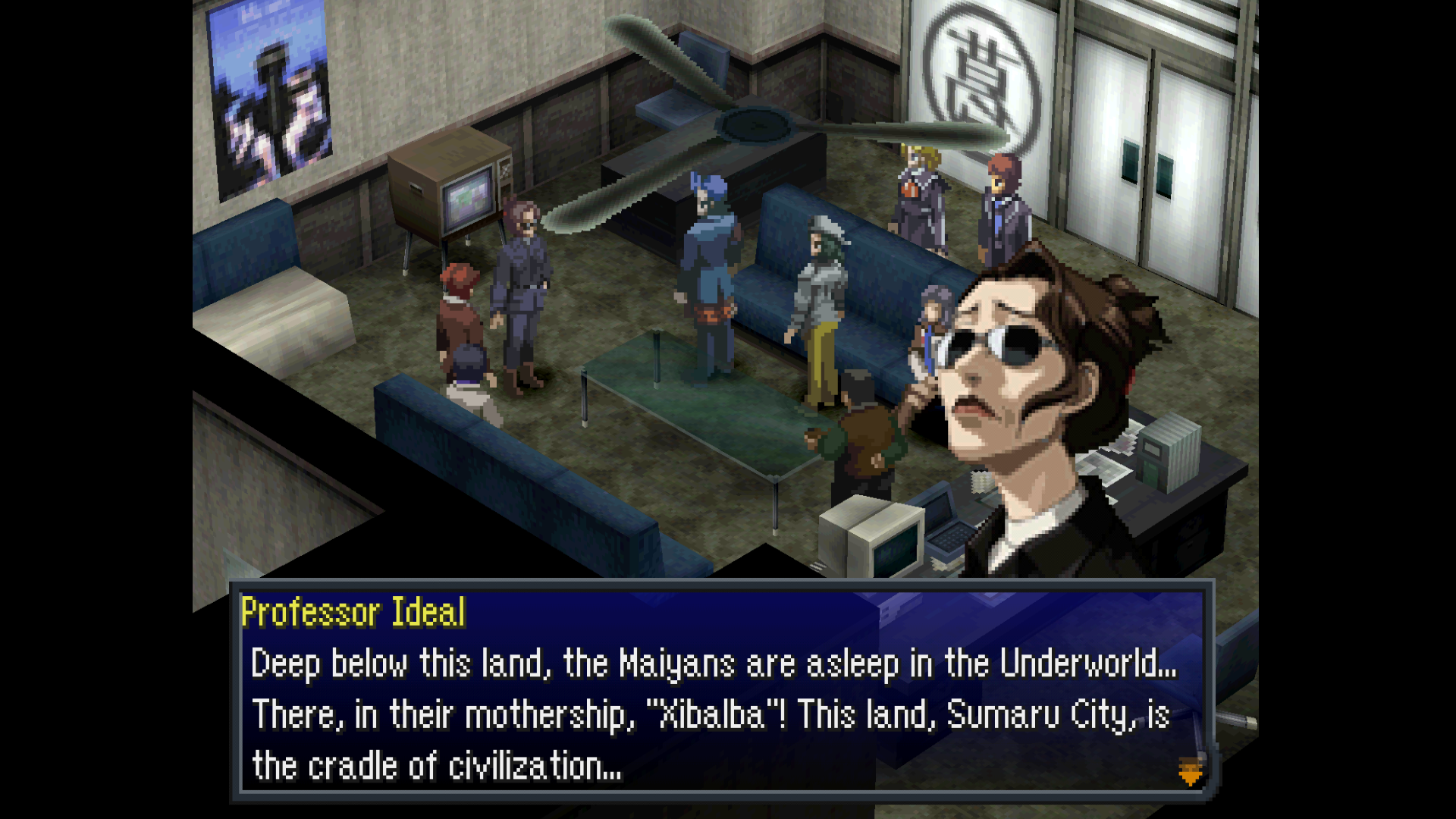
Speaking of Mayans (why did the translators write “Maiyan”?), it goes from Hitler to Christianity to…aliens?!
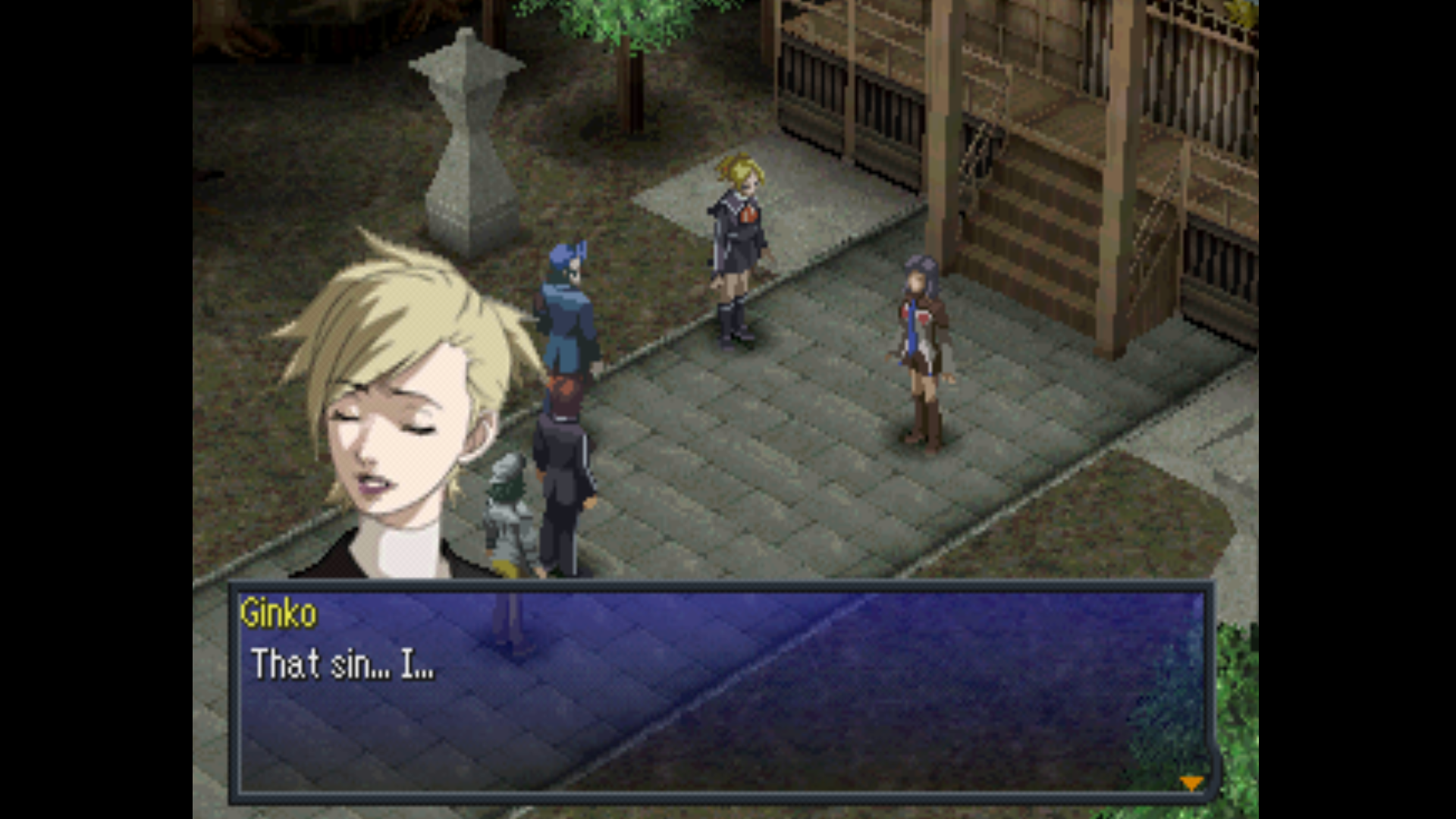

OMG! The name of the game!
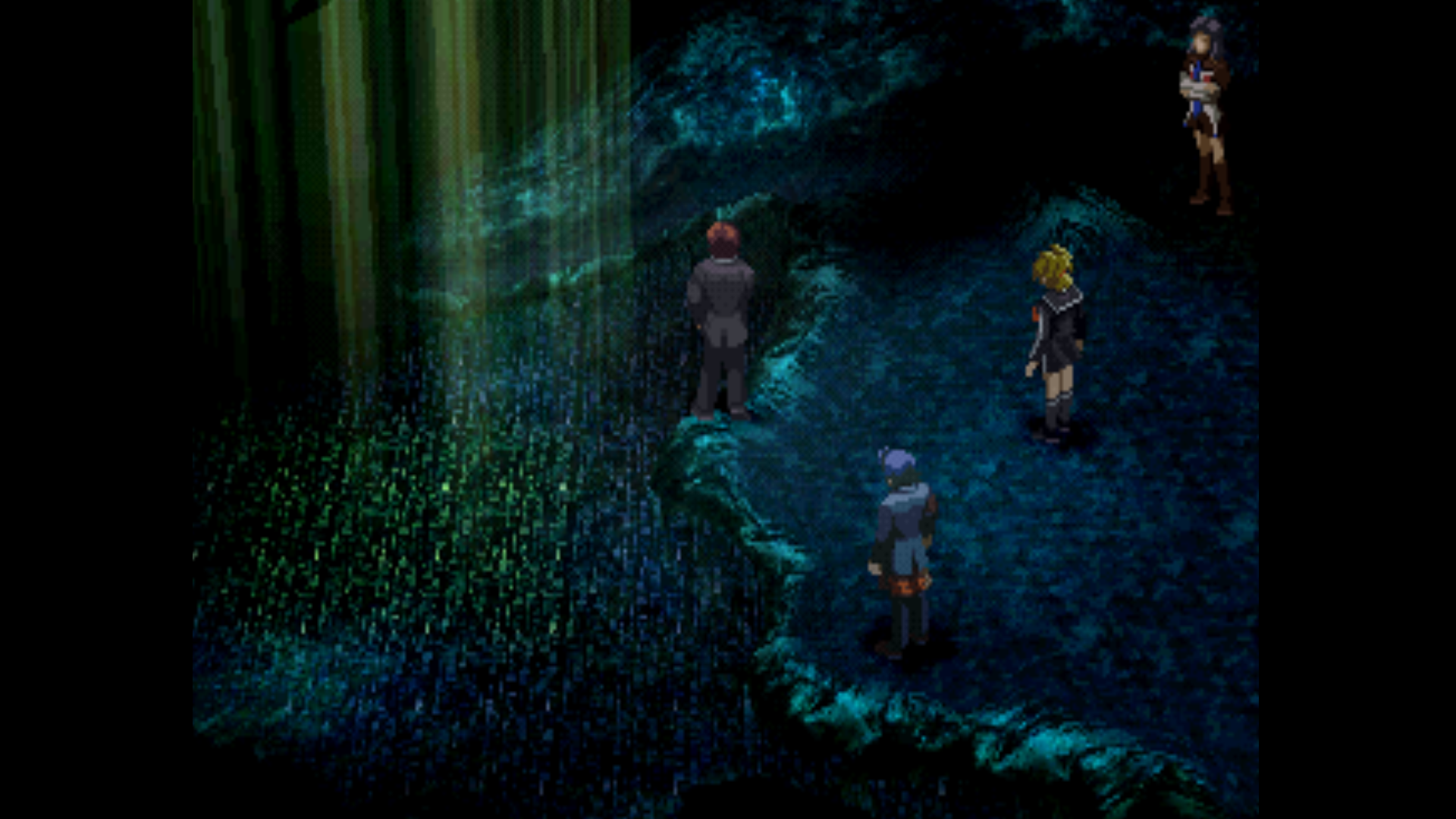
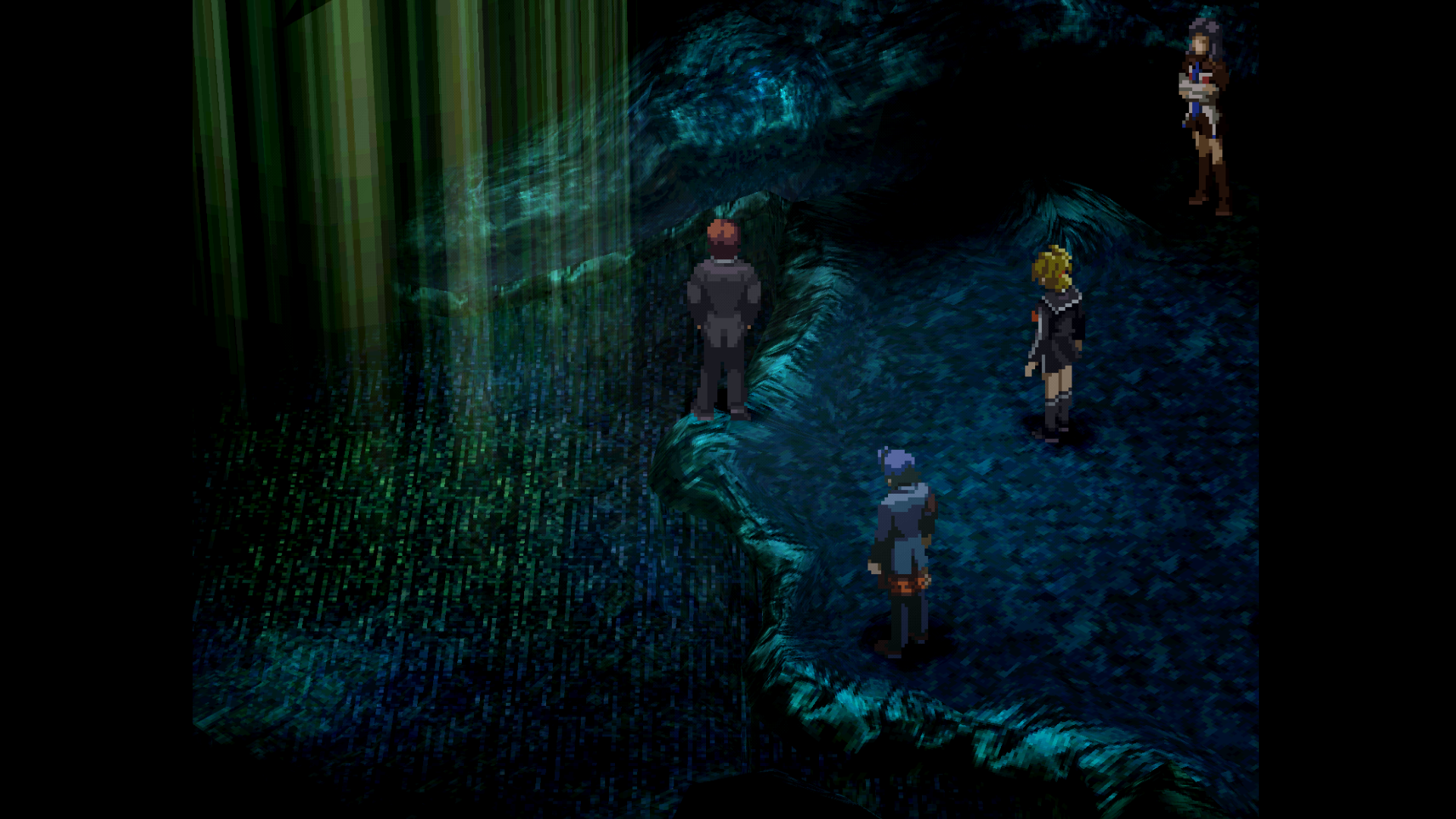
Here’s a comparison between 1x resolution with smooth bilinear filtering, and 5x resolution.

Some crazy shit starts happening at this point, and this screen sums it up. Even in a 25+ year game I am still reluctant to post large spoilers or twists–I always hope that someone will read this and decide to play the game themselves.

Oh hell yeah. I’ve never actually used a Leica, but the name itself carries a certain weight in photography circles.

Wow, I love emulation. There was no way anyone was seeing this kind of detail back in 1999. There is a certain sense of occasion playing on original hardware, but the enhancements keep me coming back to emulation.

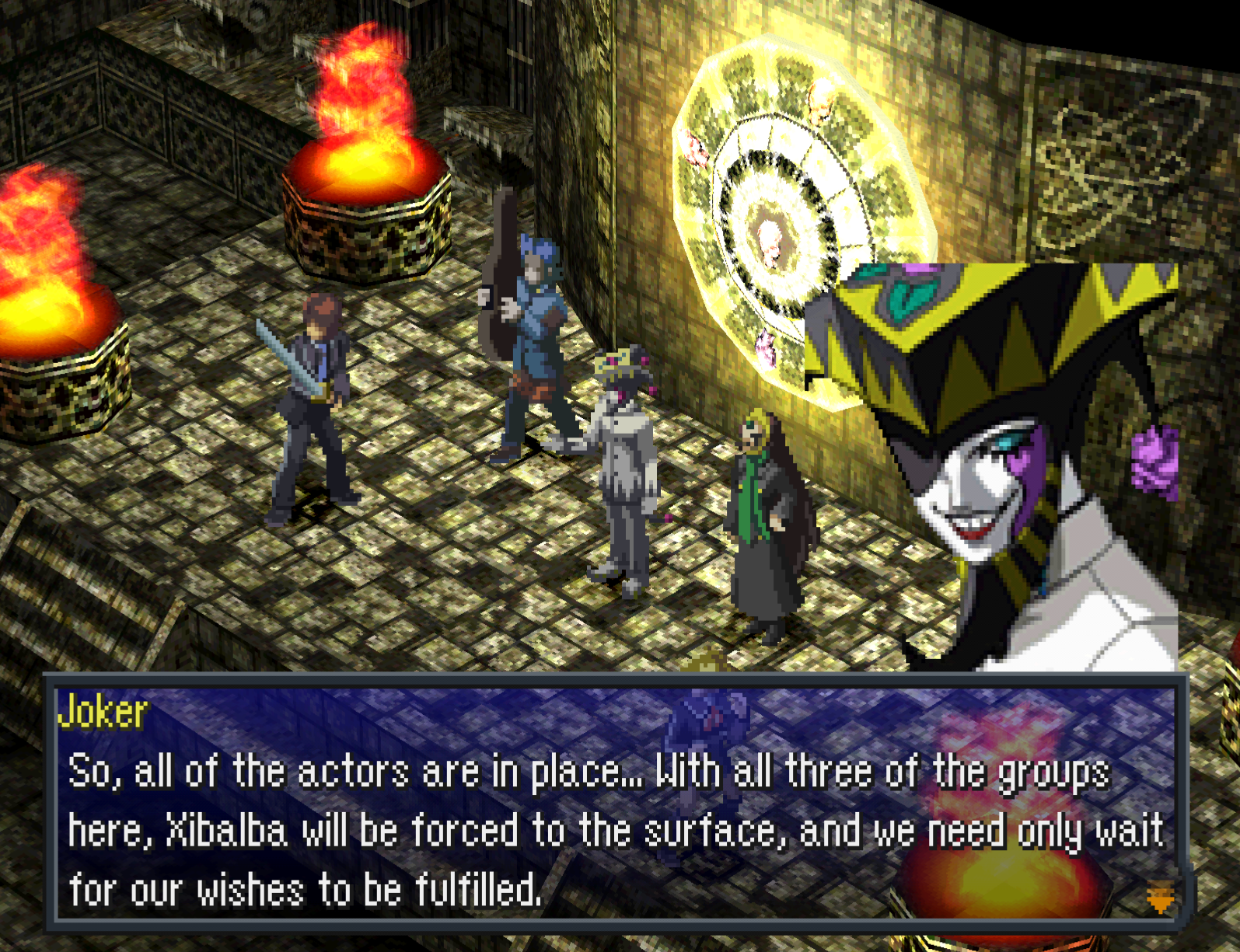
This is where the limitations of my “dig into old photos and write posts” method start to show some holes. Not only was I getting confused by the plot by this point, it’s now been a year and a half since I played this, so I can’t remember what was going on. Well, like a complicated movie, the Persona games do lend themselves to multiple playthroughs to understand what happens.

Another trippy solarization effect.
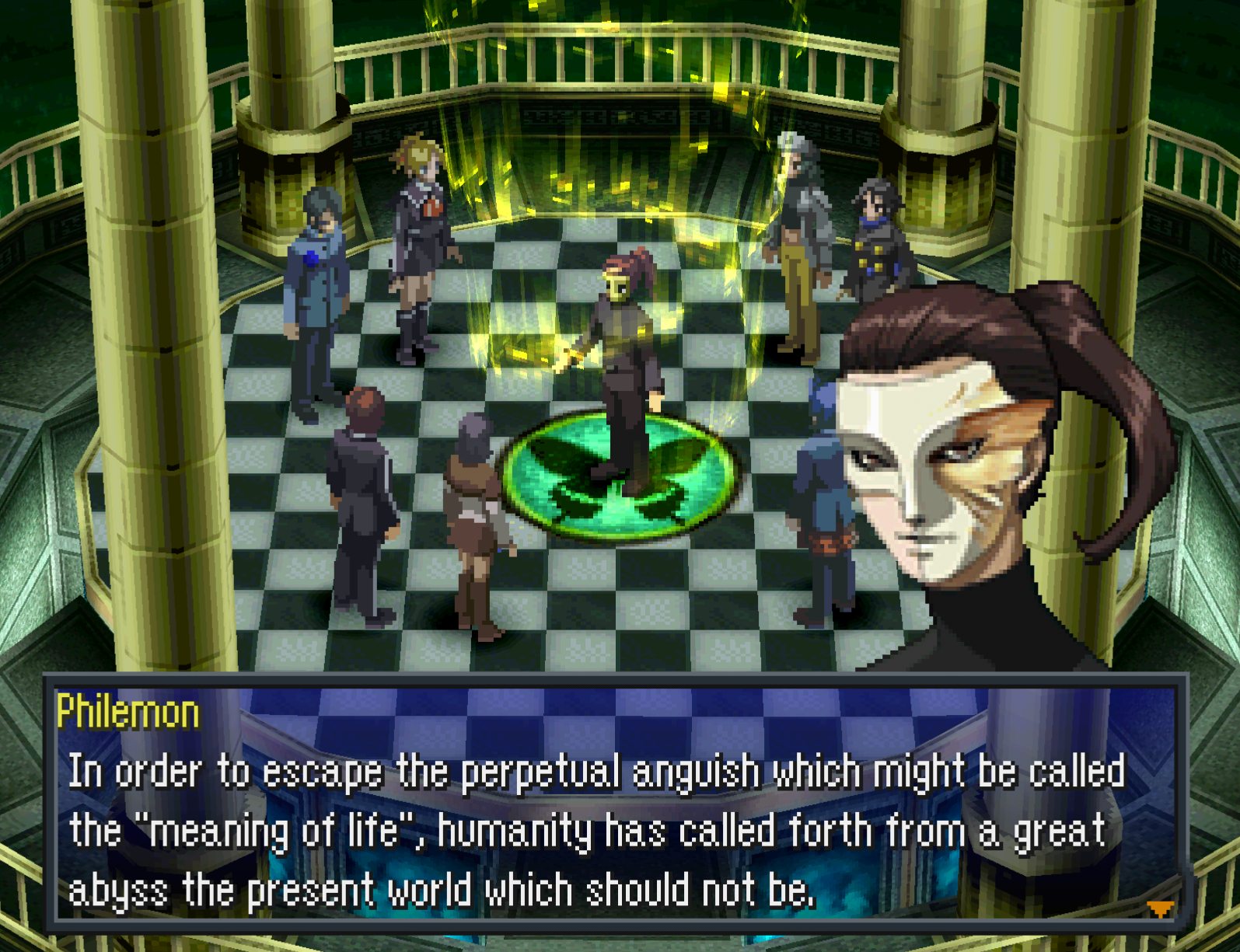
Ah yes, the misery of being a human: the classic reason for society’s struggles since time immemorial.
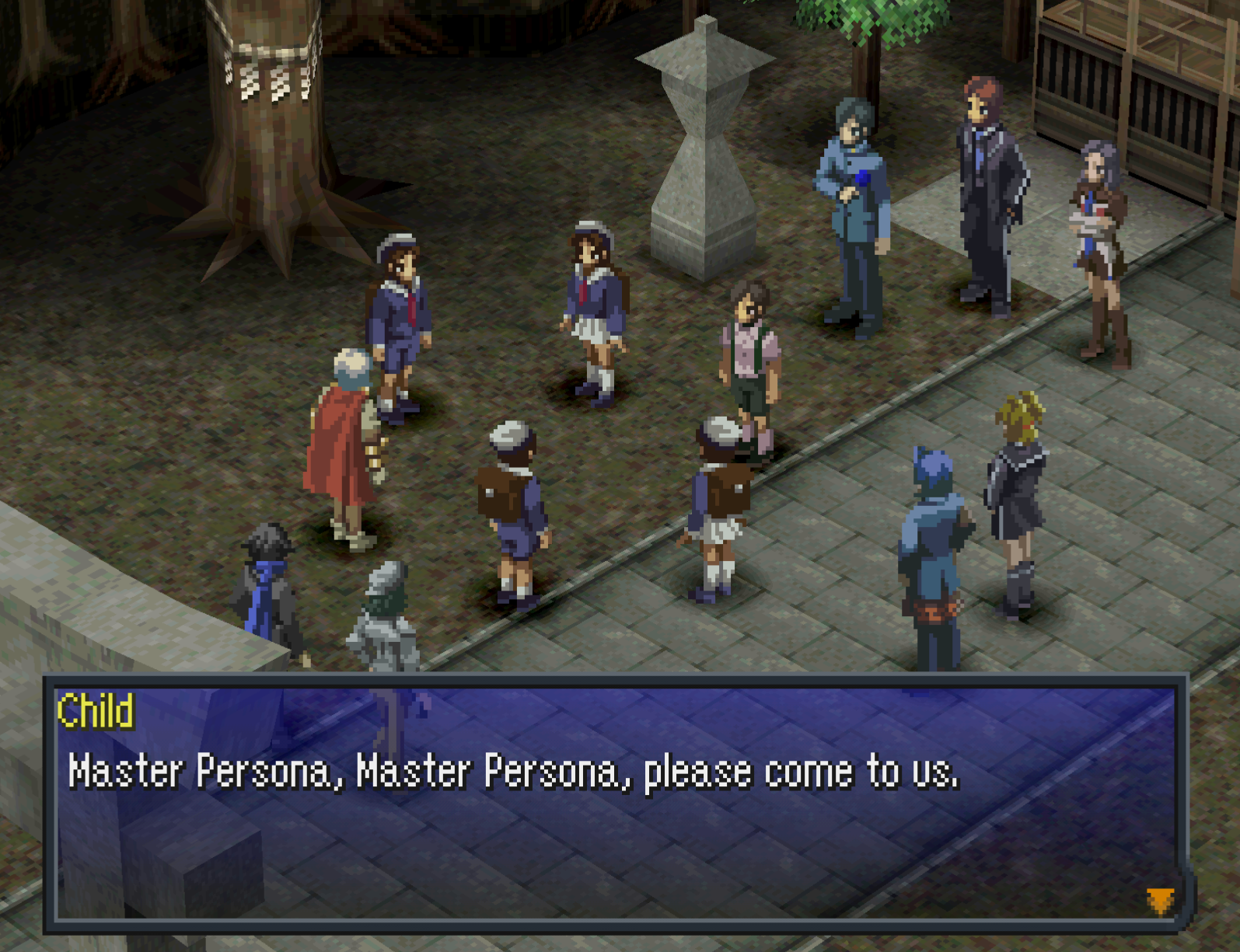
Ooh, playing the Persona game in the style of Persona 1.
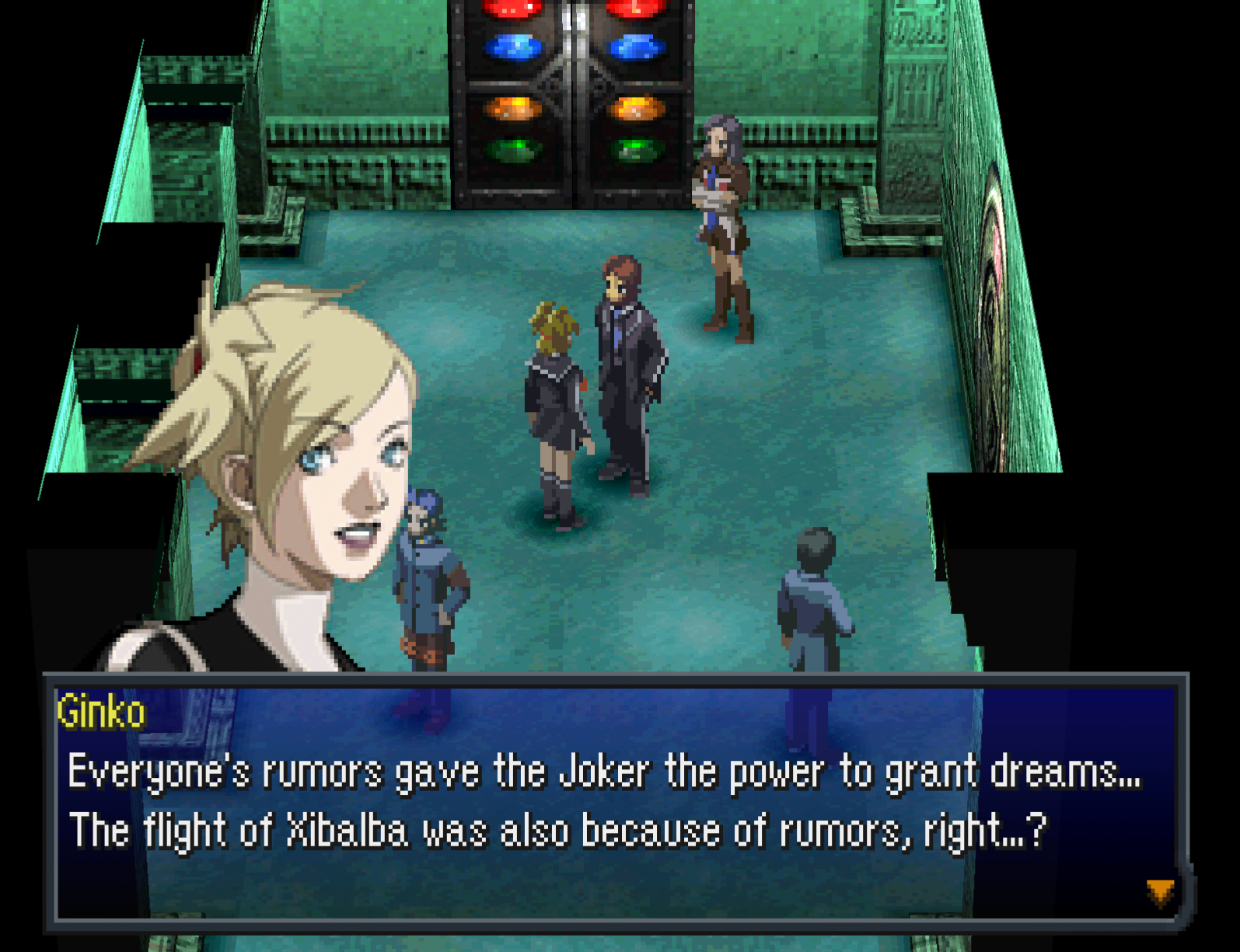
Rumors: the source of all madness in this game.
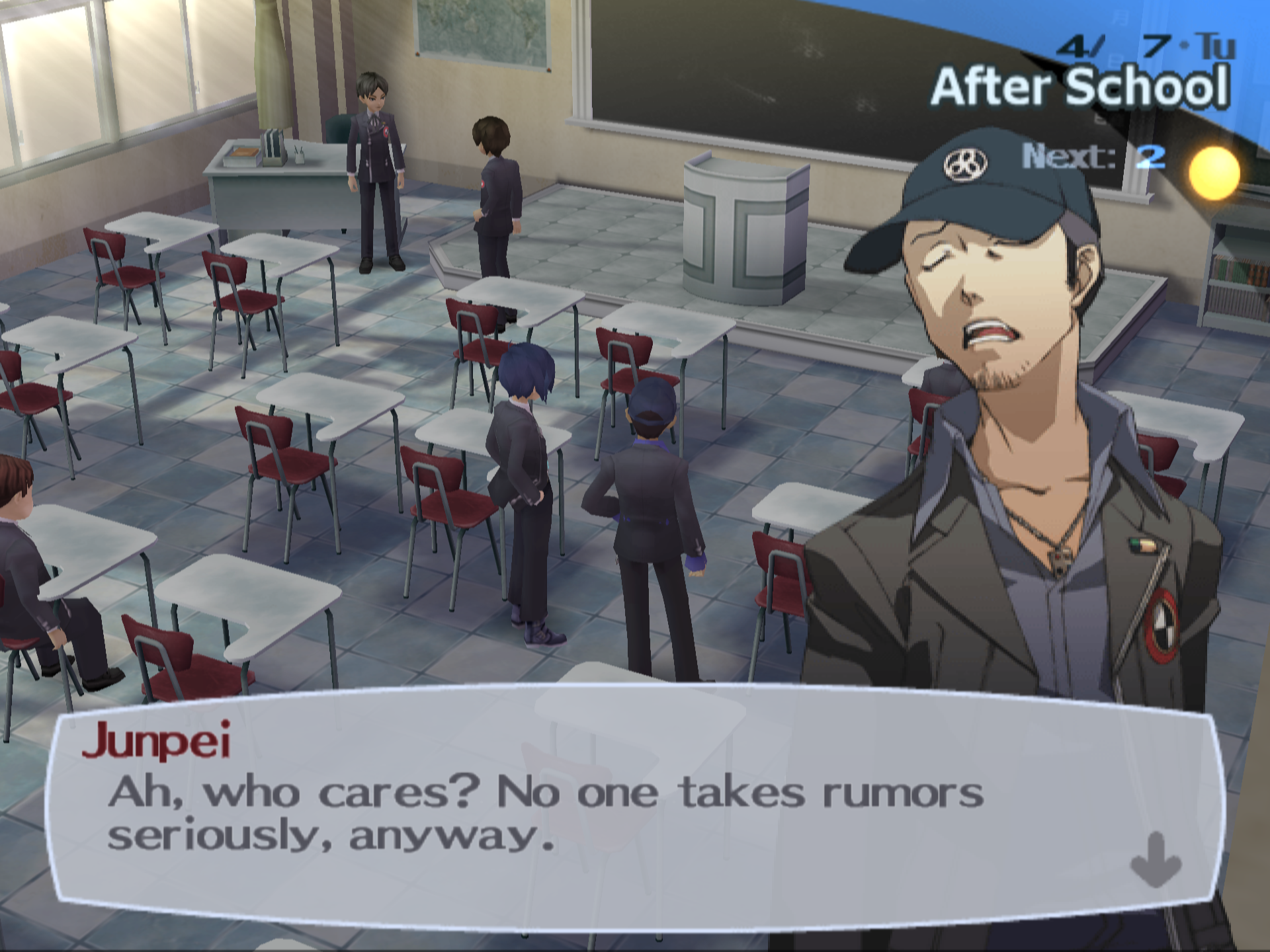
Quick diversion: I don’t plan to make a post about Persona 3 (because it’s a PS2 game), but this is a screenshot from the beginning of that game. What might seem like a flippant comment if P3 is your first Persona becomes a shocking statement after the rumor madness of Persona 2.
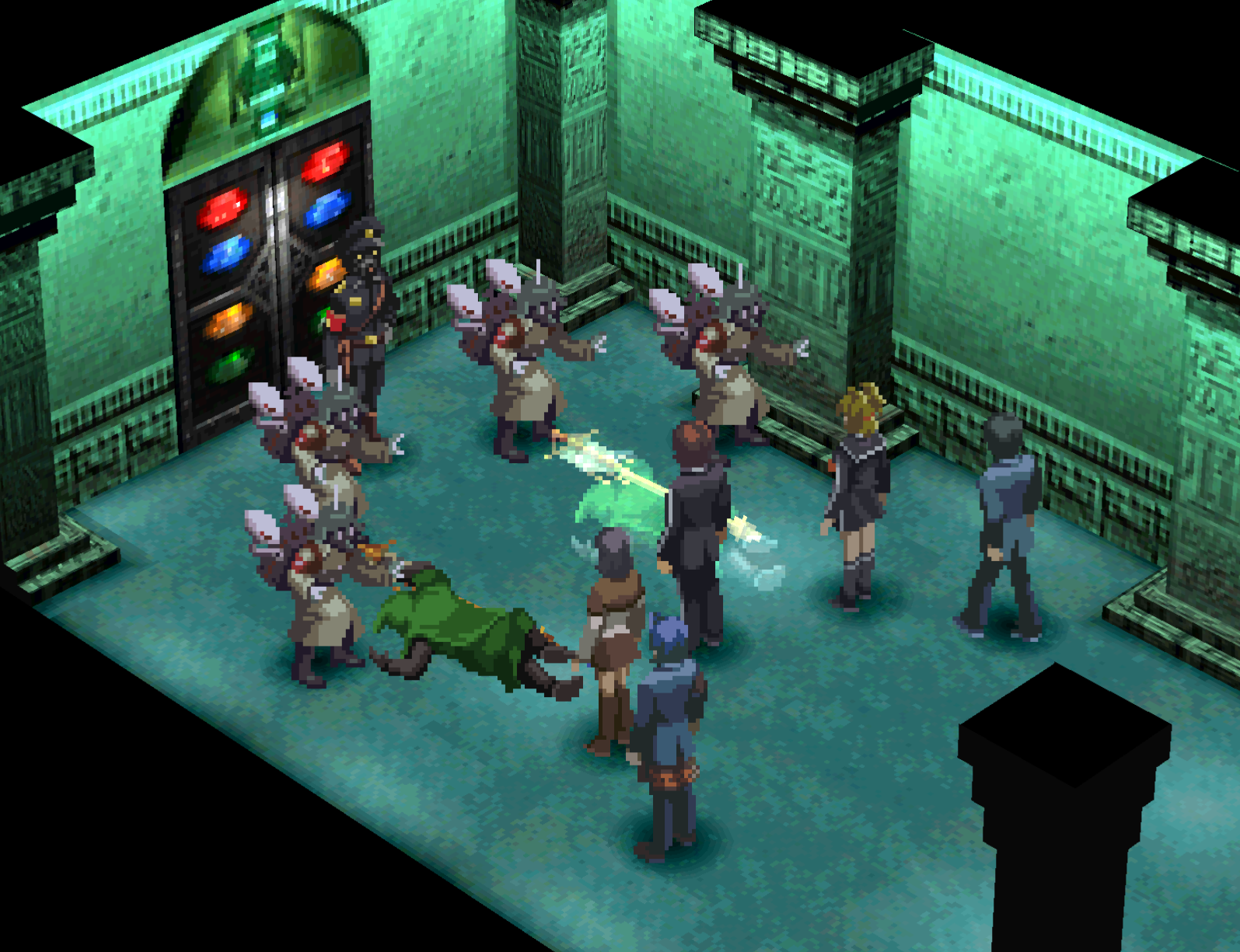
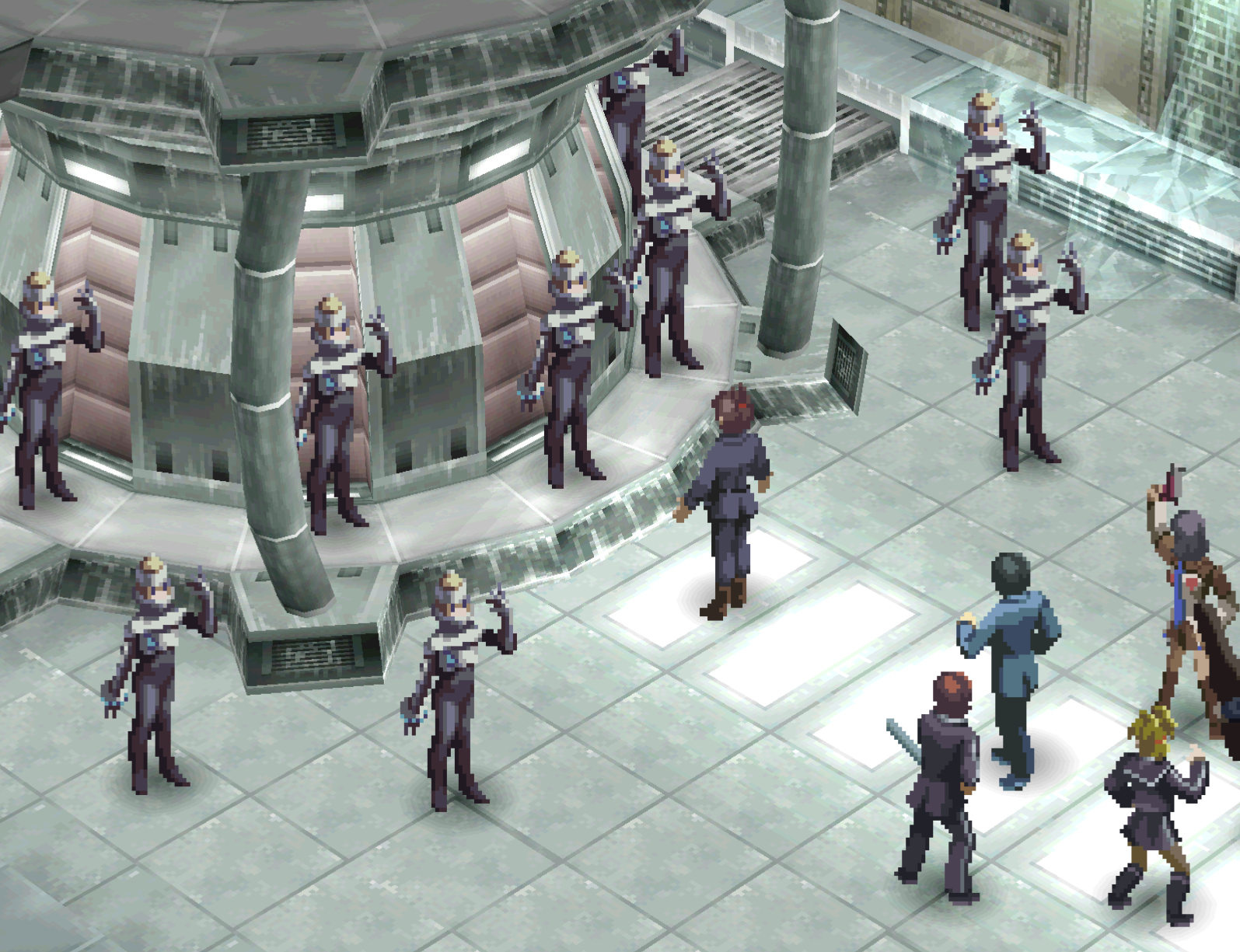
Not sure what was going on here, but these “storm trooper” looking characters are pretty interesting.
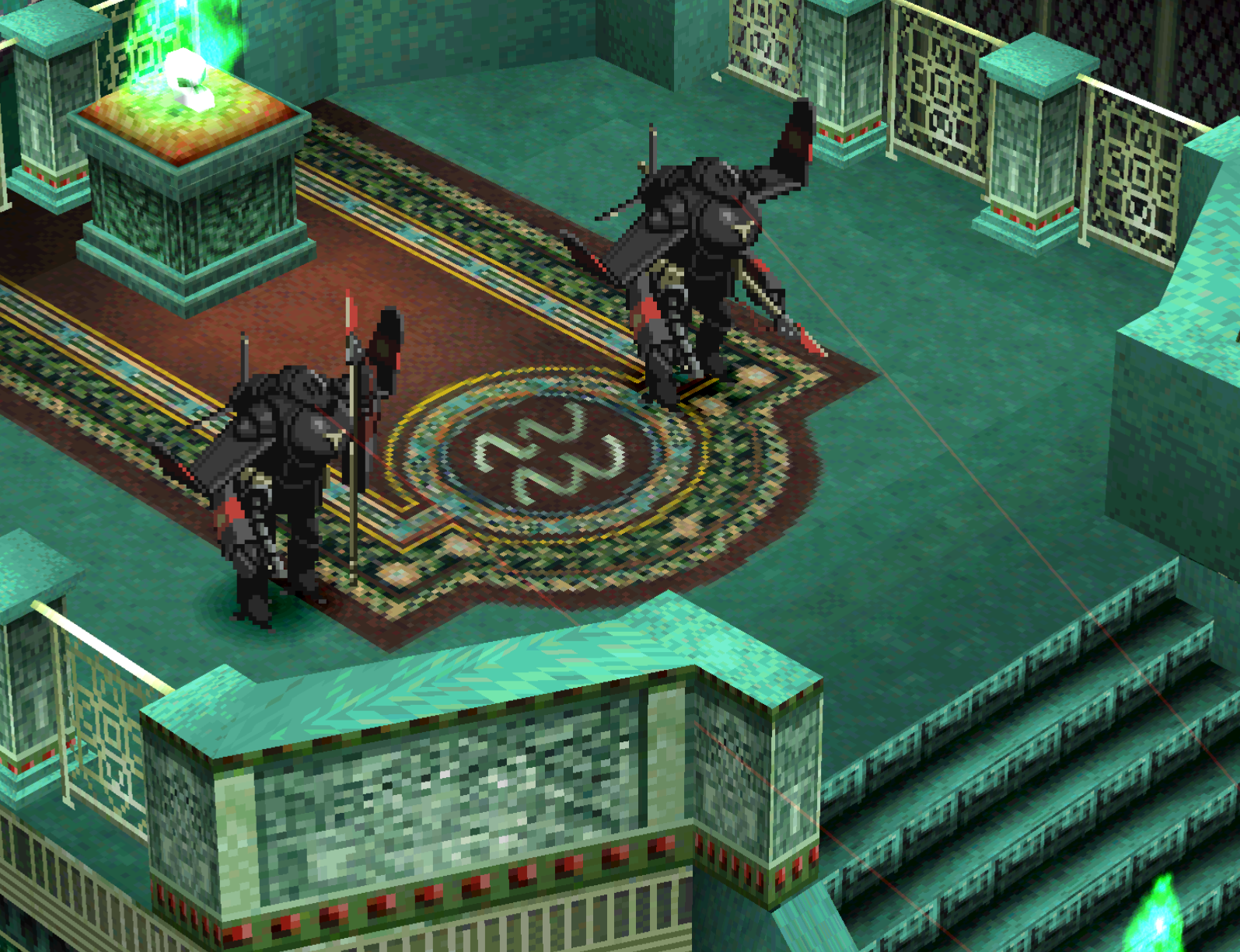
In a way this game looks dated, which is just a way to say “old and out of fashion”. Old as it may be, I think pixel art is having a resurgence, so this game actually looks pretty fresh to me.
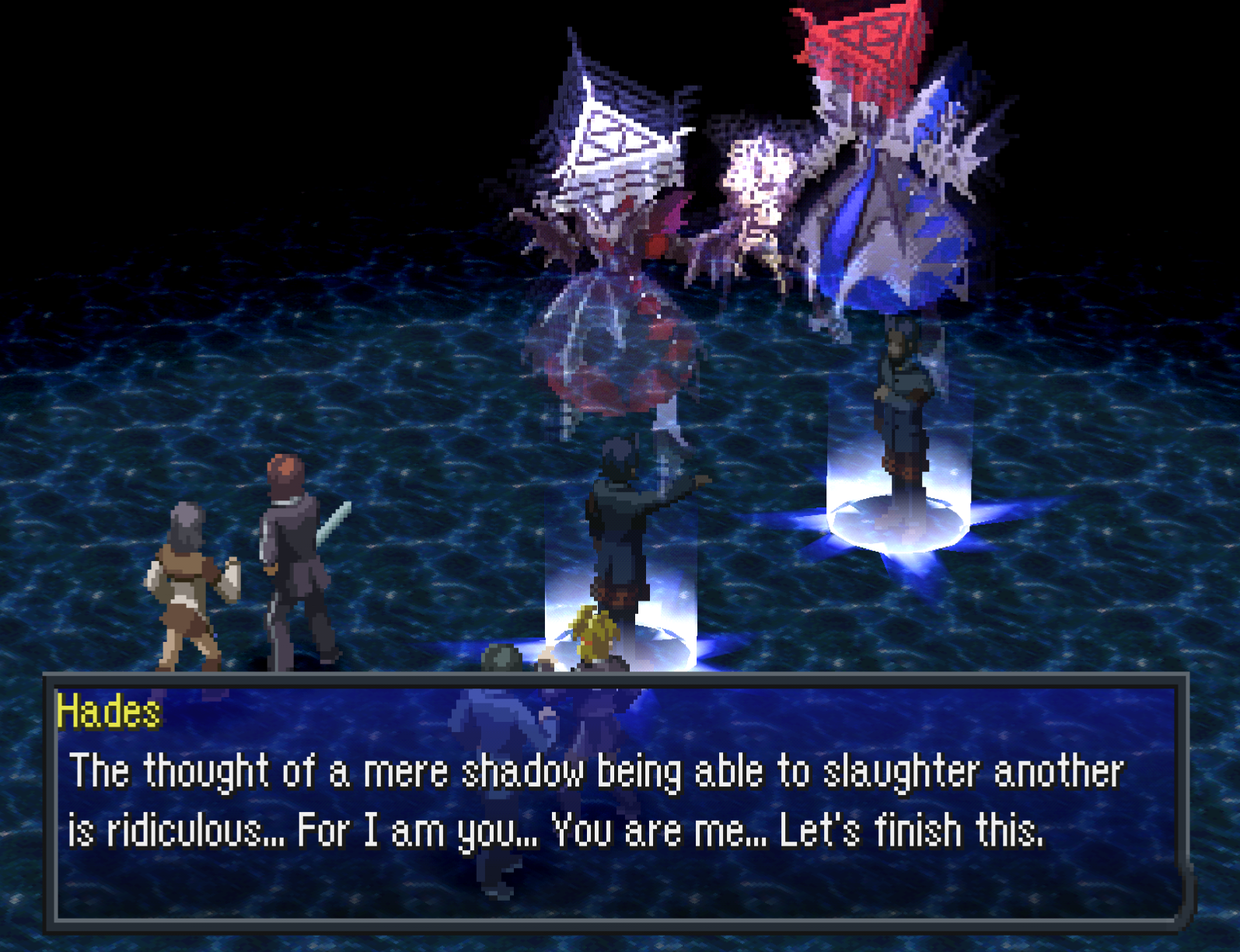
Oh look at their cute triforce hats!
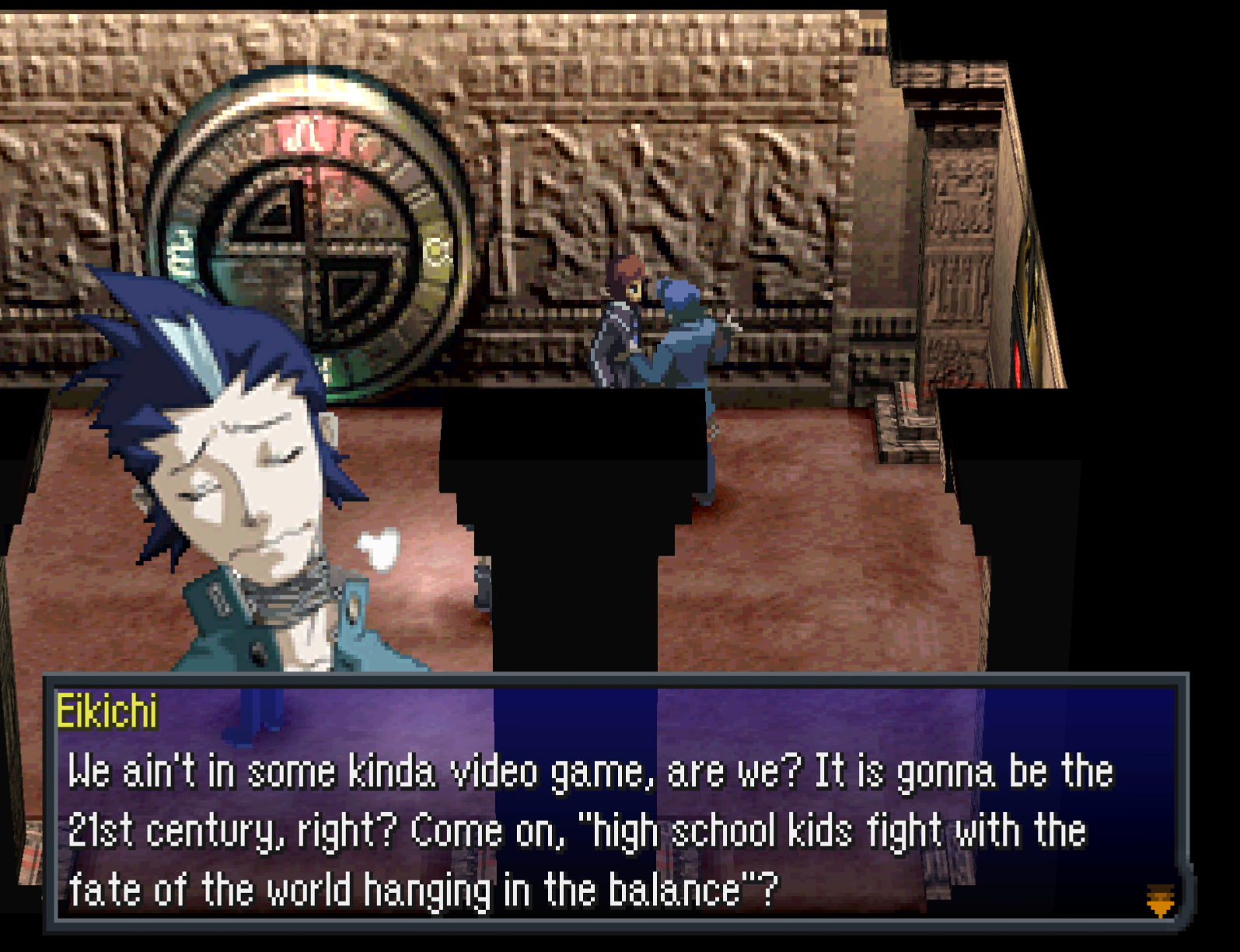
Ooh yeah, the self-aware game character quote. Although, he does have a funny point about the entire Persona franchise: these epic stories are mainly experienced by high school students.
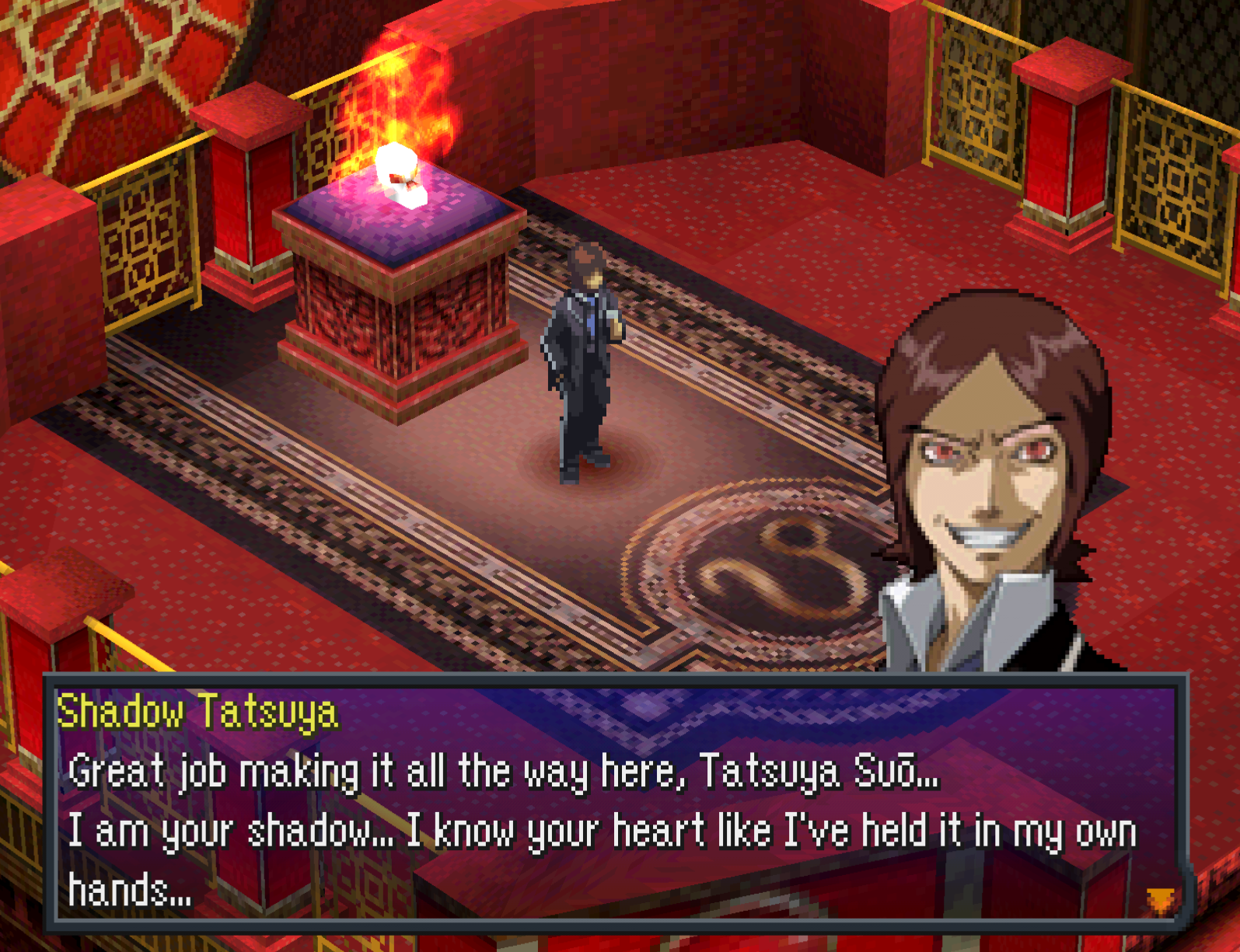
As you might expect from a series called Persona that dives into Jungian psychology, this game also involves the “shadow” as well.

The character sprites are the same size virtually everywhere in the game, so this was a unique scene.

Yeah, those pesky rumors.
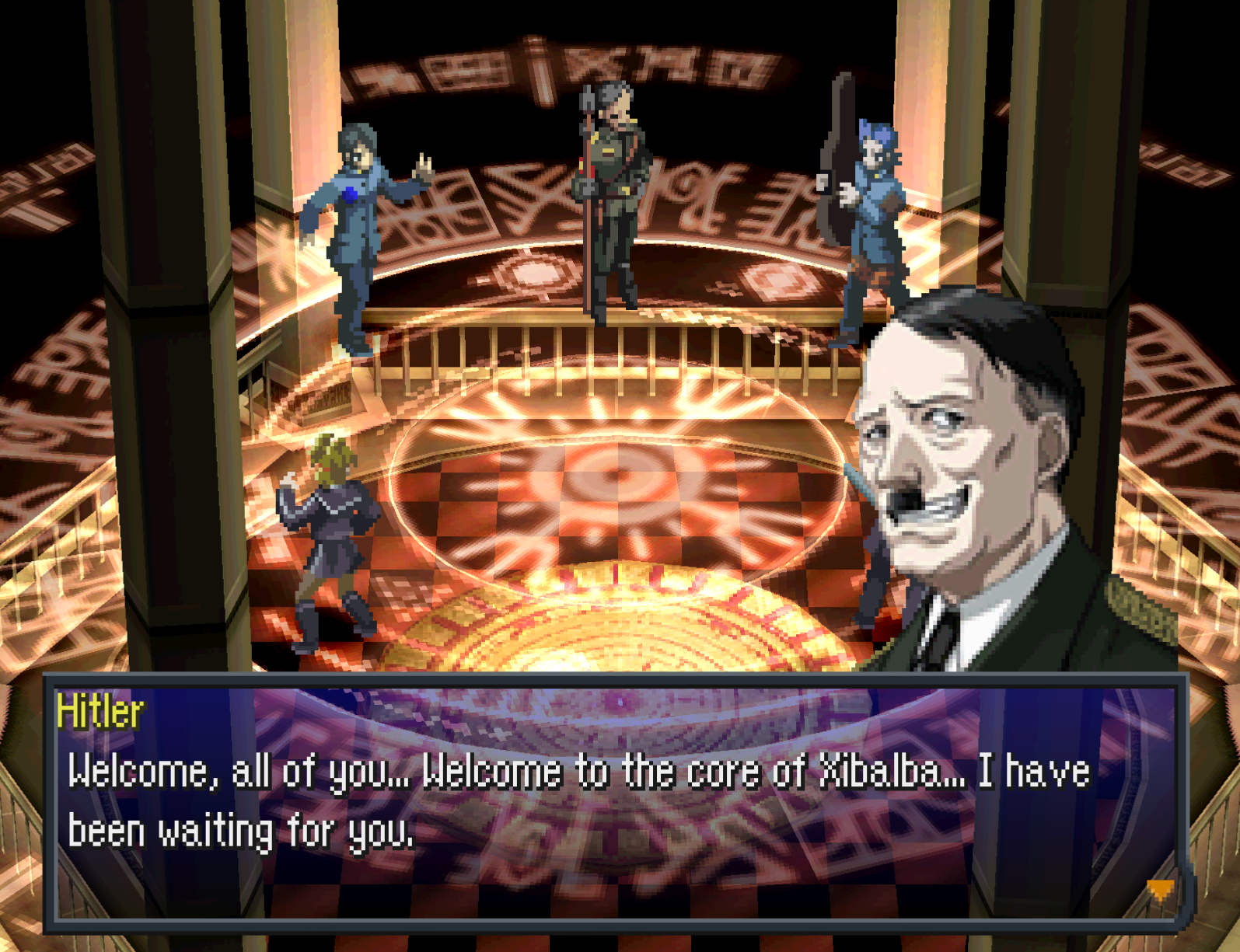
There can’t be too many video games out there that feature the actual Hitler as a game character, and surely the number that aren’t WWII games drops the total into single digits. When they localized this game for Western audiences on the PSP, they gave this character dark sunglasses and changed his name to “Fuhrer”.

Another Jung reference with the collective unconscious.

Ah yes, one of the classic moments of the Persona franchise.
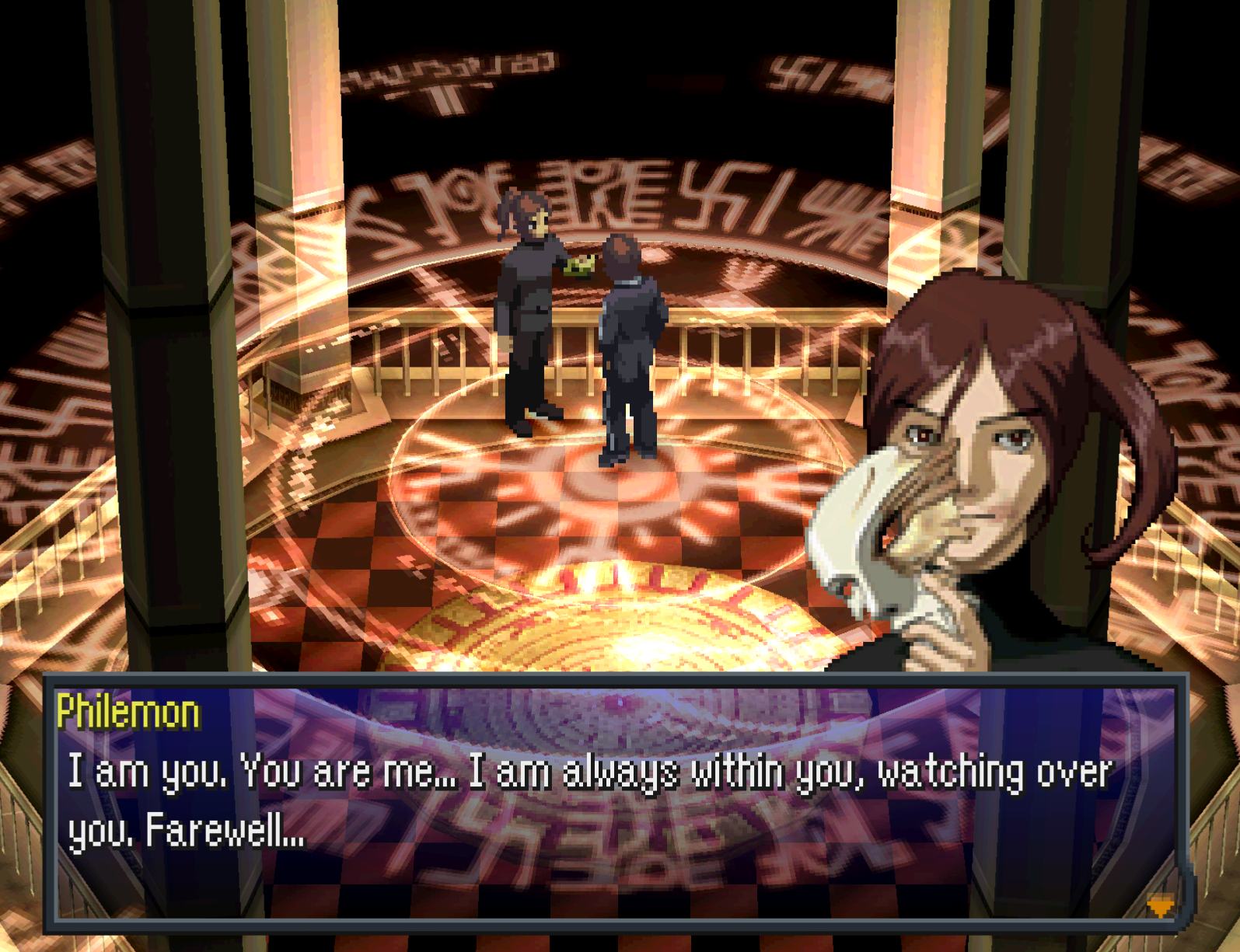
Dang, wild conclusion. Even for someone like me who barely understood what was happening.

In a nutshell, the main characters give up their memories in exchange for saving the world. In the small epilogue before the ending, the main characters all find themselves on the same street together. Tatsuya (the main character of this game) and Maya (who will be the main character of the sequel, Persona 2: Eternal Punishment) bump into each other on the street.
And of course, they don’t remember each other. But there is a hint of familiarity…

And there you have it: that’s part one of the Persona 2 duology. The next game, Eternal Punishment, picks up right where Innocent Sin left off: Maya is a journalist investigating the Joker Curse that causes rumors to become true.
At this point I was halfway through the Persona 2 duology and ready for part 2. After seeing the huge jump from P1 to P2, I was really excited for P3–but I knew it would be tough to go back to P2:EP if I skipped it. Plus, I had already committed to it, and that commitment is what drove me to finish Persona 1 and taught me a lesson about my personal gaming style: if I just casually play a game, there is very little chance I’ll get hooked, because I am so easily distracted by all of the other entertainment out there (including but not limited to other video games). I need to intentionally focus my energy, which might seem a bit uncomfortable (like I’m forcing it to happen), but in reality it’s a manifestation of the idea of If you think you can do it, you can. And that process always ends with a great deal of satisfaction, so I’d say it’s working.


 Star Road